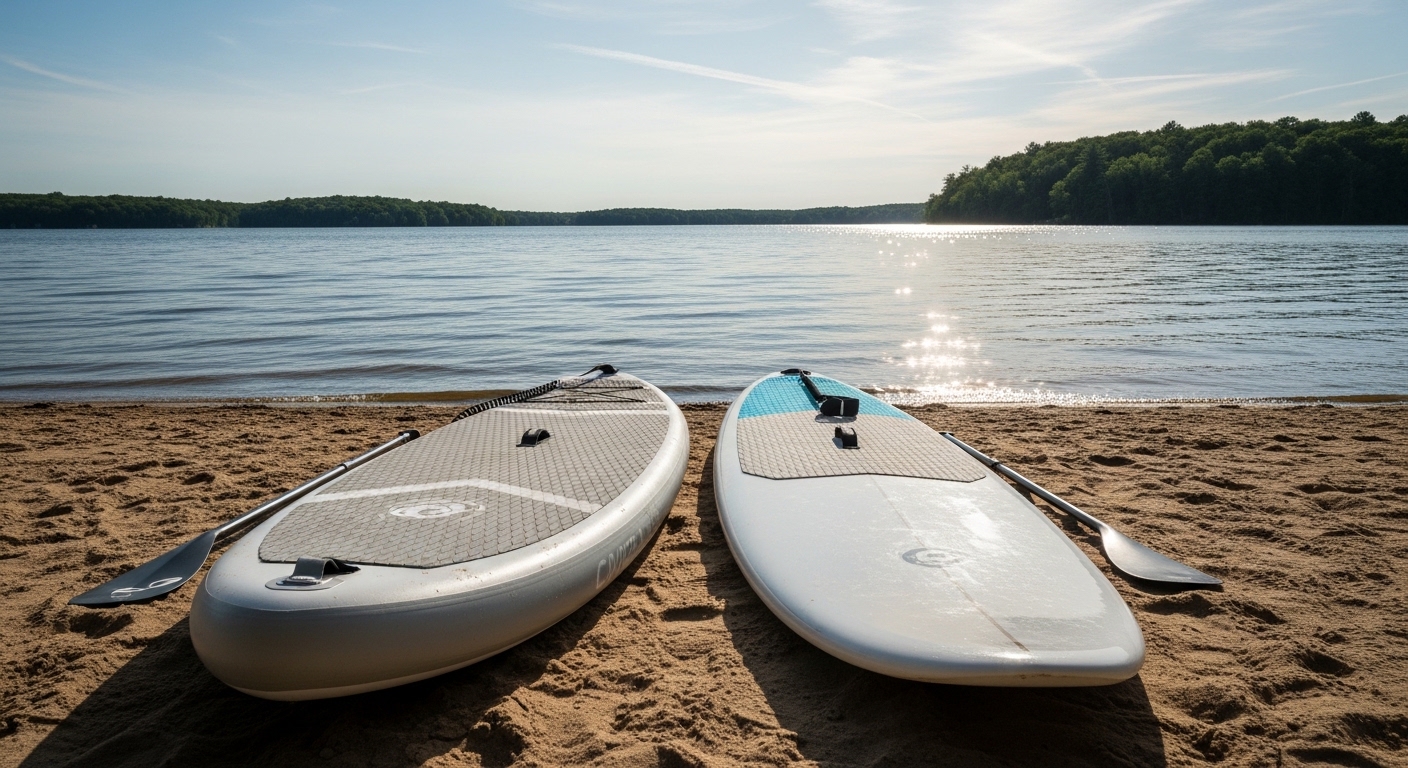
Examining Inflatable Versus Hard Paddleboards: A Comparison
Inflatable vs Hard Paddle Board
Walk into any paddle shop and you’ll hear two camps arguing past each other. One side swears rigid boards are the only real option. The other hauls an inflatable out of a backpack and paddles away just fine. The truth is more practical than either camp admits: the better board depends entirely on how you use it. This guide lays out every major difference — no fluff, no brand loyalty — so you can decide with confidence.
Stiffness and On-Water Performance
This is where hard boards hold a genuine, measurable edge. A rigid fiberglass or carbon fiber board does not flex underfoot. Every stroke transfers directly into forward momentum, which matters when you are racing, surfing a clean wave, or trying to hold a tracking line in wind.
Inflatables flex slightly — the amount depends heavily on inflation pressure. A board pumped to its rated PSI (typically 15–20 PSI for modern performance models) is dramatically stiffer than one filled to 10 PSI. Many paddlers under-inflate and then blame the board. Check our paddle board PSI guide before you write off your inflatable as floppy — proper inflation closes most of the performance gap for recreational paddling.
That said, elite racing and surf applications still favor hard boards. If speed and precision are your primary goals, a rigid epoxy or carbon board earns its premium.
Durability: Which One Actually Lasts
Hard boards look bombproof but they are not. Fiberglass delaminates when water gets under a ding. EPS foam cores crack on hard impacts. A dropped hard board in a parking lot can mean a repair bill before you even hit the water. Carbon fiber is even more vulnerable to point impacts.
Quality inflatables use military-grade PVC with drop-stitch construction — thousands of polyester threads bonded between two PVC skins. You can drop them, drag them over rocks, toss them in a truck bed, and sit on them without worrying about dings. They do not dent. UV exposure over many years will degrade the outer PVC, but quality boards from reputable brands hold up for a decade with basic care.
The durability picture is counterintuitive: the board that looks tougher is often the more fragile one in everyday handling. See our full breakdown in the fiberglass vs inflatable comparison for repair cost specifics.
Storage and Transport
This category is not close. An inflatable rolls down to roughly the size of a large duffel bag — most fit in a backpack that checks as airline luggage. You can store one in an apartment closet, a car trunk, or under a bed. Zero roof rack required.
A 10- to 12-foot hard board needs a dedicated vehicle, a roof rack rated for the weight, and straps you trust at highway speed. Storage at home means a garage, a wall mount, or outdoor cover. Apartments and small homes are largely incompatible with hard board ownership unless you have access to a storage facility near the water.
| Factor | Inflatable | Hard Board |
|---|---|---|
| Storage space needed | Closet / bag | Garage / rack |
| Vehicle required | Any (fits inside) | SUV/truck + roof rack |
| Airline travel | Yes (checked bag) | Freight only |
| Setup time | 5–10 minutes | Immediate |
| Hike-in access | Yes | No |
If you live near the water and own a truck, the setup time difference matters. If you live anywhere else, the inflatable removes nearly every logistical barrier to paddling.
Our Recommended Paddle Boards
If the comparison points you toward an inflatable — and for most paddlers it does — these are the three we’d recommend, from value to premium.
iRocker All-Around 11′
Stable, rigid and genuinely beginner-friendly, with a complete kit in the box. Our most-recommended do-everything board for the widest range of riders and weights.
Check price at iRocker →Thurso Surf Waterwalker
Carbon-rail stiffness and a premium on-water feel for well under the big-brand price. The smart mid-tier pick if you want quality without overpaying.
Check price at Thurso →BOTE Breeze Aero
Beautifully built, exceptionally stable, and backed by BOTE’s accessory ecosystem. Worth it if you simply want the nicest board on the water.
Check price at BOTE;PaddleSesh is reader-supported — if you buy through these links we may earn a commission at no extra cost to you. It never changes our picks.
Weight: Who Actually Cares
Hard boards typically weigh 20 to 30 pounds. Quality inflatables run 18 to 28 pounds — surprisingly similar when comparing equivalent sizes. The difference that actually matters is not the number on the scale but how you carry it.
A hard board is an awkward slab. Carrying it alone on a windy beach is a two-handed workout. An inflatable fits in a backpack; you carry it on your back and have both hands free. For anyone who parks more than a hundred yards from the water, or who paddles at locations that require a hike, the packable form factor is a practical game-changer regardless of the raw weight difference.
Older or smaller paddlers often find inflatables easier to manage for this reason alone, even when the specs look similar.
Price: Entry Cost and Long-Term Value
Entry-level hard boards start around $600 and climb past $2,000 for performance epoxy or carbon builds. Budget-tier rigid boards often use lower-quality foam cores that dent easily — you do not actually get durability until you spend more.
Inflatables have a wider range. You can find boards under $300, but they are thin-skin boards that sag under weight and do not hold pressure well. A genuinely good inflatable — double-layer PVC, quality drop-stitch, reliable valve and pump — lands in the $400–$900 range. At that price point, you get a board that will last years and perform well.
Total cost of ownership tips toward inflatables for most buyers: no roof rack, no storage unit, lower repair frequency, and the ability to fly with it for a vacation paddle session without booking a freight shipment. Browse our picks for the best inflatable paddle boards at every price tier.
Stability and Comfort Underfoot
Beginners often assume hard boards are more stable because they feel solid. The opposite is frequently true. A wide inflatable (33–34 inches) with a slightly soft deck has a forgiving, cushioned feel that is easier to balance on than a stiff epoxy board of the same width. The slight flex absorbs chop rather than transmitting it directly to your feet.
For yoga, fishing, or any activity that involves standing still rather than paddling forward at speed, inflatables routinely outperform hard boards on stability because of that deck softness. The cushioned surface is also more comfortable for kneeling, sitting, or letting kids pile on.
Hard boards feel more precise and responsive, which experienced paddlers prefer — but precision is only useful after you have the balance skills to use it. Most people enjoy paddling more, and longer, on an inflatable during their first year.
Where Each Board Wins
Choose a hard board when:
- You race competitively or care about top-end speed
- You surf waves and need snap and responsiveness
- You paddle the same local spot every time and own a truck and garage
- You are an advanced paddler who has maxed out what an inflatable can do for your skill level
Choose an inflatable when:
- You live in an apartment, condo, or any home without a garage
- You do not own a roof rack or prefer not to mount one
- You want to travel with your board — road trips, flights, remote lakes
- You are a beginner or intermediate paddler (which is most people)
- You paddle flatwater, rivers, coastal touring, or recreational open water
- You do yoga, fish, or paddle with kids
- You want one board that handles multiple uses without drama
That last list covers roughly 90% of paddlers. The hard board use case is real but narrow. See our guide to the best paddle boards overall if you want side-by-side model comparisons across both types.
Maintenance and Lifespan
Hard boards require ding repair whenever the surface cracks — and they do crack. Epoxy resin repair kits work, but a poorly patched ding that lets water into the foam core causes delamination that spreads. Professional repairs run $50–$200 per incident. Most hard board owners deal with this at least once per season with regular use.
Inflatables need almost no maintenance beyond rinsing with fresh water after salt or dirty water use, drying before storage, and keeping the valve clean. Punctures are rare with quality PVC and repairable in minutes with a patch kit that costs about $10. The main threat to longevity is UV degradation from storing a board inflated and uncovered outdoors — store it rolled in a bag or under cover and it lasts far longer.
Realistic lifespan with proper care: quality inflatables last 5–10 years; hard boards last similar periods but require more active repair to get there. Budget boards of either type wear out faster.