Best Beginner Paddleboard
Picking your first paddleboard doesn't have to be confusing. Here's exactly what to look for — and what to skip.
The hardest part of getting into stand-up paddleboarding isn’t the paddling. It’s wading through hundreds of boards that all claim to be “perfect for beginners” without any real explanation of why. Some of those boards are genuinely great. Others are glorified pool toys that’ll have you frustrated and wet before you ever find your footing. This guide cuts through the noise. No product lists, no affiliate rankings — just an honest breakdown of what a beginner board actually needs to do, what you should budget, and what gear to grab before you hit the water.
What Actually Makes a Board "Beginner-Friendly"
Beginner-friendly isn’t a marketing term — it’s a set of measurable characteristics that determine how stable, forgiving, and easy to learn on a board will be. Here’s what actually matters:
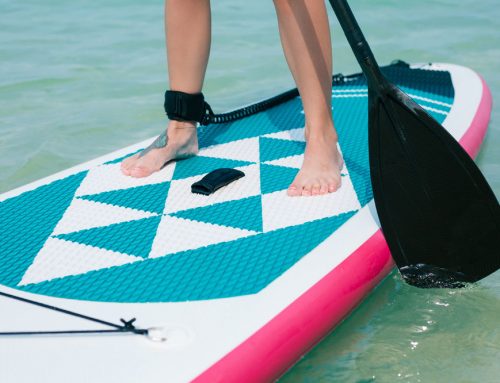
- Width (32–34 inches): Width is the single biggest factor in stability. A board in the 32–34″ range gives you a wide platform to stand on while you find your balance. Narrower boards (under 30″) are faster but punishing for new paddlers. Don’t let anyone talk you into a “performance” shape until you’ve got your sea legs.
- Length (10’6″–11′): This range hits the sweet spot for beginners. Long enough to track straight and glide smoothly, short enough to maneuver without a wrestling match. Boards under 10′ can feel twitchy; boards over 11’6″ get unwieldy for most new paddlers.
- Thickness (6 inches): For inflatable boards — which we recommend for beginners — 6″ is the standard. It gives the board rigidity and enough volume to support a wide range of body weights without feeling spongy underfoot.
- All-around shape: An all-around or “touring lite” shape with a rounded nose handles flat water, mild chop, and even a little surf. Dedicated race boards and narrow touring shapes have no place in a beginner’s quiver.
- Forgiving construction: A board should absorb minor wobbles and let you correct your stance. Stiff, high-performance shapes punish mistakes. Beginner boards are designed with extra volume and a wider tail to help you recover before you fall.
- Complete kit: The best beginner boards come as a package — board, paddle, leash, pump, and carry bag. Buying these separately adds cost and complexity. A complete kit from a reputable brand is the fastest path to being on the water.
Not sure what size is right for your height and weight? Use our paddle board size chart to dial in the right dimensions before you buy.
Inflatable vs. Hard Board: Why Beginners Should Almost Always Go Inflatable
Hard epoxy boards are faster, stiffer, and what the pros use. They’re also fragile, expensive to repair, hard to transport, and unforgiving when you fall on them — which you will, because you’re a beginner.
Inflatable boards (called iSUPs) have closed that performance gap significantly in recent years. A quality 6″ inflatable inflated to 15 PSI is remarkably rigid. It won’t feel like a pool toy. It will feel like a board. And when you inevitably fall on it, it’s softer. When you need to get it home, it rolls into a backpack. When you ding it against a dock, it bounces instead of chips.
The one downside: inflation time. A good hand pump takes about 10–15 minutes. An electric pump (often sold as an add-on) cuts that to 5. Once you’re out there, you won’t think about it.
For a deep dive into the best options right now, see our guide to best inflatable paddle boards — tested across price points and rider types.
What to Avoid: The "Cheap Pool Toy" Trap
Walk into a big-box store or browse discount sites and you’ll find paddleboards for $150–$250. They look like paddleboards. They’re the same shape. The photos show happy people standing on them in turquoise water. Buy one and you’ll understand within five minutes why that photo was staged.
Boards under roughly $300 almost universally use single-layer PVC construction, which means they’re soft, flexible, and unstable even when fully inflated. They wobble underfoot, they’re slow, the included paddles are often the wrong length, and the fins are a joke. You’ll fight the equipment instead of learning to paddle.
What you’re actually avoiding isn’t the low price — it’s single-layer construction. Even at $250, a single-layer board will frustrate you off the sport before you ever get comfortable. The minimum meaningful threshold for a board that actually behaves like a board is around $350–$400 for entry-level double-layer construction from a real paddle brand.
What to Budget: Real Price Expectations
Here’s an honest look at what your money gets you:
- $350–$500: Entry-level boards from real brands (iROCKER, Bluefin, Retrospec, Tower). Double-layer or machine-laminated construction. Decent paddle, basic leash, backpack bag. Good enough to learn on and enjoy for years. This is where most beginners should start.
- $500–$800: Mid-range sweet spot. Better materials, more rigid construction (fusion or drop-stitch with dual-layer), upgraded paddles (carbon fiber shaft), better accessories. These boards last longer and perform noticeably better. If you’re serious about the sport, stretch here.
- $800–$1,200+: Premium and specialist territory. Carbon rails, woven drop-stitch, ultra-rigid feel, brand names like Red Paddle Co., BOTE, or Starboard. Overkill for a true beginner, but the right call if you’ve paddled before and know you want performance.
A complete kit in the $400–$600 range will serve most beginners extremely well. Don’t feel like you need to spend more to have a great experience.
The Gear a Beginner Actually Needs
The board gets all the attention, but the right gear makes the difference between a safe, enjoyable session and a bad day on the water. Here’s what you need before you launch:
- PFD (Personal Flotation Device): Required by law in most states for paddleboards used on navigable waterways. A low-profile waist-belt PFD is the most comfortable option — you won’t feel it until you need it. Don’t skip this.
- Leash: Connects you to your board. If you fall and get separated, the board becomes a hazard and you lose your biggest flotation device. Coiled leashes work best on flatwater (they don’t drag). Straight leashes are better in surf. Most beginner kits include one.
- Pump: Your board ships with one. Electric pumps (12V plug-in or rechargeable) are worth every penny if you paddle frequently — hand-pumping to 15 PSI is a workout. Look for a pump with a pressure gauge built in so you don’t over- or under-inflate.
- Paddle (sized correctly): Standard advice: your paddle should reach your wrist when you raise your arm straight overhead. Most adjustable paddles cover a 68″–84″ range, which works for most adults. Aluminum is fine to start. Carbon fiber is lighter and worth it later.
- Sun protection and water shoes: Optional but practical. EVA deck pads grip your feet reasonably well barefoot, but water shoes prevent cuts when launching from rocky shores.
Ready to learn the basics of technique? Our how to paddleboard guide walks you through stance, stroke, and getting up for the first time.
Building Confidence: What Your First Sessions Will Feel Like
Here’s something most guides skip: your first few sessions will feel awkward. That’s normal. It’s not the board. It’s the wobble of water under your feet, the unfamiliar balance point, the instinct to look down instead of at the horizon. These sensations go away faster than you think.
Most new paddlers find their footing within 30–60 minutes on a proper beginner board. By session three or four, they’re not thinking about balance at all — they’re just paddling.
A few things that help the learning curve:
- Start on your knees, not your feet. Get a feel for the board’s movement before you stand.
- Look at the horizon, not the nose of the board or your feet.
- Bend your knees slightly — stiff legs are the fastest way to fall.
- Choose calm, flat water for your first sessions. Even small chop adds difficulty when you’re learning.
- Go with a friend. It’s more fun, safer, and having someone to laugh with when you fall takes the pressure off.
Where to Go From Here: Our Tested Roundups
This guide gives you the framework to evaluate any board you come across. But when you’re ready to look at specific picks — boards we’ve actually paddled and can vouch for — we have you covered.
For the best all-around inflatable options across price points, start with our best inflatable paddle boards guide. If you want picks filtered specifically for new paddlers, our best beginner inflatable boards roundup narrows it down to boards that prioritize stability, complete kits, and accessible pricing.
Every board in those guides has been tested on the water. We note what they’re good at, where they fall short, and who each one is best suited for. No filler, no speculation — just what we found when we actually used them.
Pick the board that fits your budget and your local conditions, grab the three pieces of gear mentioned above, and get on the water. The sport is as simple as it looks. You just need the right starting point.
Frequently Asked Questions
What size paddleboard is best for a beginner?
Is an inflatable or hard paddleboard better for beginners?
How much should I spend on a beginner paddleboard?
Do I need a PFD to paddleboard?
How long does it take to learn to paddleboard?
Best inflatables →Best beginner inflatables →Size chart & calculator →How to paddleboard →