
The Best Paddleboards of 2026
Four boards we’d actually put our own money on — ranked by who they’re really for, not who pays the most. Inflatable picks for every budget, with the honest catches included.
Most “best paddleboard” lists rank whatever pays the biggest commission. We don’t. Below are the four inflatable SUPs we genuinely recommend in 2026 — the all-around best, the premium build, the most stable, and the budget pick — each with who should buy it and who should skip it.
The picks, side by side.
Tap a board to jump to the full breakdown, or check the current price on the brand’s site.
| Board | Best for | Size / width | Capacity | Price | |
|---|---|---|---|---|---|
| iRocker All-Around 11′ Best overall | Most paddlers, all-round use | 11′ × 32″ × 6″ | 435 lb | ~$529 | Check price → |
| BOTE Breeze Aero Best premium | Buyers who want a top-tier build | 10′6″–11′6″ × 34″ | ~315 lb | ~$799 | Check price → |
| Thurso Waterwalker 132 Most stable | Bigger riders & nervous beginners | 11′ × 32″ × 6″ | 370 lb | ~$699 | Check price → |
| FunWater Cruise 11′ Best budget | First board / tight budget | 11′ × 33″ × 6″ | ~330 lb | ~$231 | Check price → |
iRocker All-Around 11′
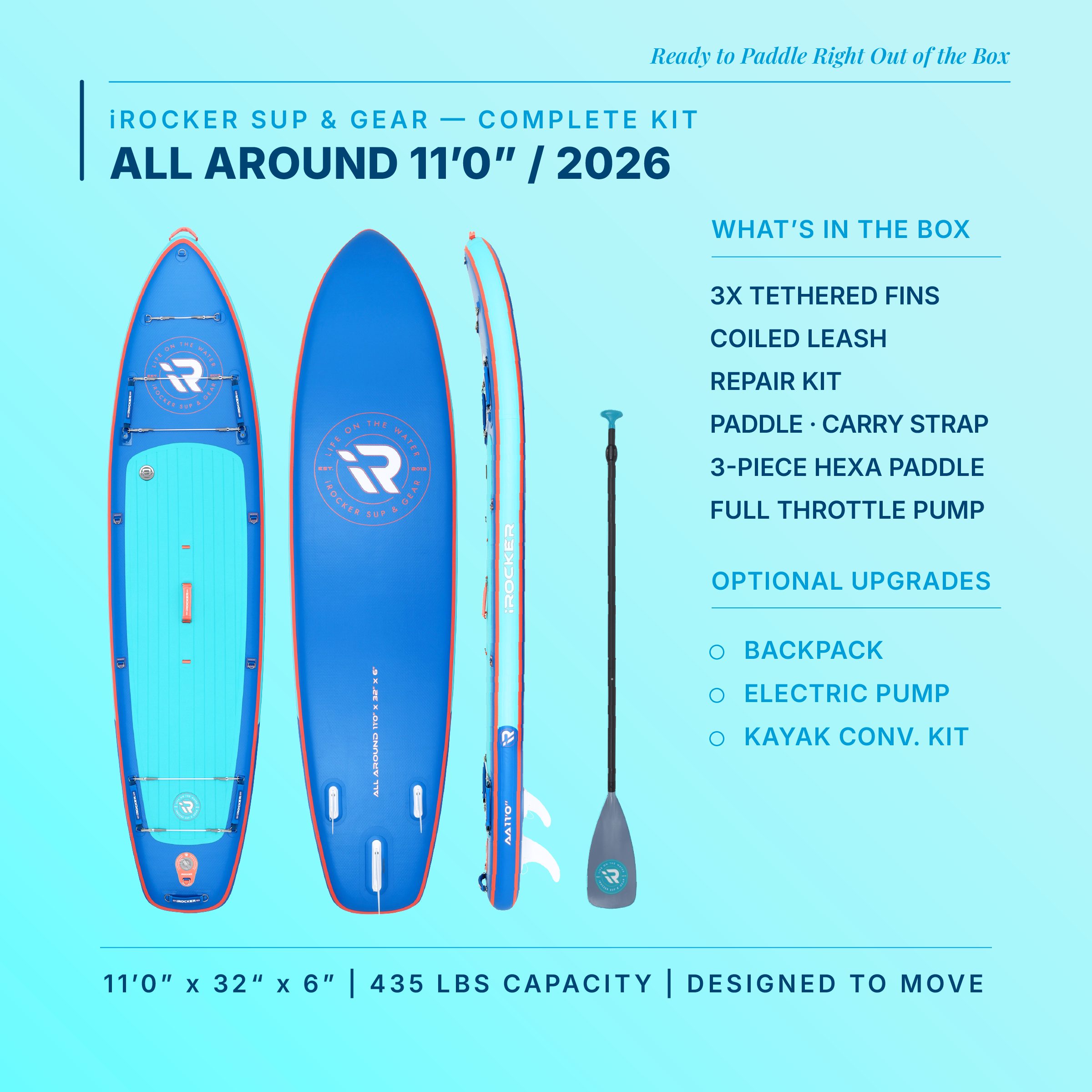
The board we recommend to most people. Triple-layer PVC makes it stiff enough to feel like a hardboard, the 32″ width is stable without being sluggish, and a 435 lb capacity covers almost everyone — solo, with a kid, or with the dog.
What we like
- Rigid, premium feel for the price
- Huge 435 lb capacity
- Complete kit: pump, paddle, fins, bag
The catches
- Not the cheapest entry point
- Hand pump is a workout (electric is extra)
BOTE Breeze Aero
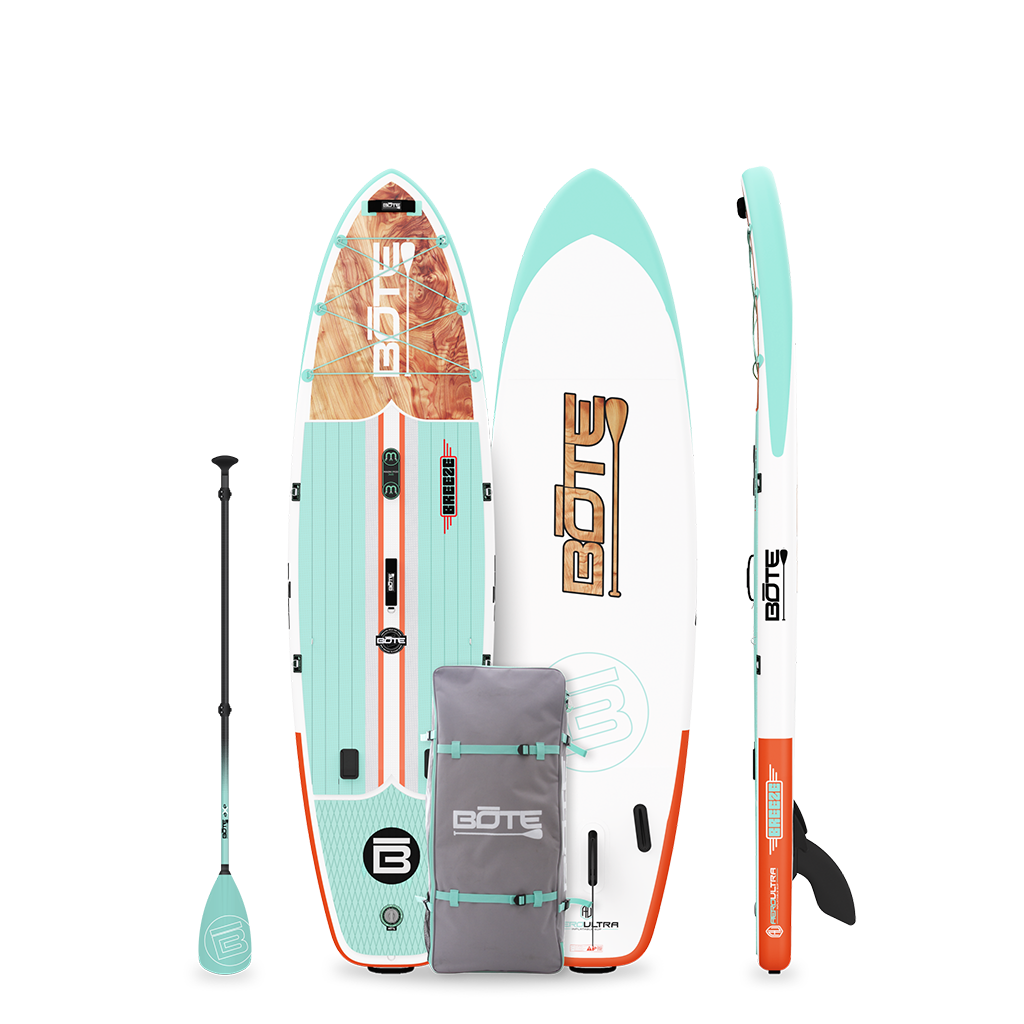
If you want the nicest board here and don’t mind paying for it, this is it. BOTE’s AeroULTRA construction is genuinely rigid, the 34″ deck is rock-steady, and the fit-and-finish is a step above. Compatible with BOTE’s clever accessory ecosystem (coolers, racks, MAGNEPOD).
What we like
- Best build quality in this list
- Wide 34″ deck = very stable
- 2-yr warranty + 30-day guarantee
The catches
- The most expensive pick here
- You pay partly for the brand
Thurso Waterwalker 132 (11′)
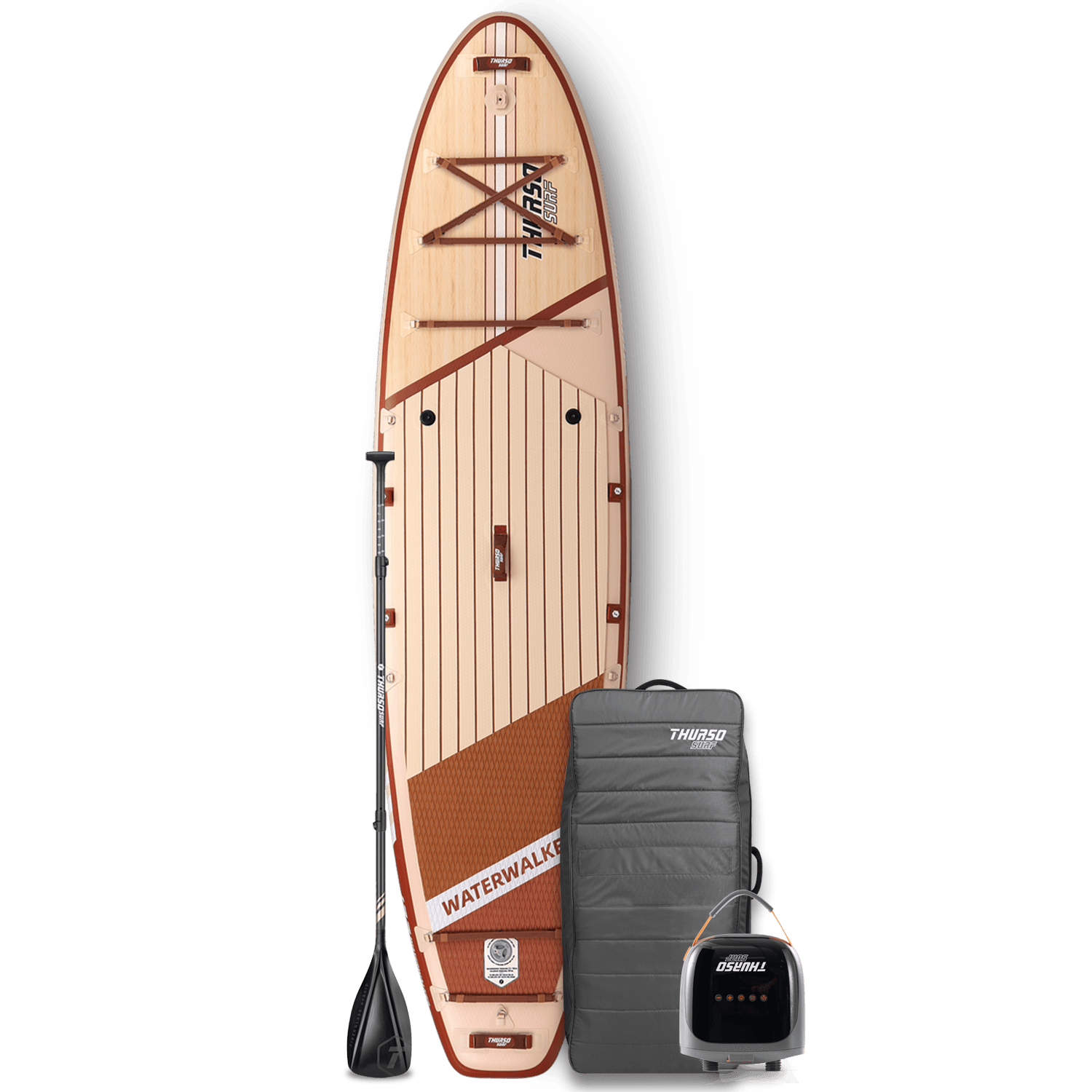
The most stable-feeling board here and the best for bigger riders or nervous first-timers. Thurso’s woven drop-stitch core is noticeably stiffer than budget boards, and the kit punches above its price — a carbon-shaft paddle and a roller backpack come standard.
What we like
- Stiff woven drop-stitch deck
- Carbon paddle + roller bag included
- Great for heavier/taller paddlers
The catches
- Heavier than the iRocker
- Wood-look styling isn’t for everyone
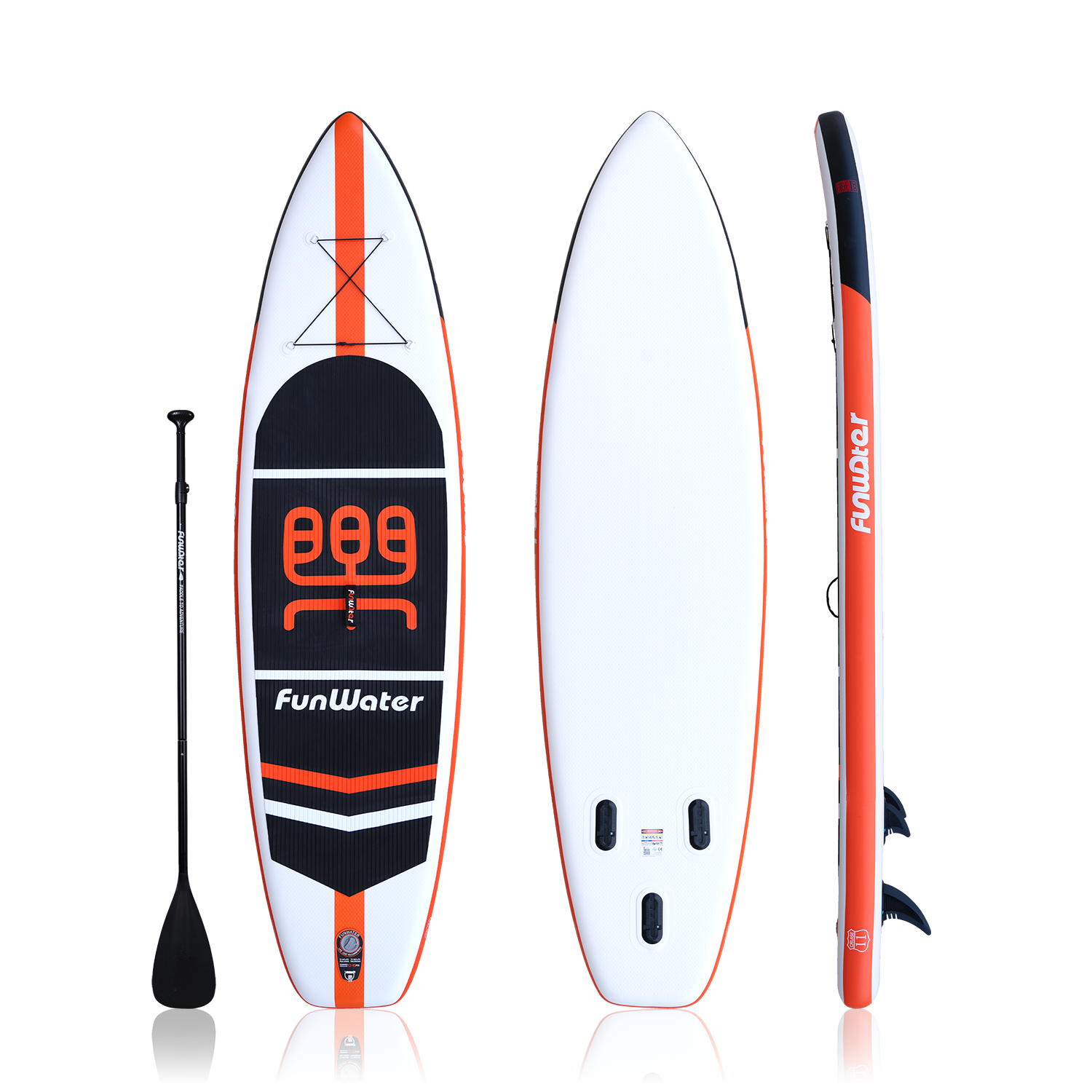
FunWater Cruise 11′
Proof a cheap board doesn’t have to be a pool toy. At around a third the price of the premium picks, the FunWater Cruise is genuinely stable, comes with a full accessory kit, and is the one we point true beginners to when budget is tight. You give up some rigidity, not your whole first season.
What we like
- Hard to beat for the money
- Complete kit + backpack included
- Light and easy to handle
The catches
- Flexier than the premium boards
- Budget paddle you may upgrade later
What actually separates these boards.
The three things that decide whether a paddleboard is worth owning — and how we weighted them.
Rigidity
A board that flexes underfoot is harder to balance on and slower. We favor boards with denser cores (triple-layer or woven drop-stitch) that stay flat at 15 PSI.
Stability vs. weight
Width and volume make a board steady; too much makes it a barge. We look for the sweet spot — stable enough to learn on, light enough to actually carry to the water.
What’s in the box
A cheap board with a junk paddle and a leaky pump isn’t a deal. We weigh the whole package — paddle, pump, leash, fins and bag — not just the board.
We’d rather lose the sale than your trust.
We test boards on real water and publish the cons next to the pros. We earn a commission if you buy through our links — at no extra cost to you — but it never changes our ranking, and we’ll happily point you to the cheaper board when it’s the smarter buy.
How to choose a paddleboard.
Skip the spec-sheet overwhelm — these are the things that actually decide whether you’ll love your board.
A paddleboard is a bigger commitment than it looks — the right one disappears under your feet and the wrong one ends up in the garage by August. Six things decide which is which: the shape, whether it’s inflatable or hard, the size for your body, how it’s built, the accessories, and the price. Here’s how to read each one.
1Start with the shape (hull type)
The hull — the underside profile of the board — is the first fork in the road, because it sets what the board is good at. Most paddleboards are one of three shapes:
| Hull type | Best for | How it feels |
|---|---|---|
| Planing (flat, wide) | Cruising, SUP yoga, surf, beginners | Stable, forgiving, easy to turn — rides on top of the water |
| Displacement (pointed nose) | Touring, fitness, distance, racing | Fast and efficient — slices through water, less twitchy at speed |
| Hybrid (rounded nose) | A bit of everything | A middle ground — quicker than a planing board, steadier than a race board |
For a first or only board, a planing or hybrid all-around shape is almost always the right answer — and it’s what every pick in this guide is. Save the pointy displacement boards for when you know you want to cover distance.
2Inflatable or hard (solid)?
For roughly nine in ten paddlers, inflatable wins. A modern inflatable SUP (iSUP) stores in a closet, travels in a backpack or the trunk, shrugs off the rock you’ll eventually bump, and — with good drop-stitch construction — is stiff enough that you genuinely won’t miss a hard board. Where each one pulls ahead:
- Inflatable — storage, travel, durability, comfort underfoot, price. The default for cruising, yoga, fishing and family use.
- Hard / solid — slightly more glide and top-end speed, instant readiness (no pump). Worth it mainly for racing or daily ocean paddling near the water.
The full breakdown is in our inflatable vs. hard paddleboard comparison.
3Get the size right — length, width & your weight
Length is mostly about your size and goals. A 10′–10′6″ board is lighter, turns quicker and suits smaller or lighter paddlers and tight water; an 11′ board tracks straighter, carries more and is the safer all-around call for most adults (three of our four picks are 11-footers). Past 11′6″ only pays off for touring.
Width is what actually makes a board feel stable. Narrow boards (29–31″) are faster but twitchier; the steadiest all-around boards sit at 32–34″ wide, and dedicated stability/yoga boards reach 34–36″. For a first board, 32″ or wider is the sweet spot. Then match length and width to your weight:
| Your weight | Board length | Width |
|---|---|---|
| Under 125 lb | 9′6″ – 10′6″ | 30–32″ |
| 125 – 175 lb | 10′6″ – 11′ | 32–33″ |
| 175 – 225 lb | 11′ – 11′6″ | 32–34″ |
| 225 lb and up | 11′6″ and up | 34″ + |
Anyone bringing a kid, a cooler or a dog should size up. Our full sizing guide goes deeper.
4Check the volume & weight capacity
Two numbers tell you whether a board will actually float you. Volume (in liters) is how much the board floats — more volume rides higher and feels more stable. Weight capacity is the total it carries (you + paddle + gear + dog) before it sits low and sluggish.
5Know the anatomy of a SUP
You don’t need to be an engineer, but a few parts are worth checking on the spec sheet before you buy:
6Rigidity is the quiet dealbreaker
The single biggest difference between a great inflatable and a frustrating one is stiffness. Look for triple-layer or woven/fusion drop-stitch construction rather than basic single-layer PVC.
7Transport & storage
This is where inflatables shine: deflate, roll, and the whole kit lives in a backpack in a closet or trunk. Leaving it inflated for a few weeks in a cool, shaded spot is fine; for long-term storage or hot car trunks, release some pressure (heat expands the air) or roll it up. Keep it out of prolonged direct sun, which is hard on every material over time.
8Paddling with kids & dogs
Family paddling rewards capacity and a wide, stable deck more than speed. A 34″+ board with a high weight limit lets a kid or dog ride up front without burying the nose, and a soft full-length deck pad saves knees and paws. Always put a leash on every rider and a properly fitted PFD on kids. More in our guide to paddleboarding with kids.
9The accessories that matter
Every board here ships as a complete package, but kit quality varies a lot — and a great board with a junk paddle isn’t a deal. What to look for (and add):
- Paddle — lighter is better all day; a carbon or carbon-shaft paddle (like Thurso’s) beats a heavy aluminum one.
- Pump — a dual-action hand pump is standard; an electric pump is the upgrade most owners say they’d buy again.
- Leash — non-negotiable. Your board is your biggest flotation device; a leash keeps it with you after a fall.
- PFD — the U.S. Coast Guard treats a SUP as a vessel outside swim areas, so carry one (and have kids wear one).
10How much should you spend?
The honest sweet spot is $500–$900 for a board that’s genuinely rigid and arrives with a decent paddle and pump. Here’s what each tier really gets you:
| Price | What you’re getting |
|---|---|
| Under $300 | Often flex and a throwaway paddle. Fine to dip a toe; many are pool toys. (The FunWater above is a rare exception.) |
| $400–$900 | The sweet spot — rigid drop-stitch boards, decent kit, real warranties. Where most people should buy. |
| $900+ | Carbon rails, premium materials and racing/touring performance most paddlers don’t need. |
Spending more than you need is as common a mistake as spending too little. Buy the board that fits how you’ll actually paddle — then spend the savings on a good paddle and a PFD.