
How Much PSI to Inflate a Paddle Board?
Get the pressure right and your inflatable feels solid underfoot — get it wrong and you'll fight a noodle all session.
Best inflatablesMost inflatable paddle boards perform best at 12–15 PSI minimum, with the sweet spot for quality boards sitting at 15–18 PSI. Some high-end boards are rated up to 20–25 PSI — always follow the max rating printed on your board near the valve.
Why PSI Matters More Than Most Paddlers Realize
Paddle board PSI is the single biggest variable controlling how your inflatable feels on the water. An under-inflated board flexes in the middle — the classic “banana” shape that makes you work twice as hard to balance and paddle. An over-inflated board risks seam stress and, in extreme cases, a blown valve or delamination.
That banana effect isn’t just uncomfortable. It actually slows the board down, throws off your center of gravity, and makes the nose dip when you shift your weight forward. New paddlers often think they’re struggling with skill when the real problem is a soft board sitting at 8 or 9 PSI.
Inflatable SUPs achieve their rigidity through drop-stitch construction — thousands of polyester threads connecting the top and bottom layers. Those threads can only pull taut and hold the board flat when there’s enough air pressure behind them. Hit the manufacturer’s recommended PSI and the board approaches the stiffness of a inflatable vs hard paddle boards comparison that often surprises first-timers.
The Right PSI Range: A Quick Reference by Rider Type
There is no single universal number, but there are solid guidelines based on rider weight and board type:
- Kids and light riders (under 120 lbs): 12–14 PSI is usually enough to keep the board flat without over-stressing seams on lighter-construction boards.
- Average adults (120–200 lbs): 15–17 PSI is the sweet spot. Most mid-range boards are designed around this range.
- Heavier riders (200–250+ lbs): Push toward 18–20 PSI if your board’s max rating allows it. More pressure means more rigidity under greater load, which equals better performance and a flatter ride.
- Performance / racing boards: Many higher-end race and touring boards are engineered for 20–25 PSI. These use heavier-duty materials specifically to handle higher tension.
- Budget boards and soft-top inflatables: Stick to the stated max — typically 12–15 PSI — and do not exceed it, even if the board feels soft. The construction isn’t rated for more.
Explore our picks for the best inflatable paddle boards — every board listed includes the manufacturer’s rated PSI range so you can compare before you buy.
How to Find Your Board's Maximum PSI Rating
Every reputable inflatable SUP prints its maximum inflation pressure directly on the board, almost always within a few inches of the valve — usually on the deck or rail. It might read “Max 20 PSI” or “Inflate to 15–18 PSI.” If you can’t find it there, check the original manual or the manufacturer’s website.
Never guess and never just keep pumping until the gauge feels high enough. Exceeding the rated PSI puts stress on the seams, the valve stem, and the drop-stitch threads. A catastrophic failure mid-session is rare but not unheard of — and it’s always avoidable.
How to Inflate a Paddle Board: Step-by-Step
The inflation process is straightforward once you’ve done it a couple of times. Here’s what actually works:
Hand Pump vs. Electric Pump
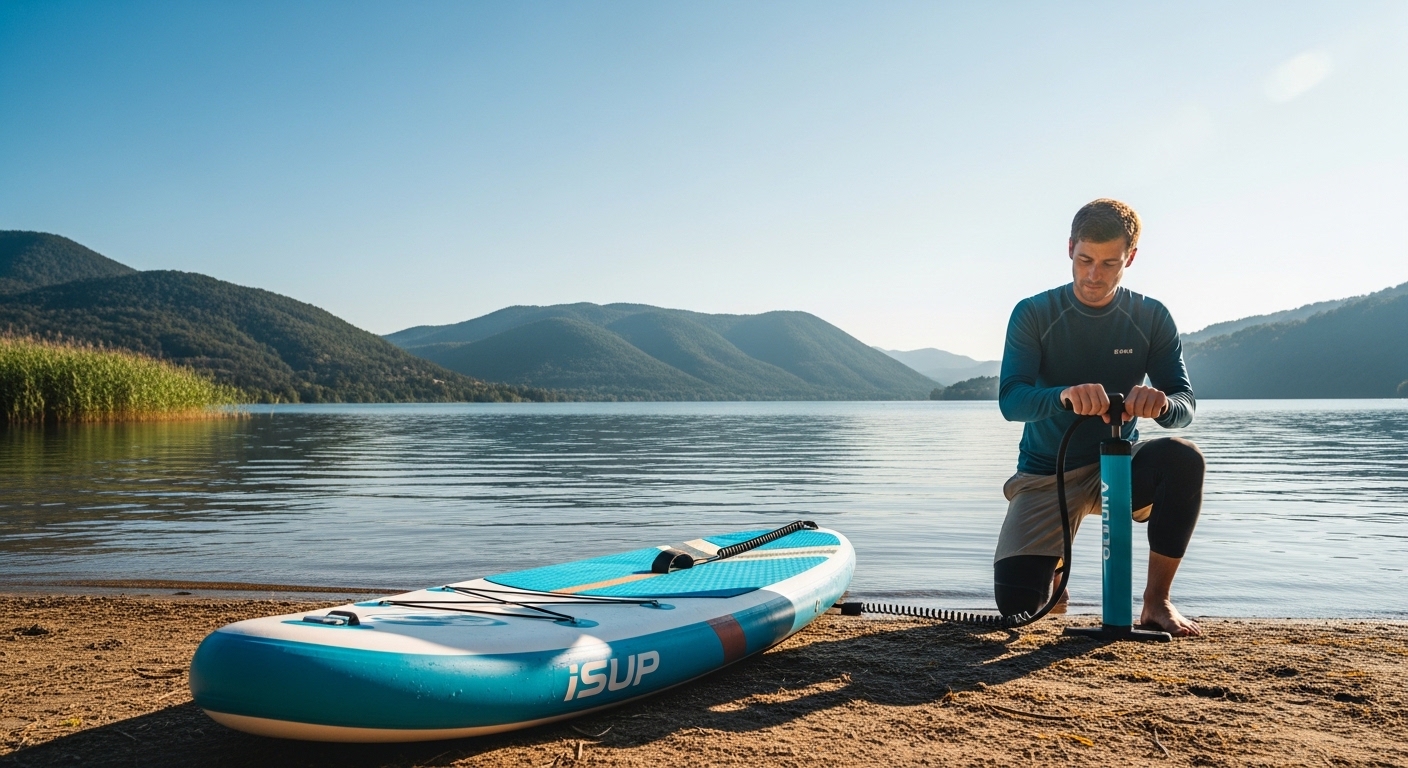
A double-action hand pump (the standard included pump on most boards) uses both the push and pull stroke to move air. It’s slower but gives you precise control over the final pressure. A quality electric pump — either 12V car-adapter or battery-operated — can get you to 12–14 PSI in a few minutes with zero effort, but many struggle to push beyond 15 PSI efficiently.
The best approach is the two-stage method: use an electric pump to get the board to around 12–13 PSI quickly, then switch to a double-action hand pump to top off the last few PSI. This is faster overall than hand-pumping from zero and more precise than relying on an electric pump’s auto-shutoff alone.
Step-by-Step Inflation
- Lay the board flat on a clean surface and unroll it fully before attaching the pump hose.
- Check that the valve pin is in the “open” position (pushed down and locked) before connecting — pumping against a closed valve can damage it.
- Connect the pump hose and begin inflating. Double-action mode is more efficient; switch to single-action when resistance makes double-action uncomfortable.
- Watch the gauge. Below 7–8 PSI it rises fast. Above 10 PSI it slows noticeably — that’s normal, not a leak.
- Stop at your target PSI. Disconnect the hose quickly to minimize air loss at the valve.
The whole process takes roughly 7–10 minutes by hand for a standard 10–11 foot board. Fit paddlers hit it in 6–7 minutes; casual pumpers may take 12. Plan for it — rushing the last few PSI is where people quit early and end up with a soft board.
A high-quality pump is one of the most underrated paddle board accessories you can own. Dual-chamber pumps and electric pumps with accurate auto-shutoff take most of the effort out of the process.
How to Read the Pressure Gauge Accurately
Most pumps ship with a built-in analog gauge on the barrel. They work fine, but they’re not precision instruments. Here’s how to read them correctly:
- Read the gauge while pumping — the needle jumps under compression and drops between strokes. The true resting pressure is the number the needle settles to between pump strokes, not the peak during a stroke.
- Dial gauges on cheaper pumps can be off by 1–2 PSI. If you want accuracy, buy a separate digital pressure gauge that screws onto the valve directly. They cost under $15 and are worth it.
- After disconnecting the hose, the board pressure will read slightly lower on a separate gauge than what the pump gauge showed. A small drop (0.5–1 PSI) is normal air loss at the valve during disconnect.
Temperature Effects: Cold Morning, Hot Sun, and Why It Matters
Air pressure inside your board changes with temperature. This is basic physics — the same volume of air exerts more pressure when hot and less when cold. For paddlers, it plays out in two practical scenarios:
Cold Water and Morning Air
If you inflate your board at home (say, 70°F indoors) and drive to a cold lake or ocean launch where the air is 50°F, your board can lose 2–4 PSI before you’ve taken a single stroke. Always do a final top-off at the water’s edge, not in your garage. This is especially relevant on early morning sessions in spring and fall.
Hot Sun and Direct Heat
The opposite problem is more dangerous. A board pumped to 18 PSI and left in direct sun on a hot day can reach 22–24 PSI or higher. On a board rated for 20 PSI max, that’s over the limit. Do not leave a fully inflated board sitting in direct sunlight for extended periods — either store it in the shade, deflate slightly before leaving it, or put a reflective cover over it.
A good rule: if you can’t leave it in shade, let out 2–3 PSI before walking away from the board on a hot day.
Deflating and Storing Your Inflatable SUP
Proper deflation is just as important as proper inflation — and it’s faster. Here’s the right way to do it:
- Remove the pump hose if attached. Press and turn the valve pin to the “release” position (usually a quarter turn up) — air will rush out fast.
- Let the board deflate fully before rolling. A board with 2–3 PSI still in it is stiff enough to crack seams if you force a tight roll.
- Once fully flat, fold the fins in and roll from the nose toward the tail, pushing remaining air toward the valve as you go. Tuck the valve end last.
- Secure with the included straps or a dedicated strap — don’t cinch so tight you crease the material.
Storage PSI: Store completely deflated. Some paddlers leave their board at 3–5 PSI to avoid creasing the material during long-term storage — this is fine as long as the board is kept out of heat and direct sunlight. Never store fully inflated for weeks at a time; UV and heat cycling stress the seams over months.
Browse the full range of all inflatable paddle boards on PaddleSesh, each listed with storage and inflation specs.