
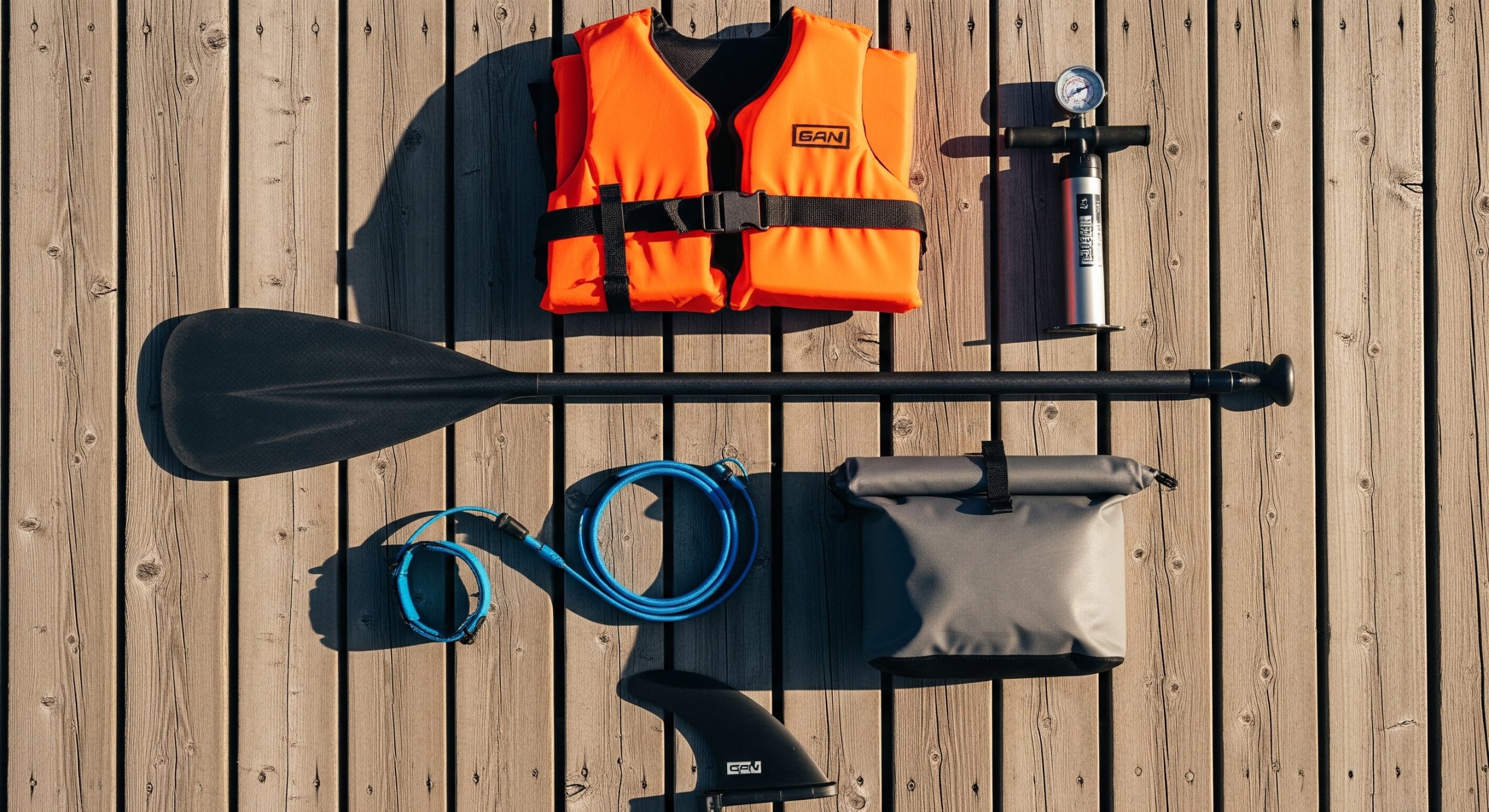
The Best Paddleboard Accessories of 2026
Your board comes with the basics — these are the upgrades and safety essentials that actually make every paddle better, safer and more comfortable.
Most boards ship with a paddle, pump, leash and fin — enough to get on the water. But a few smart additions (and a couple of non-negotiable safety items) transform the experience. Here are the accessories we’d actually buy, from must-haves to worth-it upgrades.
Gear worth owning.
Start with the safety must-haves, then add the upgrades that pay off most.
A proper PFD (life vest)
The one accessory you should never skip. The U.S. Coast Guard treats a SUP as a vessel outside swim areas, so you’re legally required to carry one — and kids must wear one. A slim, low-profile PFD or belt pack won’t get in your way. Astral makes some of the best for paddlers.
Shop PFDs at Astral →A coiled leash
Your board is your biggest flotation device — a leash keeps it tethered to you after a fall, so it doesn’t blow away faster than you can swim. A coiled leash stays off the deck for flatwater; a straight leash is safer for rivers and surf.
Shop leashes →An electric pump
The single upgrade owners say they’d buy again. Hand-pumping a board to 15 PSI is a workout you do before you’ve even paddled; a cordless electric pump (run off a battery or 12V) inflates it for you in minutes. A game-changer for bigger boards.
Shop electric pumps →A lighter carbon paddle
The stock paddle works, but a lighter carbon or carbon-shaft paddle makes a real difference over a few miles — less swing weight means less fatigue in your arms and shoulders. The best-value performance upgrade after the board itself.
Shop carbon paddles →A SUP anchor
The best cheap upgrade for yoga, fishing or a swim break — a small anchor or sandbag clipped to a D-ring holds you over one calm spot instead of drifting. Tiny, packable, and surprisingly useful once you own one.
Shop SUP anchors →A dry bag
Keep your phone, keys, a layer and a snack dry and lashed to the deck. A 10–20L roll-top dry bag clips to your bungee and shrugs off splashes and the occasional swim. Add a waterproof phone pouch and you’re sorted.
Shop dry bags →What you actually need (and what can wait).
Buy the safety gear first; add the comfort upgrades as you paddle more.
1Buy these before your first paddle
Two items are non-negotiable: a PFD (legally required and genuinely life-saving) and a leash (keeps your board with you). Everything else is comfort and convenience — these two are safety. Don’t launch without them.
2The upgrades that pay off fastest
Once you’re hooked, the two upgrades with the biggest day-to-day impact are an electric pump (saves the pre-paddle workout) and a lighter paddle (saves your shoulders on longer outings). Most paddlers wish they’d bought both sooner.
3Nice-to-haves & specialty gear
Depending on how you paddle, consider a waterproof phone case, a kayak-style seat (for fishing or long sits), a SUP anchor (yoga/fishing), and a board rack or wall mount for tidy storage. None are essential, all are genuinely useful in the right situation.
4Look after what you’ve got
The cheapest “accessory” is care: rinse salt and sand off the board and gear, dry everything before you roll it away, and store it cool and out of direct sun. Heat and UV age a board and its kit far faster than paddling does.
We’d rather lose the sale than your trust.
We test boards on real water and publish the cons next to the pros. We earn a commission if you buy through our links — at no extra cost to you — but it never changes our ranking, and we’ll happily point you to the cheaper board when it’s the smarter buy.