Paddleboarding vs. Kayaking: Which Is Right for You?
Paddleboarding and kayaking are two of the most popular water sports in the country — but they deliver very different experiences on the water. Here’s a plain-English breakdown of every meaningful difference so you can choose the one that actually fits your life.
Ease of Learning: Which Is Easier for Beginners?
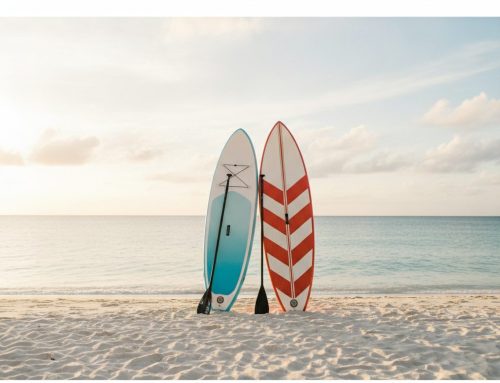
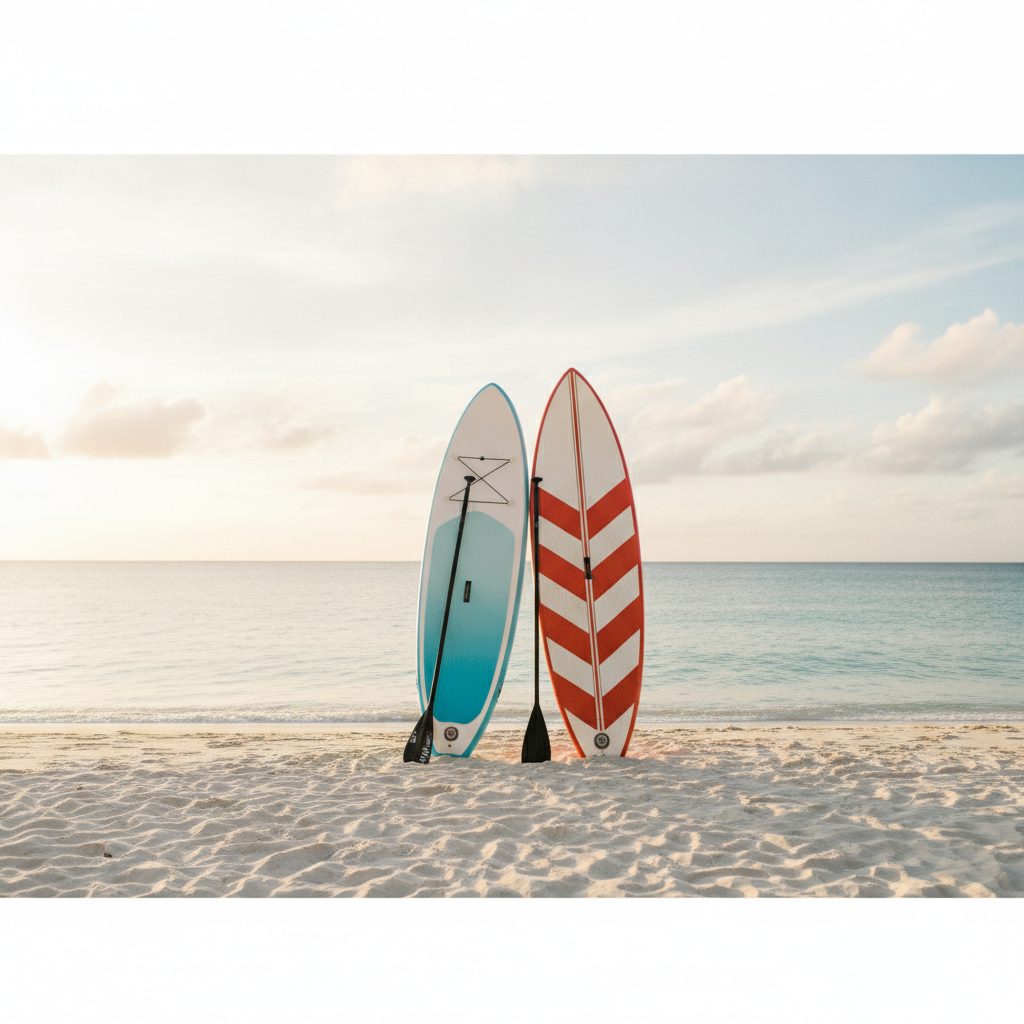
For most beginners, paddleboarding has the lower barrier to entry. On a wide, stable inflatable board — typically 10 to 11 feet long and 32 to 34 inches wide — most people can stand up and paddle in a straight line within 30 minutes of their first session. The basic stroke is intuitive: reach forward, pull back, switch sides. There are no seat harnesses, no spray skirts, and no cockpit to worry about.
Kayaking is not hard, but it involves more variables. You need to learn forward stroke, sweep stroke, draw stroke, and low or high braces before you feel fully in control. Sit-on-top kayaks are significantly friendlier than sit-in models and are the best starting point for new paddlers. Tandem kayaks add another layer — you and your partner have to synchronize strokes, which takes a few sessions.
The good news for kayaking beginners: because you’re seated and low to the water, falling in is much less common. The trade-off is that paddleboarding beginners fall in regularly until they find their balance, which is actually part of the fun for a lot of people.
Edge: Paddleboarding for absolute beginners; kayaking catches up fast after the first few outings.
Stability: Which Feels More Secure on the Water?
Stability is the question every beginner asks, and the honest answer is: it depends on the specific craft, your body weight, and the water conditions.
| Condition | Paddleboard | Kayak |
|---|---|---|
| Flat, calm lake | Stable (wide board) | Very stable |
| Light chop or mild current | Moderate — requires core engagement | Stable; lower center of gravity helps |
| Rough or open-ocean water | Challenging; narrower boards tip easily | Better; enclosed cockpit keeps you in |
| Fishing from a stationary position | Good on calm days; fishing-specific boards are wide | Excellent; pedal kayaks especially stable |
Kayaks win on stability in rougher water because you’re seated low, your center of gravity is below the waterline, and the hull is designed to resist rolling. On flat water, a wide inflatable SUP is remarkably stable — stable enough for yoga, for standing with kids, and for fishing.
If you plan to paddle on rivers, tidal channels, or open-ocean conditions regularly, a kayak is the safer, more confident choice. If your home water is a calm lake or protected bay, a paddleboard is plenty stable.
Workout and Fitness: Which Burns More Calories?
Both activities are genuinely good exercise. The differences are in which muscles they target and how hard they push your cardiovascular system.
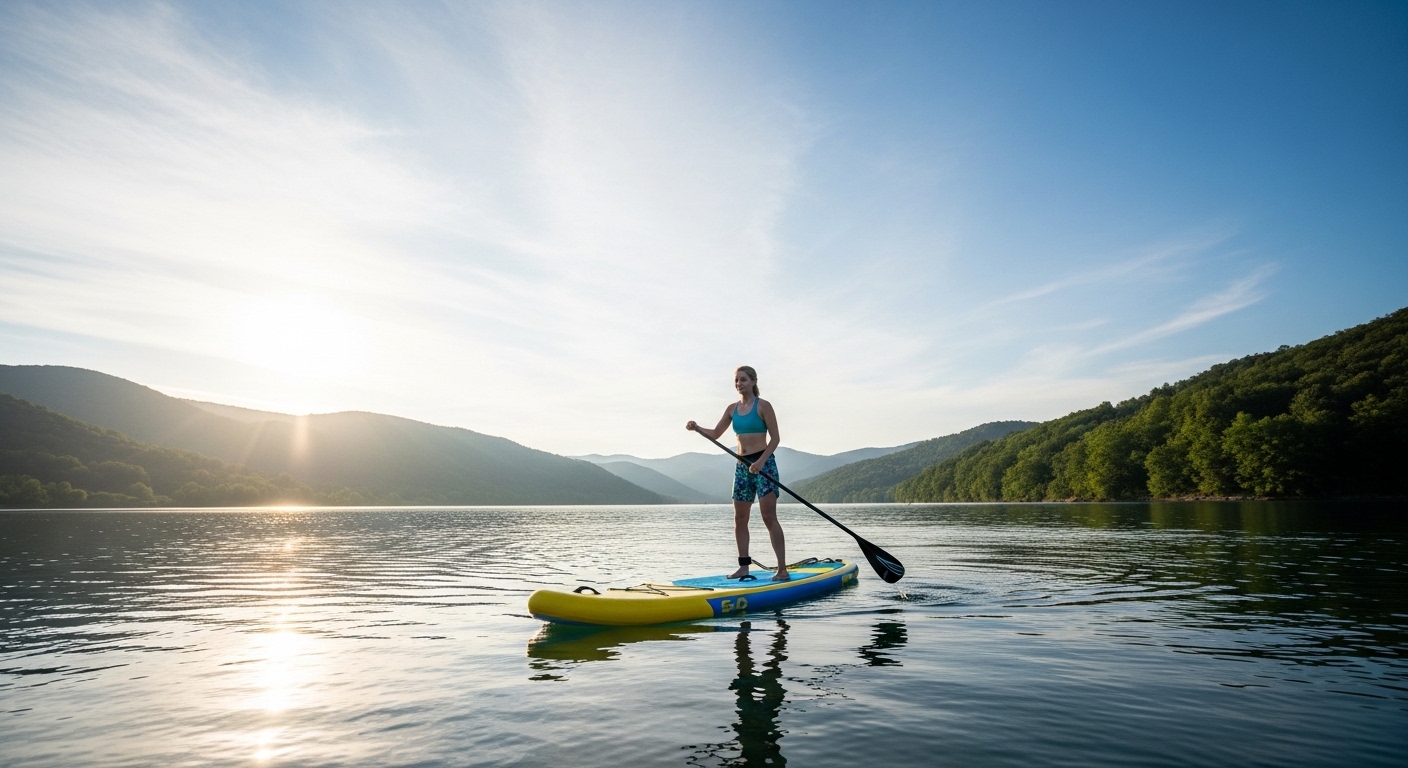
Paddleboarding is a full-body workout. Standing and balancing on a moving board continuously activates your core — not just your abs but your obliques, lower back, and hip stabilizers. Your legs are working the whole time to absorb micro-movements from the water. Your arms, shoulders, and upper back drive the paddle. A casual, recreational pace burns roughly 300–450 calories per hour; a harder SUP fitness session can hit 500–700 calories per hour. SUP yoga and SUP fitness classes add strength and flexibility training on top of the cardiovascular component.
Kayaking is predominantly an upper-body workout — arms, shoulders, and back — with less core and almost no leg engagement (unless you’re using a pedal drive kayak, which reverses that entirely). Recreational kayaking burns approximately 250–350 calories per hour. Sea kayaking or touring at a strong pace can push that to 400–500 calories per hour, and whitewater kayaking is an intense, full-effort cardiovascular challenge.
If your primary goal is overall fitness and core conditioning, paddleboarding wins. If you have lower-body limitations — bad knees, hip issues — kayaking is often the more comfortable and sustainable option.
Cost: What Does Each Sport Actually Run You?
Both sports have wide price ranges, and the entry point is more accessible than most people expect.
| Item | Paddleboard | Kayak |
|---|---|---|
| Entry-level inflatable (recreational) | $350–$600 | $250–$500 (sit-on-top) |
| Mid-range all-around or touring | $600–$1,100 | $700–$1,400 |
| High-performance / specialty | $1,200–$2,500+ | $1,500–$4,000+ (sea kayak, fishing) |
| Paddle | $60–$300 | $50–$250 |
| PFD (required by law in most states) | $40–$120 | $40–$150 |
| Leash (SUP essential) | $20–$50 | N/A |
The honest comparison: inflatable paddleboards and basic sit-on-top kayaks are comparably priced at the entry level. Hard-shell sea kayaks and touring kayaks can run significantly more than all but the most specialized paddleboards. For most recreational buyers, the starting cost is within a few hundred dollars either way.
Don’t overlook ongoing costs: paddles, PFDs, car racks or trailers, wetsuits or drysuits for cold-water paddling, and repair kits for inflatables. A good roof rack system for a hard-shell kayak can add $150–$400 to your setup.
Storage, Transport, and Portability
This is often the deciding factor for people who live in apartments, drive compact cars, or travel to paddle spots rather than launching from their backyard.
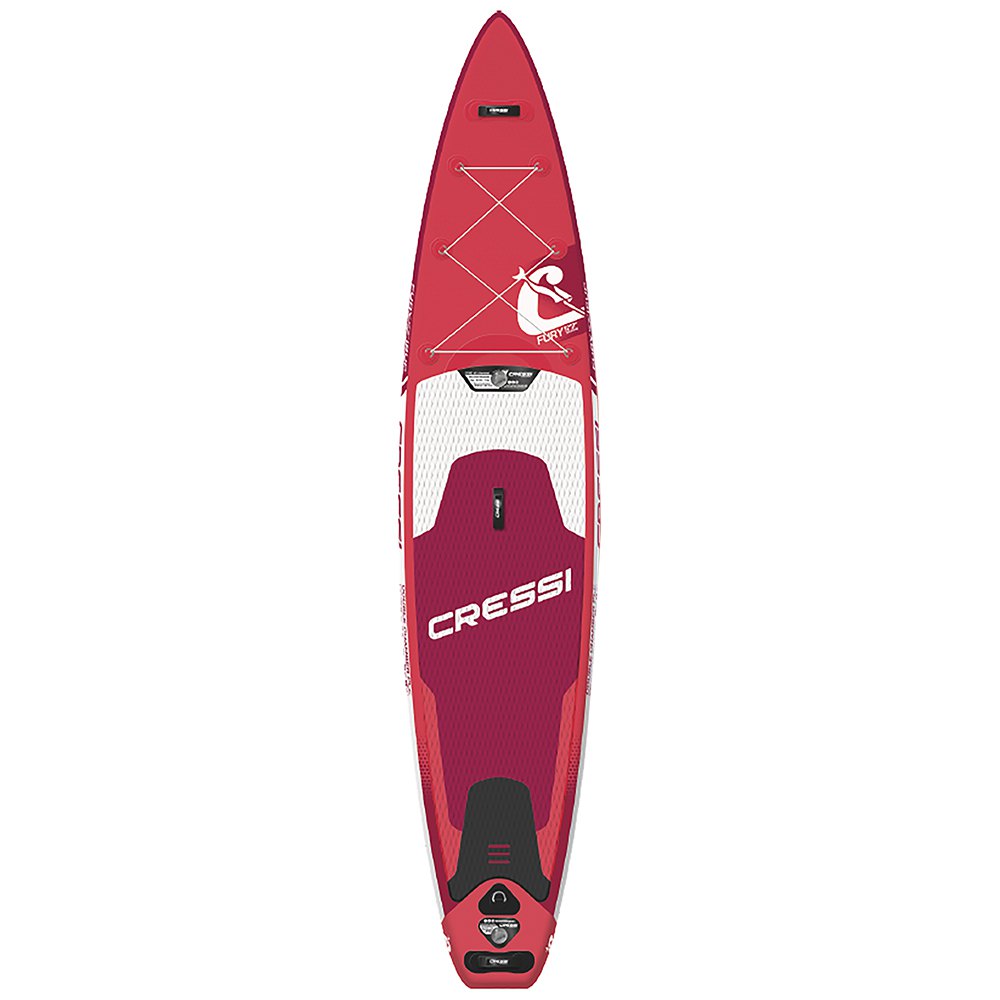
Inflatable paddleboards are the clear winners for portability. They roll down to a pack about the size of a large duffel bag (typically 30–40 lbs), fit in a car trunk or airplane overhead bin, and store in a closet. Setup takes 5–10 minutes with an electric pump. Quality inflatables are rigid enough on the water that you wouldn’t know the difference from a hard board unless you were doing serious racing or surfing.
Hard-shell paddleboards range from 10 to 14 feet and require roof racks or a truck bed. They’re lighter than hard kayaks but still unwieldy for solo roof-loading.
Sit-on-top kayaks are typically 9 to 13 feet and 45 to 80 lbs — manageable with a cart and a roof rack but not compact. Inflatable kayaks offer portability comparable to inflatable SUPs, though they’re generally wider and don’t track as cleanly as hard-shell models. Folding kayaks (Oru Kayak style) split the difference: hard-shell performance in a foldable form, at a premium price.
If storage and transport are your primary constraints, an inflatable paddleboard is the most practical option. If you have a garage and a roof rack, hard-shell kayaks are fully manageable and last decades.
Fishing: Which Is Better for Anglers?
Both sports have produced dedicated fishing-specific designs, and fishing kayaks in particular have become a full-blown industry. The right choice depends on the water you fish and how you prefer to fish.
Fishing kayaks are designed with anglers in mind: rod holders, tackle storage, anchor systems, fish finders, and motor mounts are all standard features on midrange models. Pedal-drive fishing kayaks (Hobie Mirage, Old Town Sportsman) let you keep both hands free for casting while moving. Sit-on-top kayaks provide easy access to gear and let you stand briefly for sight fishing. They’re excellent on lakes, slow rivers, bays, and protected coastal water.
Fishing paddleboards are wide (34–36 inches), ultra-stable inflatable platforms that have become popular for sight fishing in shallow flats where a kayak would spook fish. They’re extremely quiet, lower to the water, and let you stand naturally while casting — a real advantage for fly fishing or targeting redfish and bonefish on tidal flats. The trade-off is storage: you have less tackle space than a fishing kayak and need to strap everything to a D-ring system.
For general freshwater fishing — lakes, reservoirs, slow rivers — a fishing kayak offers more comfort, more storage, and hands-free pedaling. For shallow-water flats fishing or fly fishing where stealth and visibility are everything, a fishing paddleboard is hard to beat.
Families and Kids: Which Works Better with Children?
Both sports are family-friendly, but they accommodate kids differently depending on age and temperament.
Paddleboards with kids work best when kids are young enough to sit or kneel in front of you on a wide board. A 10-foot-6 to 11-foot all-around inflatable is wide and stable enough to carry an adult and a child under 60 lbs comfortably. Kids also love jumping off boards, floating on them, and generally using them as a platform — boards tolerate that abuse well. Older kids (8+) can quickly learn to paddle their own board, and many brands sell junior SUPs specifically sized for children.
Kayaking with kids offers more security because everyone is seated and enclosed or strapped into their seat. Tandem kayaks with a center seat let you put a younger child between you. Sit-on-top tandems are the easiest for families — nobody gets trapped if you capsize. Older kids often love paddling their own kayak alongside you. Kayaking feels safer to many parents because the child is in a defined seat rather than standing on a moving platform.
For very young children (toddlers through about age 5), a tandem sit-on-top kayak with a center seat or lap-riding position is generally safer. For kids 6 and up who can follow instructions and swim, either sport works well — it comes down to what the kids think looks more fun.
Which Should You Choose? A Use-Case Guide
Rather than declaring a single winner, here’s a direct recommendation by situation:
- You want a full-body workout and core training: Paddleboarding. The standing position forces constant core engagement no other paddle sport matches.
- You live in an apartment or have no storage space: Inflatable paddleboard. It rolls into a bag and stores in a closet.
- You want to paddle in rough, open-ocean, or river conditions: Kayak. The lower center of gravity and enclosed cockpit handle challenging water far better.
- You fish freshwater lakes and want hands-free pedaling: Pedal fishing kayak. Specifically the Hobie Mirage or Old Town Sportsman series.
- You fish shallow tidal flats and want silence and visibility: Fishing paddleboard. Wider boards like the BOTE Wulf or iRocker Nautical are purpose-built for this.
- You have young children and want them secured: Sit-on-top tandem kayak with a center or bow seat.
- You want something you can take on vacation easily: Inflatable paddleboard or inflatable kayak — both fit in checked luggage.
- You’re not sure yet: Rent both before you buy. Most lakes and outdoor outfitters offer hourly SUP and kayak rentals for $15–$25. Two hours on each will tell you more than any guide can.
The best paddle sport is the one you’ll actually use. Both get you on the water, both build fitness, and both offer a quality of mental reset that’s hard to find anywhere else.
Frequently Asked Questions
Is paddleboarding or kayaking better for beginners?
Paddleboarding is generally easier to pick up in the first session — the basic paddle stroke is intuitive and most beginners are standing and moving within 30 minutes. Kayaking has a slightly steeper learning curve due to different stroke types, but sit-on-top kayaks are very beginner-friendly and you’re far less likely to fall in. Either sport is accessible to beginners; the question is which experience appeals to you more.
Which burns more calories — paddleboarding or kayaking?
Paddleboarding burns more calories at a comparable effort level because it’s a full-body exercise. Standing and balancing engages your core and legs continuously in addition to your arms and shoulders. A recreational paddleboard session burns roughly 300–450 calories per hour; a focused fitness session can hit 500–700 calories per hour. Recreational kayaking runs approximately 250–350 calories per hour, though hard touring or whitewater paddling narrows the gap significantly.
Can you take kids on a paddleboard or kayak?
Yes to both. Young children (toddlers to about age 5) are often most secure in a tandem sit-on-top kayak with a center seat. Older kids can sit or kneel on a wide inflatable paddleboard in front of an adult, and children 8 and up can typically learn to paddle their own board or kayak. Always use properly fitted PFDs for children regardless of which craft you choose.
Which is easier to store and transport — a paddleboard or a kayak?
Inflatable paddleboards are the most portable option in either category — they roll into a backpack-sized bag that fits in a car trunk, closet, or even checked luggage. Hard-shell paddleboards and hard-shell kayaks both require roof racks and dedicated storage space. Inflatable kayaks offer similar portability to inflatable SUPs but don’t track or perform as well as hard-shell models. If portability is your top priority, an inflatable paddleboard is the easiest all-around solution.
Which is better for fishing — a paddleboard or a kayak?
It depends on where and how you fish. Fishing kayaks, especially pedal-drive models, are superior for freshwater lakes and rivers — they offer more storage, rod holders, fish finders, and hands-free locomotion. Fishing paddleboards win on shallow tidal flats and skinny water where stealth, silence, and the standing vantage point matter more than storage. Many serious anglers eventually own one of each.
Is paddleboarding or kayaking safer?
Kayaking is generally considered safer in rough or open water because the seated, low-center-of-gravity position is more stable in chop, and an enclosed cockpit keeps you in the boat. Paddleboarding is safe on calm, flat water — lakes, bays, protected estuaries — but falls are more common than in kayaking, especially for beginners. For both sports, always wear a Coast Guard-approved PFD, check weather before launching, paddle with a buddy, and use a leash on a paddleboard so you don’t get separated from your board.