
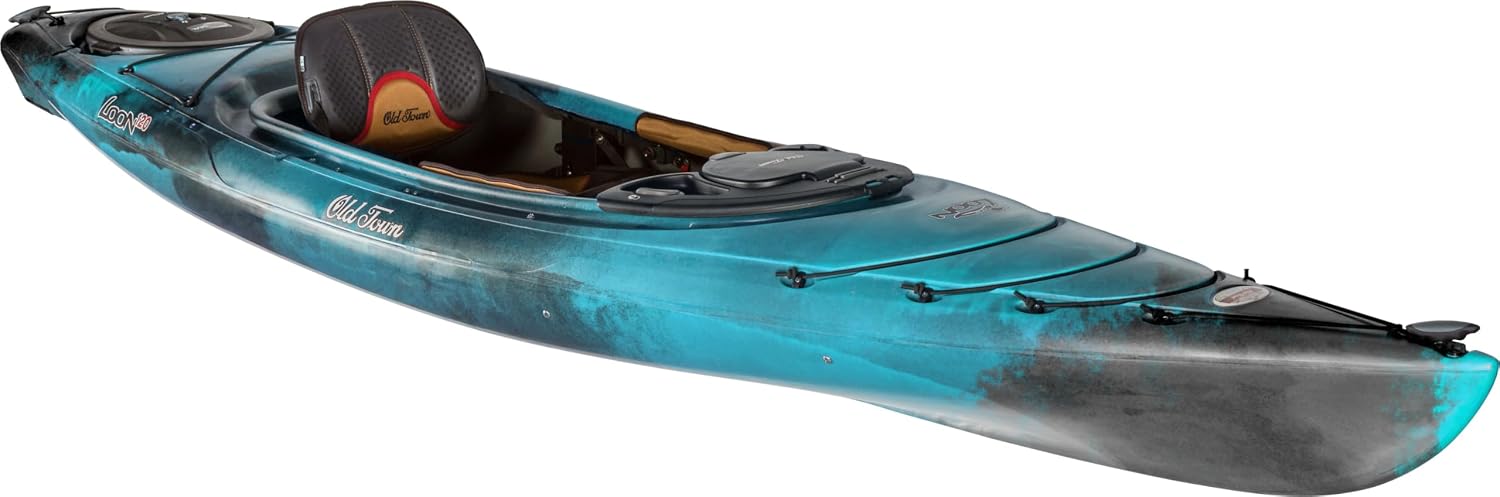
Old Town Loon 120 Review
The Old Town Loon 120 is one of the most comfortable and capable recreational sit-in kayaks on the market — a premium choice that earns its price with a class-leading seat, excellent stability, and a trusted American brand behind it.
Most recreational kayaks ask you to make a trade-off: pay less and accept a mediocre seat, or pay more and still wonder if you got the best value. The Old Town Loon 120 sidesteps that argument. At around $1,000 street price, it’s not cheap — but when we paddled it across a full day of lake miles, we came away understanding exactly where that money went. The ACS2 adjustable seat alone is better than what you’ll find on kayaks costing twice as much from other brands, and the hull does everything a serious recreational paddler needs it to do.
Old Town has been building canoes and kayaks in Maine since 1898, and the Loon line has been a flagship recreational offering for decades. The 120 — 12 feet long, wide open cockpit, sealed stern hatch — is aimed squarely at comfort-focused paddlers who want a trustworthy boat for big-water lakes, calm bays, and long afternoon sessions. If you’re still deciding between hull styles, our sit-in vs. sit-on-top guide is worth reading before you commit. And if you want to see how the Loon stacks up against the broader field, our best recreational kayak roundup has the full comparison.
Here’s our honest take: what works, where it shows limits, and who should buy this kayak versus who should spend their money elsewhere.
Old Town Loon 120 specs
| Type | Sit-in recreational |
| Length | 12′ |
| Max load | ~375-450 lb |
| Seat | ACS2 adjustable |
| Storage | Bow + sealed stern hatch |
| Best for | Comfort-first rec paddling |
On the water — tracking & stability
The Loon 120 was built to feel planted and purposeful on flatwater, and it delivers on both counts. At 12 feet and a moderate beam, it offers exceptional primary stability — the kind where you can reach over the side to grab a water bottle, swing your camera around, or just sit still and watch a heron work a cove without the boat making you nervous. Beginners feel safe in it immediately. Experienced paddlers will appreciate that the stability never comes at the cost of responsiveness.
Tracking is a genuine strength relative to its recreational class. The 12-foot hull holds a line noticeably better than 10-foot rec boats, and the slight keel line helps you stay on course without constant corrective strokes. It won’t out-track a touring kayak — no recreational boat will — but on a calm lake with a light breeze, you’ll spend most of your energy going forward, not correcting. In moderate crosswinds, you’ll feel some weathercocking, which is normal for a hull without a rudder or skeg. The good news is a few sweep strokes manage it without drama.
Speed sits at a comfortable recreational cruise, roughly 3–3.5 mph for most paddlers. It’s not going to keep up with a 16-foot touring hull on a point-to-point crossing, but that’s not the mission. The Loon 120 is optimized for comfortable exploration, not for covering miles fast. If distance touring is on your horizon, our best touring kayak guide is the better starting point.
The cockpit, seat & comfort
The headline feature of the Loon 120 is the ACS2 seat, and it earns the attention. Old Town’s Adjustable Comfort Seat 2 is a high-backed, fully adjustable padded seat that lets you dial in lumbar support, backrest angle, and position. We paddled four-plus hours in it without the lower-back fatigue that typically ends a long day in a rec kayak. The seat back is tall enough to actually support your back — not just your hips — and the padding is genuinely generous, not the vinyl-covered foam that passes for “padded” on budget boats.
The cockpit itself is large and open, which is by design. Old Town built the Loon 120 with an oversized cockpit to make entry and exit easy, to reduce claustrophobia for new paddlers, and to allow a little extra freedom of movement. The trade-off is that a spray skirt won’t seal this hull for rough water use, but that’s not what this kayak is for. For its intended environment — lakes, calm bays, mild rivers — the open cockpit is an asset.
Foot braces are adjustable and solid, offering good leg bracing without any flex or slop. Most adult heights up to around 6’1″ will fit comfortably. Very tall paddlers should verify cockpit length before buying — the open design helps, but there are limits. The overall interior ergonomics feel considered in a way that cheaper recreational kayaks don’t: the thigh area isn’t cramped, the seat position relative to the foot pegs allows proper paddle reach, and you don’t feel like you’re fighting the boat to sit correctly.
Storage & build quality
Storage on the Loon 120 is well-sorted for a recreational kayak. The stern features a sealed bulkhead hatch — a proper watertight compartment, not just a bungee-cord deck bag — that holds a dry bag, a light lunch, extra layers, and the usual day-paddle kit without issue. There’s also an open bow storage area behind the front deck bungee, sized for a small drybag or a rolled-up layer. Neither compartment is expedition-scale, but for the kind of paddle this boat is built for, both are genuinely useful.
The hull is rotationally molded from high-density polyethylene, Old Town’s standard construction for their recreational line. It handles scrapes, dock bumps, and beach landings without fuss. The finish is clean, the seams are well-executed, and the hardware — hatch cover, carry handles, seat hardware — all feels like it was sourced with longevity in mind rather than cost-cutting. At around 59 lb, the Loon 120 is not a lightweight boat, and that’s the most honest thing we can say about build quality: Old Town built it solid, and solid means weight. The carry handles fore and aft are comfortable for two-person lifts; solo car-topping is doable but not effortless.
Old Town’s reputation as an American brand — manufactured in Old Town, Maine by Johnson Outdoors — means parts availability and warranty service are straightforward. The American Canoe Association recognizes Old Town as a long-standing manufacturer in the paddle sports industry, and the Loon line reflects decades of refinement. For paddlers who want a boat that will last a decade of regular use and still look respectable, the build quality here supports that expectation.
Who it's for (and who should skip it)
The Loon 120 is the right boat for a specific and underserved buyer: the comfort-focused recreational paddler who wants a trustworthy, well-made sit-in kayak for big-water lakes and isn’t interested in compromising on the seat or the storage. That includes photographers who need a stable platform, casual fishing-lite paddlers who don’t need rod holders but want dry hatch space for gear, paddlers with back issues who genuinely need a supportive seat, and experienced recreational paddlers who have outgrown budget boats and want something that will hold up for years.
It also works well for intermediate beginners — people who’ve tried kayaking, decided they love it, and are ready to invest in something serious. The stability makes it forgiving without being boring, and the 375–450 lb max capacity accommodates a wide range of body types and gear loads. If you’re still figuring out what size hull fits your needs, our kayak sizing guide and our best beginner kayak picks are good resources before spending $1,000.
Who should skip it: paddlers who want to cover serious distance on open water will find the Loon 120 enjoyable but ultimately limited — a touring or sea kayak is a better tool for that mission. Paddlers who want a rudder standard will need to look elsewhere or budget for an aftermarket addition. And anyone who needs to solo car-top frequently and struggles with 60-pound lifts should factor in a kayak cart or a lighter alternative. At $1,000, it’s also a considered purchase — not an impulse buy — and paddlers who are uncertain about their commitment to the hobby might consider a less expensive entry point before moving up to this tier.
What we liked
- ACS2 seat is one of the most comfortable in any recreational kayak category
- Large open cockpit makes entry, exit, and movement easy for all body types
- Sealed stern hatch provides genuine dry storage for day-paddle essentials
- Tracks noticeably better than most 10–11 ft recreational hulls
- High 375–450 lb max capacity accommodates larger paddlers and gear loads
- Old Town's American-made build quality and reputation support long-term ownership
The catches
- Heavy at ~59 lb — solo car-topping and portaging require effort or a kayak cart
- Premium $1,000 street price puts it out of reach for casual or uncertain buyers
- At 12 feet, storage and transport require more space than shorter recreational kayaks
- No rudder or skeg standard — weathercocking in crosswinds requires manual correction
Frequently Asked Questions
Is the Old Town Loon 120 good for beginners?
Yes, with one caveat: it’s a premium beginner-to-intermediate kayak, not an entry-level budget boat. The wide hull and excellent stability make it forgiving and confidence-inspiring for someone new to paddling, and the ACS2 seat means long learning sessions won’t leave your back wrecked. The caveat is the $1,000 price — if you’re genuinely unsure whether kayaking is for you, starting with something less expensive and stepping up later makes financial sense. But if you know you’ll stick with it, the Loon 120 is one of the best places to start.
How stable is the Loon 120 — can you stand in it?
The Loon 120 has excellent primary stability for a sit-in recreational kayak. Calm-water tasks like shifting weight, reaching over the gunwale, or swapping gear won’t threaten to dump you. Standing, however, is not what this hull was designed for — the open cockpit and recreational beam give you stability for seated paddling, not stand-up fishing. Paddlers who want a platform for standing should look at purpose-built stand-up fishing kayaks or wider pontoon-style hulls instead.
Is the Loon 120 or Loon 106 better?
It depends on your paddling context. The Loon 106 (10.5 feet) is lighter, easier to store, and more maneuverable in tight spots — better for small ponds, narrow rivers, and paddlers who will solo car-top frequently. The Loon 120’s extra length gives it a real-world advantage in tracking, speed, and cargo capacity, which shows up on open lakes and longer paddles. If most of your paddling is on bigger water and you can handle the extra weight and length, the 120 is the better boat. If portability and maneuverability matter more, the 106 makes sense.
Does the Old Town Loon 120 have a rudder?
No — the Loon 120 does not come with a rudder or skeg as standard equipment. For calm lake paddling in typical recreational conditions, most paddlers don’t miss it; the 12-foot hull tracks well enough that corrective strokes are occasional rather than constant. In sustained crosswinds or on larger exposed water, the absence of a rudder is more noticeable. Old Town does not offer a factory rudder kit for this model, so paddlers who know they want rudder-assisted tracking should consider a step-up touring hull instead.
How heavy is the Loon 120, and can one person transport it?
The Loon 120 weighs approximately 59 lb, which puts it on the heavier end for recreational kayaks. A fit adult can handle it solo — the fore and aft carry handles make a two-point carry manageable — but regular solo car-topping at that weight gets tiring, especially with a high roof rack. We’d recommend a kayak cart for moving it across parking lots or down a boat ramp, and a rear-loading aid or a second person for getting it onto a roof rack. If weight and solo transport are a primary concern, factor in a cart budget alongside the kayak cost.