
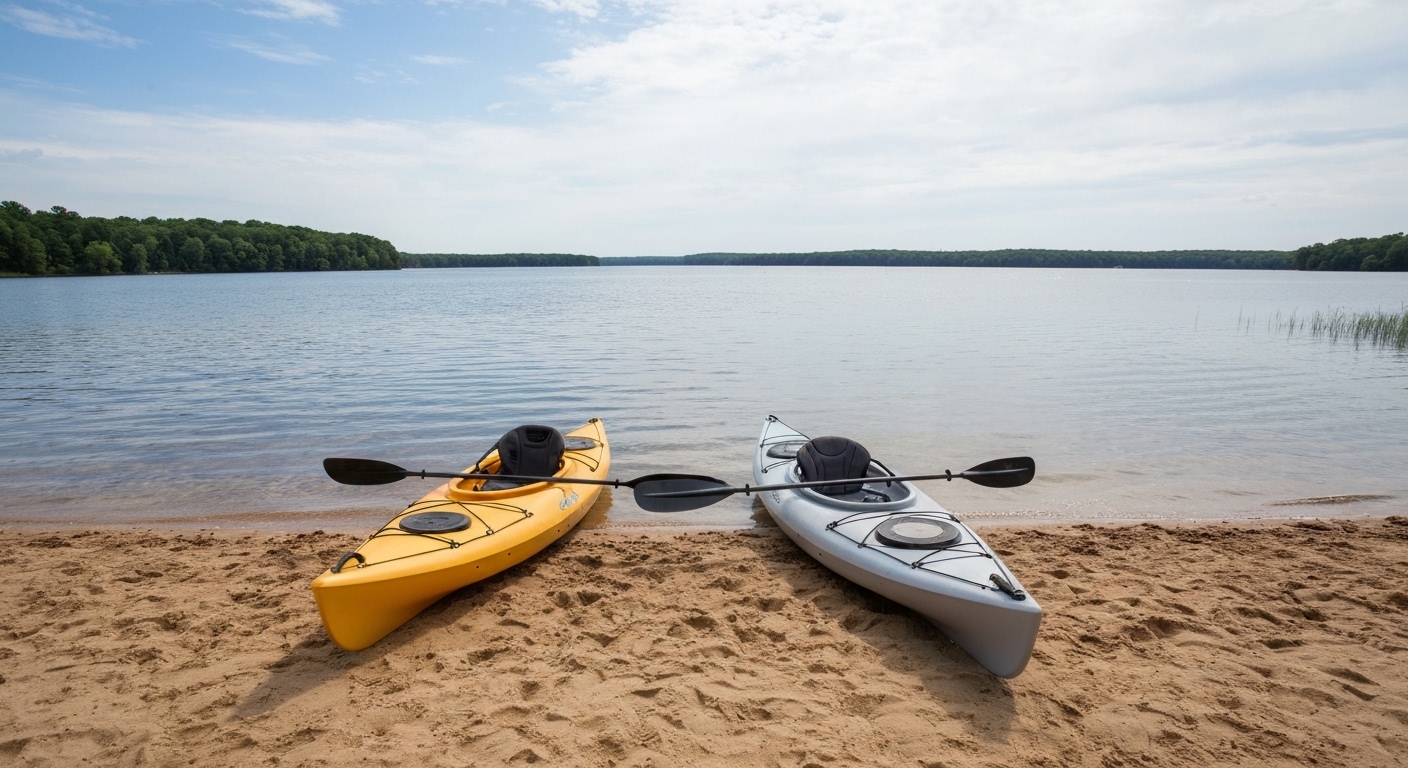
Sit-In vs Sit-On-Top Kayaks
Sit-In vs Sit-On-Top Kayaks: Which Is Right for You?
Best recreational kayaksWalk into any paddle shop and you’ll see two basic shapes of kayak staring back at you — one with an open, molded seat on top, one with a cockpit you climb inside. The sales floor answer is usually “it depends,” which isn’t wrong, but it isn’t helpful either. This guide breaks down every meaningful difference between sit-in and sit-on-top kayaks so you can stop guessing and start paddling the right boat.
How Each Design Works
A sit-on-top kayak (SOT) is exactly what it sounds like: a fully molded, solid hull with a contoured seat mounted on the deck. There is no enclosed cockpit. Your legs rest in molded footwells on the surface of the boat, and the hull is sealed — there is no interior space that can flood. Scupper holes drain any water that washes over the deck.
A sit-in kayak (SIK) has a traditional cockpit — an opening in the deck that you lower yourself into. Your lower body sits inside the hull. Most sit-ins come with a spray skirt option, a neoprene or nylon cover that seals around the cockpit rim and keeps water out. The enclosed hull typically has bulkheads fore and aft that create watertight storage compartments and provide flotation if the cockpit floods.
Both designs paddle with the same basic technique. The difference is where your body sits relative to the waterline — and that single fact drives almost every practical trade-off between the two.
Stability: Which Kayak Is Harder to Tip?
Sit-on-tops win on initial stability — the feeling of steadiness when you sit still or shift your weight. Because you sit on top of the hull rather than inside it, your center of gravity is higher, but the wide, flat hull designs used in most SOTs more than compensate. The result is a boat that feels rock-solid for most recreational paddlers.
That matters in three specific situations:
- Standing up. Anglers and photographers often need to stand and cast or shoot. Sit-on-tops — especially wide fishing models — are the only realistic option here.
- Getting on and off. Boarding from a dock, a beach, or shallow water is dramatically easier on an SOT. You just step on.
- Kids and beginners. A tippy boat is a discouraging boat. The forgiving initial stability of a wide sit-on-top keeps new paddlers confident.
Sit-ins, by contrast, have higher secondary stability — they resist actually capsizing once you lean into a brace or edge the boat. Experienced paddlers who have learned to read a kayak’s feedback often prefer this feel, especially in moving water or surf.
If you’re shopping for a stable fishing platform, our best fishing kayaks guide covers the widest and most angler-focused hull designs available.
Staying Dry vs. Getting Wet
This is the starkest real-world difference between the two designs, and it matters more than most buyers expect.
On a sit-on-top, you will get wet. Paddle splash hits your lap. Waves wash over the deck. The scupper holes that drain the cockpit area can also let cold water seep up under you. In warm weather and warm water, this is a non-issue — often a selling point. In cold water or cool air, it can become a safety concern.
In a sit-in with a spray skirt, you stay almost completely dry. Your lower body is sheltered inside the hull; the skirt seals out waves and splash. Paddlers in cold climates, touring paddlers who cover long distances, and anyone who runs rivers in early spring default to sit-ins for this reason alone.
| Condition | Sit-On-Top | Sit-In |
|---|---|---|
| Summer flatwater | Perfect — stay cool | Fine, but can get warm |
| Cool weather day trip | Dress for immersion | Spray skirt keeps you dry |
| Cold water (below 60°F) | High exposure risk | Safer with drysuit or wetsuit |
| Rain or surf | Already wet — no difference | Skirt sheds water well |
Speed and Paddling Efficiency
Sit-in kayaks are generally faster. The reasons are structural: sit-ins tend to have narrower hulls (lower width equals less drag), a lower center of gravity (better hydrodynamic efficiency), and a more streamlined deck profile. A well-designed touring sit-in will cover the same distance with noticeably less effort than a comparable sit-on-top.
This matters most on longer trips. If you’re crossing a bay, paddling into a headwind, or logging miles on a touring route, the efficiency advantage of a sit-in compounds over hours on the water.
For casual paddling — a few miles on a calm lake, a half-day coastal cruise, floating a slow river — the speed difference between a recreational SOT and a recreational SIK is small enough that most people won’t notice or care.
The exception: high-performance fishing kayaks designed for pedal drives or touring shapes have closed most of the gap. A 13-foot fishing SOT is not slow. But a narrow sea kayak will still outrun it on a long haul.
Self-Rescue: What Happens When You Flip?
Capsize recovery is one of the most practical factors to think through, and sit-on-tops have a decisive advantage here.
If you flip a sit-on-top, you simply flip the boat upright, pull yourself back on, and keep going. The hull can’t flood because there’s no enclosed interior. Even a beginner can self-rescue in calm water after a few practice runs.
If you flip a sit-in without a spray skirt, the cockpit can fill with water — making re-entry difficult without pumping it out first. With a skirt, you need to learn the wet exit (pushing the skirt off and escaping the cockpit underwater) before you capsize, not after. Rolling a sit-in back upright and doing a deep-water re-entry are real skills that take practice to execute reliably.
This doesn’t make sit-ins unsafe. Properly trained kayakers in sea kayaks handle rough water conditions every day. But it means the skill floor is higher — you need to invest in paddling instruction if you’re going to take a sit-in into serious conditions.
Storage and Gear Capacity
Both designs carry gear, but in different ways.
Sit-in kayaks typically have sealed bow and stern hatches that lead to dry storage compartments. A day touring kayak might give you 10–20 liters of dry stowage in each compartment. Because the space is enclosed and protected, you can pack camera gear, food, and clothing without worrying about spray or splash.
Sit-on-tops usually have open tank wells — a recessed area at the stern where you can bungee a drybag, cooler, or tackle box. Some SOTs also have small hatch covers over enclosed compartments, but these are often less watertight than the hatches on touring sit-ins. The open deck is more convenient for quick access but exposes your gear to water.
For multi-day camping trips where you’re packing into a loaded boat, a dedicated touring sit-in typically offers more organized, reliably dry storage. For fishing day trips where you want fast access to a tackle tray and a cooler, the open SOT layout usually wins on convenience.
See our best recreational kayaks guide for models with particularly well-designed storage layouts in both categories.
Fishing, Warm Water vs. Cold Water, and Beginners
Fishing: The fishing kayak market is almost entirely sit-on-top territory, and for good reason. SOTs let you stand to cast, mount rod holders and fish finders at deck level, swing a fish into the open cockpit area without wrestling it through a hatch, and get in and out on muddy banks without drama. Our best fishing kayaks are nearly all sit-on-top designs. The rare exception is a specialized skirted SOT hybrid — still an SOT at heart.
Warm water vs. cold water: In warm climates — Southern coastal paddling, summer lake season, tropical travel — sit-on-tops are the dominant choice because getting wet is comfortable or pleasant. In cold-water environments (Pacific Northwest, Great Lakes, New England coast, early and late season anywhere), experienced paddlers lean toward sit-ins because the enclosed cockpit and spray skirt option provide meaningful thermal protection. If cold water is your environment, factor immersion gear costs into your budget regardless of which hull you choose.
Beginners: Most first-time paddlers do better starting on a sit-on-top. The boarding process is simpler, the forgiving stability reduces anxiety, and falling off doesn’t create a rescue situation. Once you’ve built confidence and want to develop rolling skills, go touring, or paddle whitewater, a sit-in opens up. But there’s nothing wrong with paddling an SOT indefinitely — plenty of experienced paddlers own only sit-on-tops and never feel limited.
Explore all of our recommendations across both design types at all our kayak guides.