
Can You Over-Inflate an Inflatable Paddle Board?
Yes, you can over-inflate an inflatable paddle board — but it's harder than you think with a hand pump, and the bigger danger often isn't the pump at all. It's what happens after you inflate.
PSI guideMost paddlers are more likely to under-inflate than over-inflate. But “more likely” doesn’t mean “impossible” — and when over-inflation does happen, it can shorten your board’s life or, in extreme cases, cause a seam blowout. The less obvious risk? Heat. A board inflated to its maximum PSI and then left in a hot car or baking in the sun can push past safe limits as the air inside expands. This guide walks through how over-inflation happens, what it does to your board, and how to get your inflation right every time.
Can You Actually Over-Inflate a Paddle Board?
Technically, yes. Practically, it depends on how you’re inflating.
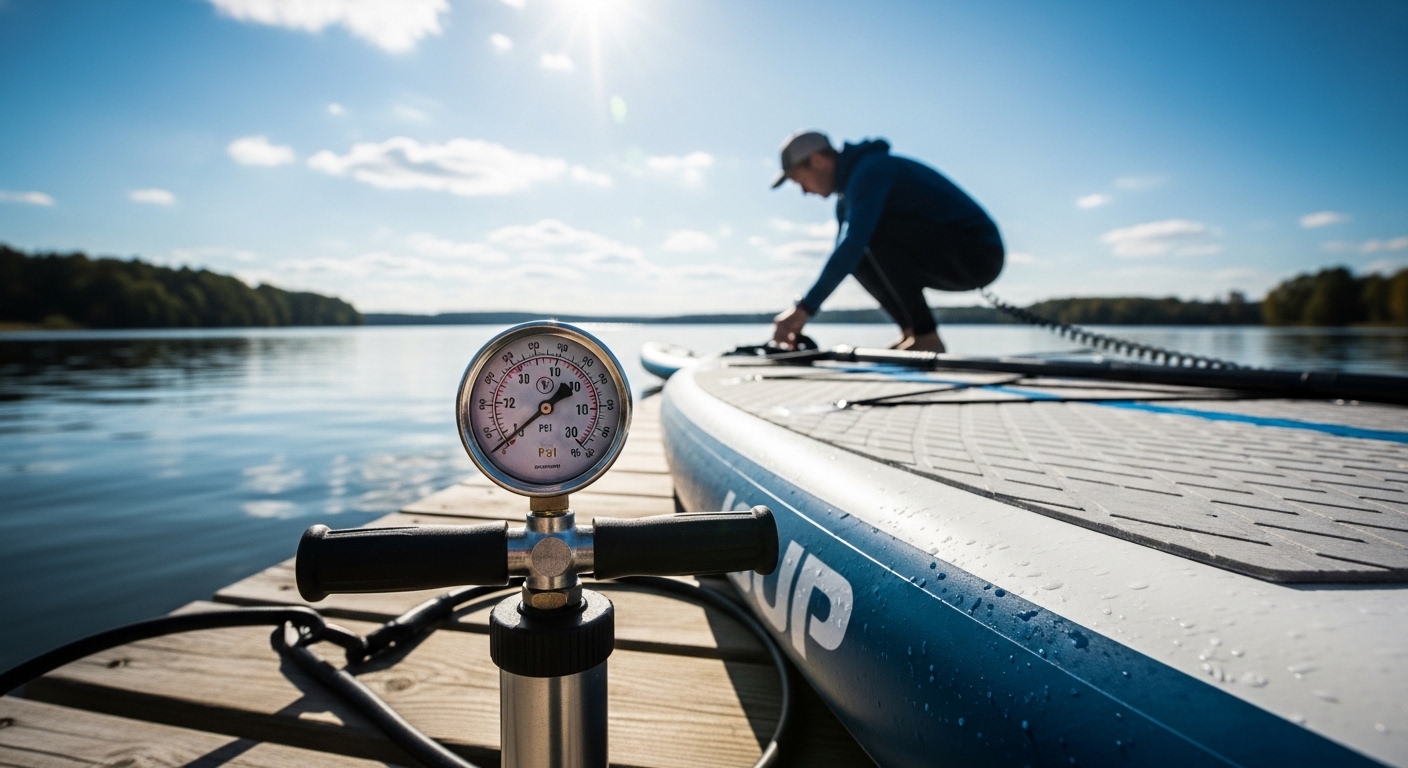
With a standard hand pump, over-inflation is genuinely difficult. By the time you reach 15–18 PSI — the rated range for most quality inflatable SUPs — pumping has become hard work. Your arms give out before the board does. Most paddlers who use a hand pump and follow the gauge stop well within the safe zone, even if they’re pushing hard.
Electric pumps change the equation. A cheap or unregulated electric pump without an auto-shutoff feature can keep pushing air past the rated PSI if you’re not watching the gauge. That’s where mechanical over-inflation becomes a real risk.
The maximum PSI for your specific board is printed on a label near the valve. It might say 15 PSI, 18 PSI, or occasionally higher for specialized touring boards. That number is not a target — it’s a ceiling. Going over it repeatedly stresses the drop-stitch fibers and seams that give the board its rigidity.
For a deeper look at what PSI numbers actually mean and how they affect performance, see our paddle board PSI guide.
The Heat Risk: Why Your Board Can Over-Pressurize Without You Touching It
Here’s the basic physics: for every 10°F rise in temperature, air pressure inside a sealed chamber increases by roughly 2–3%. That sounds small until you do the math. A board inflated to 18 PSI in 70°F air and then left in an 120°F car or on dark pavement in August can easily climb to 20–22 PSI — well past the rated maximum.
Two simple habits prevent this entirely:
- Leave a margin. If the max is 18 PSI, inflate to 15–16 PSI when you know the board will sit in the heat before you paddle.
- Deflate slightly if you’re storing in a hot car, truck bed, or in direct sun for more than 30 minutes.
The board won’t feel different in the water at 15 vs. 18 PSI for recreational paddling. The tradeoff is worth it.
What Happens If You Over-Inflate?
Minor, occasional over-inflation probably won’t destroy your board immediately. But the damage accumulates:
- Seam stress: The glued seams running along the rails take the most strain. Repeated over-inflation causes micro-tears that eventually become leaks — ones that are hard to locate and tedious to patch.
- Drop-stitch fiber fatigue: The thousands of internal threads that keep the board flat under pressure can weaken over time if consistently pushed past rated limits.
- Valve damage: Excessive pressure can distort the valve housing or the Halkey-Roberts valve itself, leading to slow leaks that are frustrating to chase down.
- Sudden blowout: In severe cases — especially combined with heat — a seam can let go suddenly. It’s loud, it’s startling, and it’s expensive. This is rare with quality boards, but it happens.
The board might look and feel fine right after over-inflation. The problem shows up later, often as a mystery leak during a paddle when you’d rather not deal with it.
What Happens If You Under-Inflate?
Under-inflation is actually the more common problem — and it makes the paddling experience noticeably worse.
A board inflated to 8–10 PSI instead of the recommended 15–18 PSI will flex and banana under your weight. This makes it harder to balance, slower to paddle, and more tiring to ride. Heavier paddlers will feel it more acutely — the board dips in the middle, the nose and tail kick up, and every stroke is working against the flex.
Under-inflation also puts stress on the board in a different way: the drop-stitch fibers sag, and the board’s shape distorts under load rather than staying rigid. Long-term, that’s not great either.
The fix is simple: use a gauge every time. Don’t guess by squeezing the board — it feels firm well before it’s actually at proper pressure.
How to Inflate Your Board Correctly
Getting the inflation right takes about 10 minutes with a hand pump and costs nothing to do correctly:
- Check the label near the valve for your board’s rated PSI range and maximum. Write it down somewhere easy to reference.
- Use a pump with a pressure gauge. Most hand pumps include one. If yours doesn’t, buy a separate inline gauge — they’re inexpensive and non-negotiable.
- Pump to the lower end of the rated range first (typically 13–15 PSI), then reassess. For most recreational paddling, 15 PSI is enough. Push toward the max only for high-performance or touring use.
- Account for conditions. Hot day with the board sitting in the sun before launch? Stop 2–3 PSI below maximum.
- With an electric pump: Set the target PSI and use a model with an auto-shutoff. Good electric pumps stop automatically at your set pressure. If your pump doesn’t have that feature, watch the gauge manually and don’t walk away from it.
Electric pump auto-shutoff is one of the features worth paying for. Set it to 15 PSI, walk away, come back to a properly inflated board — no guesswork, no over-shoot.
If you’re shopping for your first inflatable or comparing options, our best inflatable paddle boards roundup covers boards with high-quality valves and construction that holds up to real use.
Cold Weather and Pressure: The Other Side of the Coin
Just as heat raises pressure, cold drops it. If you inflate your board in a warm garage at 17 PSI and then carry it out to a 30°F lake, the pressure can drop to 14–15 PSI by the time you get to the water.
This isn’t dangerous, but it means you might need to top off after you’ve been outside for a few minutes. Inflate to your target pressure in the same environment where you’ll be paddling, or plan to do a quick top-up once the board has adjusted to the ambient temperature.
Competitive paddlers and touring paddlers who care about maximum rigidity often carry a small hand pump for this reason — just a few strokes to bring the pressure back up after the board cools down.
It’s also worth noting that inflatable SUPs behave differently from hard boards in cold conditions. If you’re still deciding which type is right for your paddling, our inflatable vs hard breakdown covers the tradeoffs honestly.