
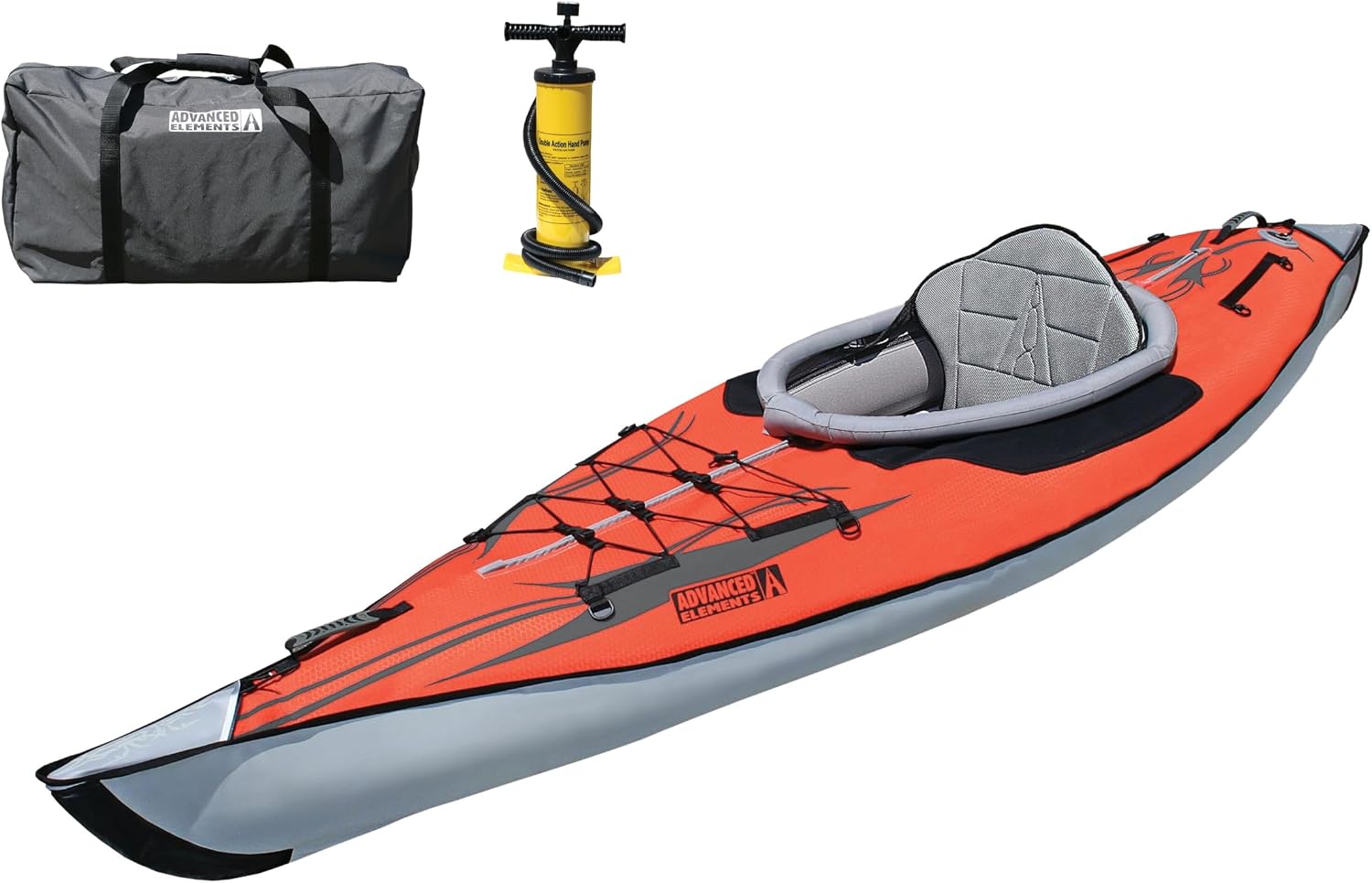
Advanced Elements AdvancedFrame Review
The AdvancedFrame earns its premium price by doing something most inflatables can't — it actually tracks. The aluminum rib frame in the bow and stern gives it a defined hull shape that puts it in a class of its own for recreational paddlers who want the convenience of an inflatable without the sloppy handling.
We’ve paddled a lot of inflatables. Most of them feel like what they are — air-filled tubes that go roughly in the direction you point them. The Advanced Elements AdvancedFrame is different, and the difference is obvious within the first 50 yards on the water. There’s a rigidity to the hull, a sense that this kayak is actually going somewhere when you take a stroke.
That’s not an accident. Advanced Elements built an aluminum rib frame into the bow and stern sections, which gives the AdvancedFrame a defined hull shape you don’t get from a standard drop-stitch or air-beam design. At 10’5″ and a ~300 lb load capacity, it sits squarely in the best recreational kayak category — good for day trips on calm lakes, slow rivers, and coastal bays. It’s the pick for paddlers who want one boat they can stuff in a closet, throw in a trunk, or check as luggage.
Street price hovers around $550. That’s real money for an inflatable. Here’s what you actually get for it.
Advanced Elements AdvancedFrame specs
| Capacity | 1-person |
| Length | 10′ 5″ |
| Max load | ~300 lb |
| Hull | Aluminum-rib + PVC |
| Folds to | Backpack-size duffel |
| Best for | Performance inflatable touring |
On the water — does it track?
Yes, and that’s the whole story with the AdvancedFrame. If you’ve paddled a cheap inflatable and spent your entire trip correcting course, the AdvancedFrame is a revelation. The aluminum ribs in the bow and stern maintain a true hull profile, so the boat cuts through the water rather than pushing it. You’re not going to mistake it for a composite touring kayak, but compared to every other inflatable in this price range, it handles like a different category of boat.
On flat water — a calm lake, a sheltered bay, an easy river section — it performs confidently. Straight-line tracking is genuinely good. Side-to-side stability is solid enough that beginners won’t feel wobbly, but it’s not a barge; you can edge it slightly for maneuvering. We found it comfortable for two- to three-hour paddles without fatigue.
Where it shows its limits is in conditions. Headwinds expose the taller, rounder profile that all inflatables share. It’s not as efficient as a dedicated touring kayak, and you’ll feel the difference on long crossings or in choppy open water. But for the recreational day-tripper, it more than holds its own. According to the U.S. Coast Guard’s boating safety guidelines, a properly fitted PFD and float plan are essential regardless of kayak type — something to keep in mind before any open-water session.
Build quality and durability
The AdvancedFrame uses a 3-layer puncture-resistant material — a polyester fabric exterior, a welded PVC inner bladder, and reinforcing layers at stress points. In practical terms, this means it can take the kind of abuse a recreational paddler dishes out: scraping over gravel launches, bumping into dock pilings, the occasional rock strike in shallow water.
We’ve used the AdvancedFrame on rocky New England rivers and never had a puncture. That said, it’s not bulletproof — dragging it over sharp barnacle-covered rocks or submerged rebar would stress any inflatable. The materials feel noticeably more substantial than bargain-tier inflatables, and the welded seams show a quality of construction that matches the price point.
The integrated seat is comfortable with back support, and the foot braces are adjustable — details that matter on longer paddles. The D-rings and grab handles are well-placed and feel sturdy. Overall, this is a kayak built to last years with reasonable care, not something you’ll be patching after a season.
Setup, packing, and portability
Advanced Elements claims a 7-minute inflation time, and in our testing that’s realistic if you’re using a quality pump. The included duffel bag is genuinely usable — not the afterthought bag some brands toss in. Packed down, the AdvancedFrame fits in a car trunk, a train’s overhead storage bay, or checked luggage. For apartment dwellers or people without garage storage, this matters.
Here’s the honest caveat: at ~36 lb, this is on the heavy end for an inflatable kayak. You’re not going to sling it over your shoulder for a mile-long portage without noticing. The duffel has shoulder straps, and it’s manageable, but if your use case involves serious portaging, that weight is worth thinking about. Lighter inflatables exist — they just don’t track as well.
Setup involves unfolding the hull, inserting the aluminum bow and stern frames, inflating the tubes, and seating yourself. It takes a few sessions to get the frame insertion smooth, but most paddlers figure it out quickly. Packing down takes slightly longer than inflation — deflating, folding, and coaxing everything back into the duffel is a 10 to 15 minute process. Not a problem for a day trip. Slightly tedious if you’re doing it every single time. If you’re comparing options and wondering what size kayak you need, the 10’5″ length is versatile enough for most recreational uses.
Who it's for — and who should skip it
The AdvancedFrame is built for the paddler who wants a real kayaking experience but genuinely can’t deal with storing or transporting a hardshell. If you live in an apartment, share a car, travel with your gear, or rent a vacation cabin and want a kayak waiting in the trunk — this is your boat. It’s also excellent for someone doing occasional day trips on calm water who doesn’t want to invest in a roof rack system.
Beginners will appreciate the stability and predictability. More experienced paddlers will appreciate that it doesn’t embarrass them. At 300 lb capacity, it accommodates most adult paddlers with gear.
Who should skip it: if you’re doing multi-day expeditions, paddling in serious open-water conditions, or racing, look at a hardshell touring kayak instead. If budget is the primary concern, cheaper inflatables exist — the tradeoff is handling quality. And if you’re comparing recreational inflatables side by side, our best inflatable kayak roundup breaks down the full field at every price point.
One non-negotiable: a paddle is not included. Factor in another $80 to $150 for a quality recreational paddle. It’s a frustrating omission at $550, but it’s standard practice in this segment — worth knowing before you hit checkout.
What we liked
- Tracks far better than any comparable inflatable — aluminum rib frame creates a real hull shape
- 3-layer puncture-resistant construction holds up to normal recreational use
- Folds into an included duffel bag — true apartment, car-trunk, and airline portability
- Comfortable padded seat with back support for multi-hour sessions
- 7-minute inflation time is realistic, not marketing fiction
- 300 lb capacity handles most adult paddlers with day-trip gear
The catches
- ~$550 is a real investment — you're paying a premium for the tracking advantage over cheaper inflatables
- At ~36 lb, it's one of the heavier inflatables at this size; portaging any distance is noticeable
- Paddle not included — add $80–150 to the total cost
- Slower and less efficient than a comparable-length hardshell touring kayak in challenging conditions