What Muscles Does Paddle Boarding Work?
Every stroke on a stand-up paddle board fires more muscles than most people expect. Here's the honest breakdown.
Calories burnedPeople ask whether paddle boarding is “really” a workout. The short answer: yes, and probably in more places than you’d guess. A single SUP session calls on your core, shoulders, back, arms, legs, and even the small stabilizing muscles in your feet. It’s not a replacement for weightlifting, but for a low-impact activity you can do on a lake at sunrise, the muscle recruitment is genuinely impressive. This guide breaks it all down by muscle group, explains how different SUP styles shift the emphasis, and covers why that matters if you’re using paddle boarding for fitness.
Core: The Engine Behind Every Stroke
If there’s one muscle group that defines paddle boarding, it’s the core — and not in the vague “engage your core” way that fitness influencers toss around. On a paddle board, your core is working constantly. The moment you stand up, your abs, obliques, transverse abdominis, and lower back muscles are all firing just to keep you upright on an unstable surface. That’s before you even take a stroke.
Each paddle pull requires you to rotate at the torso, which drives your obliques and rectus abdominis hard. Reach forward, pull through, switch sides — that rotational pattern is essentially a standing plank with resistance, repeated hundreds of times per session. Paddlers who come from gym backgrounds are often surprised how sore their obliques are the next morning.
This is also why paddle boarding pairs well with fitness goals beyond the sport itself. Strengthening the deep core carries over to posture, lower back health, and almost every other athletic activity. Harvard Health notes that a strong core is foundational to nearly all movement, not just sport-specific ones.
Shoulders and Upper Back: The Stroke Drivers
Your deltoids — front, side, and rear — are primary movers in the paddle stroke. The front deltoid drives the reach phase, while the rear deltoid and rotator cuff muscles stabilize throughout. Do this for 45 minutes and your shoulders will know about it.
Behind the deltoids, the trapezius and rhomboids (the muscles between your shoulder blades) work to retract and stabilize the shoulder girdle with each pull. Weak upper-back muscles are one of the most common desk-job complaints, and paddle boarding addresses them directly. You’re essentially doing rows — one arm at a time, standing, on the water.
The lats (latissimus dorsi) are arguably the biggest power contributors in the pull phase of the stroke. Think of the lat pulldown machine at the gym: the motion is almost identical, except here you’re pulling a blade through water while balancing on a moving surface. Experienced paddlers often develop noticeably broader backs over a season of consistent paddling.
Arms: Biceps, Triceps, and Forearms
Arms get worked, but they’re not the prime movers — and that’s actually a good thing. In proper paddle technique, the big muscle groups (core, lats, shoulders) do the heavy lifting while the arms act more as transmitters of force. If you’re paddling correctly and learning how to paddleboard with good form, your arms shouldn’t fatigue as fast as your core and back.
That said, the biceps assist during the pull phase and the triceps push the paddle back toward the tail. Forearm flexors and extensors work constantly to grip and control the paddle shaft, especially in chop or current. After a long session, forearm fatigue is real — it’s similar to what climbers describe as “pump.”
For beginners, arms tend to dominate early because the core and back aren’t yet conditioned to take over. As technique improves, the workload shifts to the bigger, more efficient muscle groups and arm fatigue drops off significantly.
Legs and Glutes: The Unsung Workers
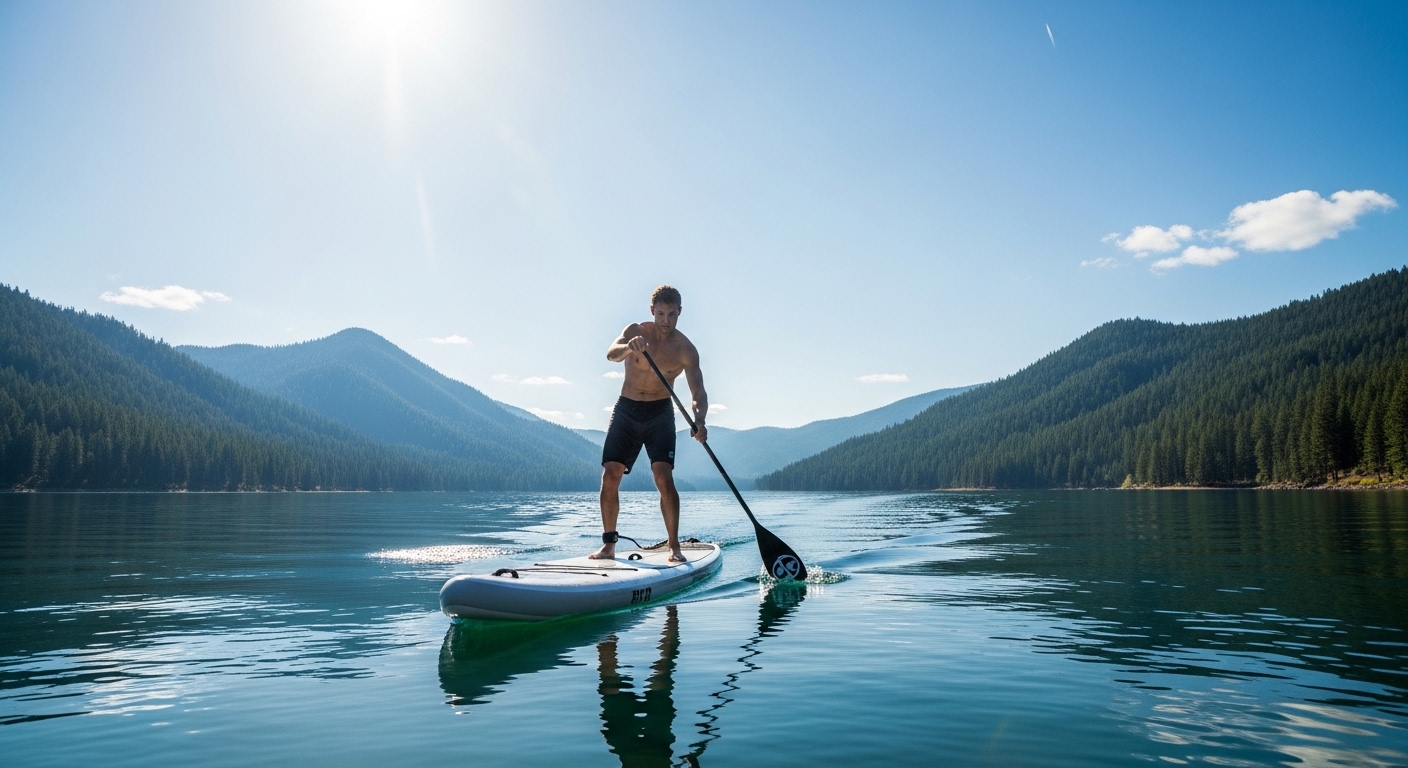
Most people don’t think of paddle boarding as a leg workout. They’re wrong. Your legs are never truly at rest on a board. The quads, hamstrings, and glutes are in a constant low-level contraction to hold a slight athletic stance — knees soft, hips over feet. That’s a sustained isometric load that adds up over an hour on the water.
When conditions get choppy or you’re paddling in moving water, the leg demand spikes. You’ll find yourself bending deeper into your knees to absorb waves, shifting weight laterally, and making constant micro-adjustments to stay centered. Glutes engage hard during these stability corrections. Your inner thighs (adductors) work to prevent your feet from drifting apart on a wide board.
SUP yoga takes this even further. Holding warrior poses or downward dog on a floating, moving surface demands far more from the legs and glutes than the same poses on a mat. If you’re curious about board options for that style, check out our guide to the best yoga paddle boards — stability and deck pad coverage matter a lot.
Feet, Ankles, and Proprioception
This is the muscle group nobody mentions in fitness articles, but it’s real. The small intrinsic muscles of your feet — the ones that keep your toes spread and your arch engaged — fire continuously on a paddle board. So do the muscles around your ankle (peroneals, tibialis posterior) that prevent rolls and adjust to the board’s tilt.
Proprioception is the body’s ability to sense where it is in space. Paddle boarding is essentially proprioception training disguised as recreation. The unstable surface forces your nervous system to process balance information and make corrections in real time, building the kind of functional stability that’s hard to replicate on flat ground.
This has real-world carryover. Surfers, skiers, and trail runners often use SUP in off-season training specifically because of the balance and ankle stability benefits. Physical therapists use balance boards for similar reasons — a paddle board is a larger, more dynamic version of the same tool.
How SUP Style Shifts the Muscle Emphasis
Not all paddle boarding is the same workout. The muscles you tax most depend heavily on what style you’re doing.
- Casual cruising: Lower intensity overall. Core and shoulders still active, but you’re not driving hard strokes. Good for active recovery or beginners building time on the water.
- Touring / distance paddling: High lat and shoulder demand, sustained core engagement, significant forearm and grip endurance. The closer this gets to a race pace, the more it resembles a cardio rowing workout. If you want to know how the calorie burn scales up with effort, read our breakdown of calories burned paddle boarding.
- SUP racing: Sprint intervals and sustained high-output paddling recruit fast-twitch muscle fibers in the lats, deltoids, and core. Elite racers have backs and shoulders that reflect the training load.
- SUP yoga: Shifts emphasis dramatically toward legs, glutes, and stabilizing muscles. Upper body demand drops; balance and proprioception demand spikes. The core is engaged differently — more in anti-rotation and postural control than in power generation.
- Surfing SUP (SUP surfing): Explosive, reactive. Requires quick hip and knee flexion for pumping waves, rotational core power for turning, and strong ankle stability for rail-to-rail transitions.