
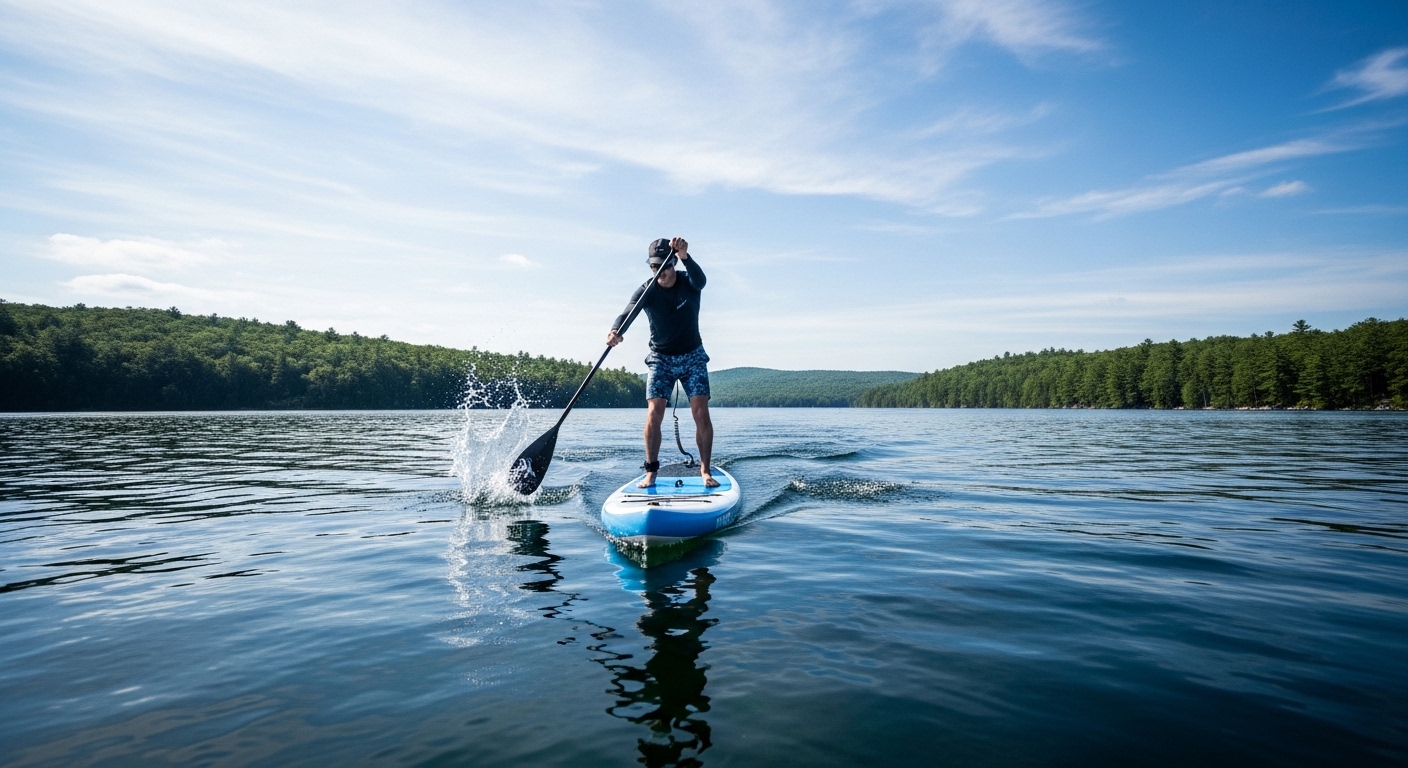
How Many Calories Does Paddle Boarding Burn?
The honest calorie breakdown for every style of SUP — backed by MET values, not marketing.
Estimate my burnPaddle boarding burns roughly 300 to 450 calories per hour at a casual pace on flat water, climbing to 450–700+ for fitness touring and hitting 700–1,000+ during racing or surf SUP. Your actual number depends on your body weight, effort level, and what the water throws at you.
Paddle Boarding Calorie Calculator
Estimate the calories you’ll burn from your weight, time on the water and how hard you paddle.
Calculate calories burned
Calorie Ranges by SUP Activity Level
Not all paddle boarding is the same workout. A relaxed float with your dog and a hard-charging downwind run are completely different metabolic events. Here’s a practical breakdown by activity style:
| Activity Style | Approx. Calories/Hour* | MET Range |
|---|---|---|
| Casual flat-water paddling | 300–450 | 3.0–5.0 |
| Fitness / touring pace | 450–700 | 5.0–7.0 |
| SUP racing / interval training | 700–1,000+ | 7.0–8.5+ |
| SUP surfing | 650–950 | 6.5–8.0 |
| SUP yoga | 400–500 | 3.5–4.5 |
*Estimates based on a 155 lb (70 kg) paddler. Heavier paddlers burn more; lighter paddlers burn less.
The MET Formula: How to Calculate Your Own Number
Sports scientists measure exercise intensity using METs — Metabolic Equivalents of Task. One MET equals the energy your body uses at rest. An activity rated at 6 METs burns six times that baseline.
The calculation is straightforward:
Calories = MET × body weight in kg × hours paddling
Working example for a 180 lb (82 kg) paddler doing 90 minutes of fitness-pace SUP at a MET of 6:
- Convert weight: 82 kg
- Convert time: 1.5 hours
- Calories = 6 × 82 × 1.5 = 738 calories
The MET values used here are drawn from the Compendium of Physical Activities, the peer-reviewed reference database exercise physiologists use worldwide. The on-page calculator on this site uses this same formula — plug in your weight and time to get a personalized result.
What Actually Controls How Many Calories You Burn
Paddle board calories burned are not fixed — several variables can push your number up or down by 30% or more in the same session.
Body Weight
It takes more energy to move more mass through the water. A 200 lb paddler at casual pace will burn closer to 500 cal/hr; a 130 lb paddler doing the same thing might hit 330. Weight is the single biggest multiplier in the formula.
Paddling Intensity
Stroke rate and power output matter more than most people expect. Bumping from a leisurely 20 strokes per minute to a steady fitness tempo of 30–35 strokes at full reach can nearly double your energy output. Interval-style paddling — hard sprints followed by recovery — is especially effective at spiking calorie burn.
Water Conditions and Wind
Paddling into a 15 mph headwind on choppy water is a fundamentally different workout than gliding across a glass-flat lake at sunrise. Resistance from chop forces constant micro-corrections; wind resistance adds aerobic load. Rough conditions can push a casual outing into fitness-intensity territory without you even noticing.
Board Type and Size
A long, narrow race board cuts through water efficiently — meaning less energy wasted, but also less stabilization work. A wider all-around board or an inflatable with more flex demands more constant balance engagement. Choosing the right equipment for your goals matters; see the paddle board size chart for guidance on how dimensions affect performance and effort.
Standing vs. Kneeling
Standing engages your core, glutes, and stabilizer muscles continuously. Kneeling lowers the center of gravity and reduces that postural demand — which also reduces calorie burn by roughly 10–15%. Most of the calorie estimates in this article assume standing paddling.
Which Muscles Does SUP Work — and Why That Matters for Burn Rate
Stand-up paddleboarding is genuinely full-body exercise, which is a large part of why paddle board calorie burn competes favorably with activities that look more intense.
- Core: Every stroke rotates through your obliques and engages your transverse abdominis for spinal stability. Balance on a moving board keeps these muscles firing between strokes, too.
- Shoulders and upper back: The catch and pull phases of each stroke load the deltoids, rotator cuff, trapezius, and rhomboids. On a long touring session these muscles accumulate significant volume.
- Lats and triceps: The power phase of a proper SUP stroke is lat-dominant, with the tricep finishing the push-down past the hip.
- Legs and glutes: Quiet-looking from the shore, but your quads, hamstrings, and glutes are continuously contracting to maintain balance — especially on choppy water.
Because so many large muscle groups are working simultaneously, your cardiovascular system has to supply oxygen to all of them at once. That’s what drives the calorie expenditure up — and why learning proper technique (covered in detail in our how to paddleboard guide) helps you paddle longer and burn more over a full session.
How SUP Compares to Other Popular Activities
Context helps. Here’s how fitness-pace SUP stacks up against other common workouts for a 155 lb (70 kg) person over one hour:
- Casual SUP (flat water): 300–450 cal — similar to a brisk walk
- Fitness SUP: 450–700 cal — comparable to recreational cycling or light jogging
- SUP racing / surf SUP: 700–1,000+ cal — on par with running at a moderate pace or vigorous cycling
- Kayaking (recreational): ~300–400 cal
- Casual cycling: ~300–400 cal
- Running at 5 mph: ~580 cal
- Swimming (moderate): ~500–600 cal
The key difference: SUP is low-impact. There’s no repeated joint loading from heel strikes, no impact shock through the knees. For people managing joint issues or recovering from lower-body injuries, SUP sits in a sweet spot — meaningful calorie burn with minimal skeletal stress.
SUP yoga deserves a separate mention. The instability of the board forces deeper engagement of stabilizer muscles during every pose, which is why calorie burn is higher than land yoga (typically 200–300 cal/hr). If you want to explore that route, our guide to the best yoga paddle boards covers what to look for in a stable, yoga-friendly platform.
Tips to Burn More Calories on Your Next Paddle
If maximizing calorie burn is a goal, these tactics work — tested on the water, not invented in a content factory:
- Add intervals. Sprint hard for 2 minutes, paddle easy for 90 seconds, repeat. This drives heart rate into Zone 4–5 and significantly raises post-exercise oxygen consumption.
- Paddle against the wind on the outbound leg. The hardest work happens when you’re freshest. Turn downwind for the return leg and let the conditions give you a partial rest.
- Extend your reach. A longer stroke that fully extends the top arm and plants the paddle well ahead of the feet engages more muscle mass per stroke. Sloppy short strokes are both less efficient and burn fewer calories.
- Use a heavier paddle in training. Carbon paddles are wonderful for race day, but an aluminum or fiberglass paddle adds resistance that builds strength and increases energy expenditure in practice sessions.
- Choose choppier water deliberately. Flat glass is fun, but mild chop forces constant balance correction that quietly adds hundreds of calories to an otherwise moderate session.
- Try SUP racing or downwind runs. Even recreational downwind paddling requires sustained power output. It’s the fastest route to genuine cardiovascular conditioning on the water.
Whatever board you’re on, the best paddle boards for fitness work tend to be narrower and longer than all-around boards — more glide per stroke means you can sustain higher speeds and higher heart rates without burning out prematurely. See our best paddle boards roundup for options across every category.
Why SUP Is Worth It Even at the Lower End of the Calorie Range
Three hundred calories an hour is not a jaw-dropping number on paper. But SUP delivers that burn with a set of secondary benefits that most gym cardio machines can’t match:
- Time passes quickly. Being on the water with scenery changing around you is categorically different from staring at a gym wall. People who struggle to sustain 30 minutes on a treadmill routinely paddle for two hours without noticing.
- Mental health benefits are well-documented. Time near or on water reduces cortisol and subjective stress — a benefit that supports consistent exercise habits over the long term, according to research reviewed by Harvard Health.
- It’s genuinely full-body. Few cardio activities simultaneously develop shoulder endurance, core stability, leg balance, and cardiovascular fitness in the same session.
- The barrier is low. No gym membership, no traffic, no waiting for equipment. Inflate your board, walk to the water, and you’re working out.
If you’re new to the sport and figuring out what gear you actually need before committing to a session, the how to paddleboard beginner guide covers everything from launching safely to basic stroke mechanics — the foundation that makes longer, higher-burn sessions possible.