
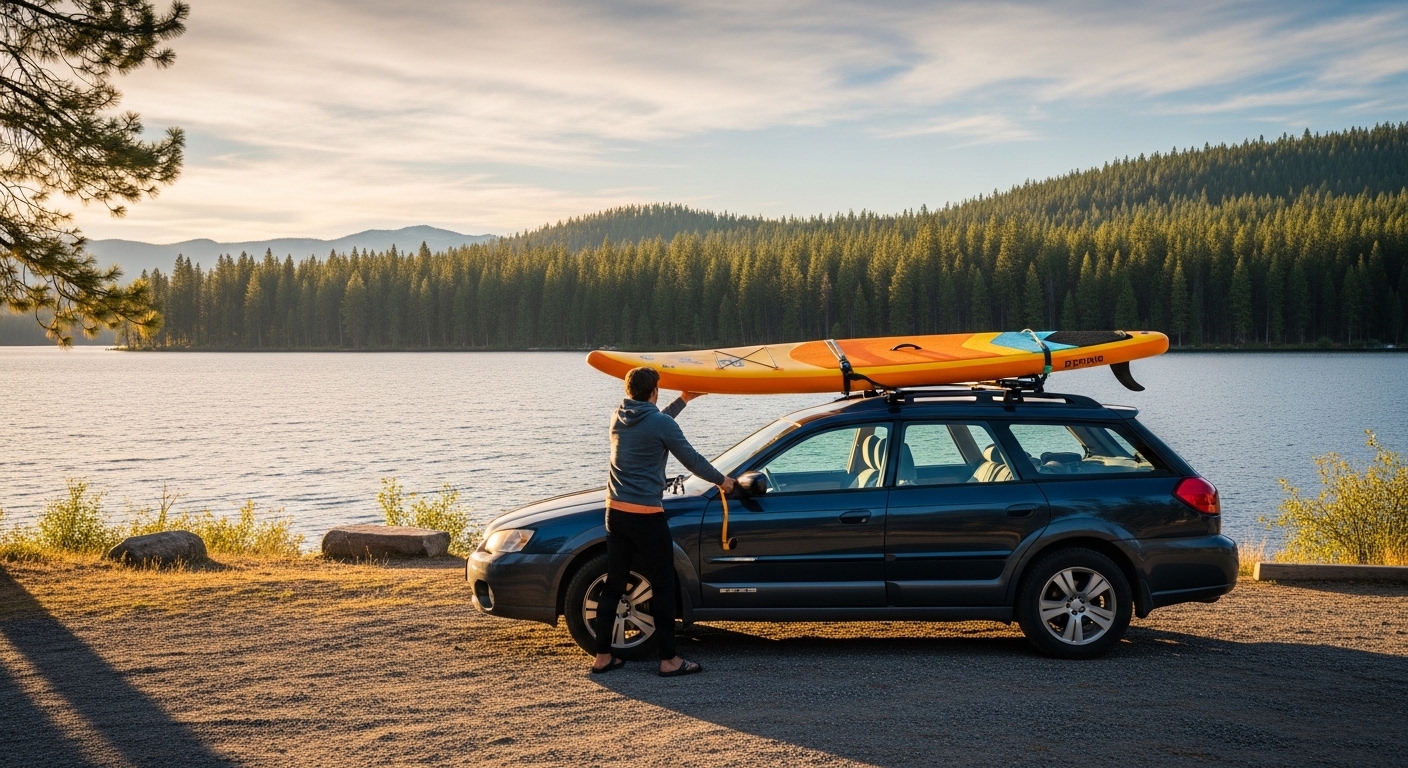
How to Transport & Store a Paddle Board
Getting your board to the water and back without damage takes a little know-how — here's exactly what to do.
Best inflatables (easy transport)Whether you’re strapping a hard board to the roof or stuffing an inflatable into a backpack, how you move and store your board has a direct impact on how long it lasts. A few simple habits will keep it dent-free, fade-free, and ready to paddle for years.
Transporting an Inflatable Paddle Board
If you own one of the best inflatable paddle boards, you already have the biggest transport advantage in the sport: when deflated and rolled up, most inflatables pack down into a backpack-sized bag that fits in any trunk, overhead bin, or backseat. No roof rack required. No worrying about low-clearance parking garages. You can fly with it as checked baggage or even carry it on if the bag stays under airline size limits.
That said, a few details matter when you’re packing one up:
- Deflate fully before rolling. Leave any air in the board and the roll will be lumpy, stiff, and harder on the seams.
- Roll from the nose toward the fins so the fin box ends up on the outside where it has a little give. Avoid folding sharply at the mid-point.
- Don’t cram it in wet. Rolling a damp board traps moisture inside the bag and against the seams. Rinse, shake off the water, and let it air briefly before packing.
- Use the backpack straps properly. Most quality inflatable bags have padded shoulder straps and a waist belt — use them. A misbalanced pack on one shoulder will wreck you on a long beach walk.
Transporting a Hard Paddle Board by Car
Hard boards require a roof rack or truck bed — there’s no getting around it. The question is which rack setup is right for your vehicle and how to strap the board down without damaging it. Check out our notes on inflatable vs hard paddle boards if you’re still deciding which type fits your lifestyle.
Soft Racks vs. Crossbar Racks
Soft racks (foam pads with straps that loop through the car doors) are inexpensive, work on nearly any vehicle, and are fine for short, low-speed trips. They’re not ideal for highway speeds or long hauls — they can shift, and the door seal wear adds up. Use them as a backup option, not a primary system.
Crossbar racks (Yakima, Thule, or factory rails with aftermarket crossbars) are the proper solution for regular use. Add padded cradles or a simple foam bar pad and you have a solid, stable platform that won’t move at 70 mph. This is what we use for anything over 30 miles.
How to Strap the Board Down
- Nose forward or fin-forward: Place the board fin-up (deck down) or fin-forward, nose pointing toward the front of the car. Either orientation reduces wind lift. Fin-up-forward keeps the fin from acting as a sail.
- Two cam buckle straps, one per crossbar: Run each strap over the board, under the crossbar, and back up — cam buckle on top. Tighten until firm, not bone-tight. Overtightening is one of the most common ways to dent a foam deck.
- Bow and stern lines are not optional on the highway: Tie a line from the nose to your front tow hook (or bumper loop) and from the tail to the rear. These prevent the board from lifting or sliding forward if a strap slips.
- Never place the board on bare metal crossbars. Always use foam pads or cradles. Bare metal will scratch the hull and create pressure points that can cause stress cracks over time.
Transporting a Paddle Board in a Truck Bed
A truck bed is a convenient option as long as you handle it right. Lay the board deck-side up on foam padding or a moving blanket — never directly on bare metal bed liner, which scuffs the hull. If the board overhangs the tailgate, tie a red flag to the tail and use a stern line to prevent it from sliding out on braking. Two straps across the width of the board, anchored to the bed tie-down points, are the minimum — add a third if the board is longer than 11 feet.
Keep in mind that truck beds bounce and vibrate differently than a solid roof rack. Check that fins are protected and that the nose isn’t resting on the cab’s rear window edge, which concentrates pressure on a narrow point.
Carrying Your Board to the Water
Once you’re parked, you still have to get the board from the car to the launch. Most hard boards have a center carry handle — use it. Keep the board vertical (on edge) if possible rather than flat; vertical is easier to manage in wind and less likely to catch a gust and slam you sideways.
For longer carries, the shoulder carry is the move: board balanced across one shoulder, hand through the center handle, board angled slightly so the nose rides up and the tail doesn’t drag. Switch shoulders every few minutes to avoid strain.
Invest in a good board bag if you’re carrying across rocks or gravel regularly — the right paddle board accessories make every part of ownership easier, and a padded bag pays for itself after one trip across a rocky shoreline.
Storing an Inflatable Paddle Board
Inflatables are forgiving to store, but a few rules apply if you want the seams and material to last.
- Clean and dry it first — every time. Salt, sand, and grit left on the board will work into the seams and valve threads. Rinse with fresh water, dry thoroughly before storing. Moisture trapped inside a rolled bag is the number one cause of mold and seam degradation.
- Roll loosely or store lightly inflated. A tight roll stresses the PVC along the fold lines. If you have garage or closet space, storing the board lightly inflated (3–5 PSI) and laid flat is actually gentler on the material than a compressed roll.
- Keep it out of direct sun and high heat. UV degrades PVC and bleaches the graphics; prolonged heat can stress the glued seams. A shaded garage, closet, or board bag works well.
- Watch for rodents. This sounds odd, but mice and squirrels will chew through PVC board bags and the boards themselves if they smell the residual salt. Elevate the board off a garage floor and check it periodically in winter.
Storing a Hard Paddle Board
Hard boards need a bit more space and a bit more care, but proper storage keeps them performing like new indefinitely.
- Use a wall rack or padded sling. Store the board on its edge or suspended deck-down in padded straps. Both orientations distribute weight evenly. Never lean it fin-first against a wall — the fin will snap or the board will eventually fall.
- Never flat on the ground long-term. A board resting on a flat concrete floor collects moisture underneath, puts point pressure on the hull at every pebble or floor imperfection, and is an easy target for being stepped on or having something dropped on it.
- Sun and UV are the enemy. Epoxy and fiberglass degrade with prolonged UV exposure — the resin yellows and becomes brittle, delamination accelerates. UV degradation of polymer materials is well-documented; keep hard boards in a garage, shed, or board bag outdoors. Even a simple tarp helps.
- Never store in a hot car or enclosed trailer in summer. Interior car temps can exceed 140°F on a sunny day. That level of heat can warp a hard board’s nose or tail rocker, bubble the deck pad, and cause delamination — damage that’s expensive or impossible to reverse.
Browse our paddleboard guides for rack recommendations and storage accessory picks that work with both board types.
The Heat Warning Every Paddler Should Know
Heat is the overlooked threat to both inflatable and hard boards. For inflatables, a board left fully inflated in a hot car or direct summer sun can over-pressurize beyond its rated PSI as air expands — some boards have burst valves, others don’t. Either deflate slightly before storing in a hot car, or better yet, don’t leave an inflated board in a parked vehicle.
For hard boards, the foam core and resin system are sensitive to sustained high temperatures. A board baking on a car roof in a parking lot (even with straps on) is experiencing prolonged UV and heat stress simultaneously. When you arrive somewhere and can’t immediately get to the water, prop the board in shade or cover it with a light towel or board sock.
The same principle applies to storage sheds with metal roofs — these can act like ovens in summer. If your shed has no insulation, a hard board is better off in the garage or under a shaded overhang than inside a south-facing metal shed in July.
Frequently Asked Questions
Can I transport a paddle board without a roof rack?
If you have an inflatable, absolutely — it packs into a backpack-sized bag that fits in any trunk or backseat. For hard boards, soft foam racks that strap through your car doors work for short, low-speed trips, but a proper crossbar rack system is safer for highway driving. Never transport a hard board resting on bare metal.
How do I tie down a paddle board on a roof rack?
Use two cam buckle straps (one per crossbar), run them over the board and under each bar, and tighten firmly — not so tight that you dent the deck pad. Add bow and stern tie-down lines for any highway driving. Place the board nose-forward or fin-forward, deck-side down, on padded bars or cradles.
Is it okay to leave an inflatable paddle board rolled up for months?
Yes, but roll it loosely and make sure it’s completely dry first. Moisture trapped in a tight roll can cause mold and seam damage over time. If you have the space, storing it lightly inflated and laid flat is actually easier on the material than a compressed roll.
Can extreme heat damage a paddle board?
Yes — both types. Hard boards can warp and delaminate in sustained high heat (think 130°F+ inside a parked car). Inflatables can over-pressurize if left fully inflated in a hot vehicle or direct sun, potentially stressing seams. Never leave either type in a sealed, parked car in summer.
How should I store a hard paddle board in a garage?
Use a wall-mounted rack or padded ceiling slings and store the board on its edge or suspended deck-down. Keep it off the ground, away from direct sunlight through garage windows, and away from anything that could fall on it. Check for dings before long-term storage and seal them with a ding repair kit before putting it away.
Can I fly with a paddle board?
Yes, if it’s an inflatable. Deflated and rolled, most best inflatable paddle boards pack into a bag that qualifies as checked sports equipment on most airlines. Check your airline’s size and weight limits before booking. Hard boards are generally too large to fly with as standard checked baggage and require freight shipping.