
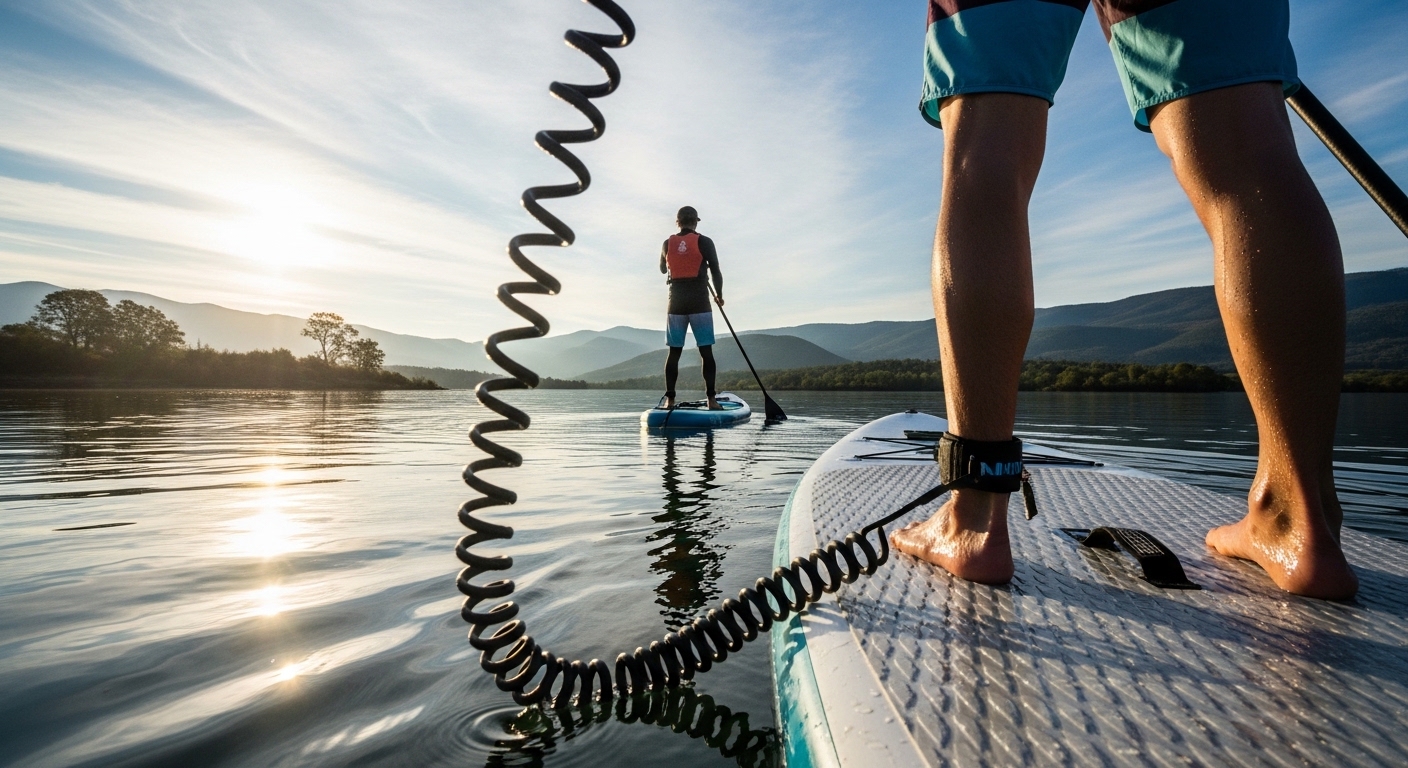
Coiled vs Quick-Release SUP Leash
The right leash keeps you connected to your board. The wrong leash in the wrong water can kill you. Here is exactly what to use and when.
Shop leashes & gearA paddle board leash is the cheapest piece of safety gear you own, and most paddlers never think twice about it — until something goes wrong. Knowing the difference between a coiled leash, a straight leash, and a quick-release waist belt is not just gear trivia. On moving water, it is life-or-death information. This guide breaks down every leash type, the conditions each one belongs in, and the one hard rule you must follow before paddling any river or tidal current.
The Three Main SUP Leash Types
Walk into any paddle shop and you will see three categories of SUP leash. Each is designed for a specific environment, and none of them are truly interchangeable.
- Coiled leash — A coiled cord (like a phone cable) that extends when it needs to and springs back when it does not. Usually attaches at the ankle or calf. Common lengths are 9–11 feet coiled, extending to roughly 15–20 feet under tension.
- Straight (uncoiled) leash — A flat, continuous cord the same length end-to-end. Standard for surfing. Stays taut in the water beside you and does not retract.
- Quick-release waist belt leash — A hip-worn leash system with a breakaway or pull-tab release mechanism. The leash attaches to the back of the waist belt, not your leg. This is the only acceptable leash for moving water.
There is also a fourth option — no leash at all — which is the wrong choice in almost every paddling scenario. More on that below.
Coiled Leash: Best for Flat Water, Touring, and SUP Yoga
The coiled leash is the default recommendation for most recreational paddlers. Here is why it works so well on flat, calm water.
Because the cord recoils when slack, it sits on top of your deck rather than dragging behind you in the water. That means less drag, less resistance, and no cord wrapping around your fin or your paddle shaft during a stroke. On a calm lake, a bay, or a fitness paddle session, you will barely notice it is there.
Coiled leashes are especially popular for:
- Lake and flat-water SUP
- Touring and long-distance paddling
- SUP yoga and fitness
- Racing (where drag matters)
- Paddling in light chop
The tradeoff is recoil tension. In surf, a coiled leash snapping back toward you after a wipeout is genuinely dangerous — it can smack your board back into your face at speed. That is why surfers do not use them. But in flat water, that scenario never happens, so the coiled format is a clean win.
Look for a coiled leash matched to your board length — roughly the same length as the board, coiled. A 10-foot board pairs well with a 10-foot coiled leash.
Straight Leash: Built for Surf
A straight, uncoiled leash is the standard for SUP surfing. When a wave wipes you out, your board gets hurled away fast. A straight leash can fully extend immediately — no recoil delay — so it absorbs the pull without jerking you backward.
Straight leashes also sit in the water where the current keeps them away from your board during a ride. In surf, drag is irrelevant because the wave is doing all the work. The constant drag and tangle risk that makes straight leashes annoying on flat water simply does not matter when you are riding a wave.
For ocean SUP in breaking surf, a straight leash in the 9–12 foot range is the right call. Pair it with proper life jacket rules for ocean paddling and you are set up correctly for the conditions.
One note: straight leashes in flat water drag constantly behind you, creating resistance and occasionally tangling in your fin. This is low-stakes annoyance, not danger — but it is one more reason to match your leash to your water.
The River Rule: Quick-Release Waist Belt — No Exceptions
If you are paddling a river, tidal rapid, or any water with meaningful current, you must use a quick-release waist belt leash. An ankle or calf leash is not just the wrong choice on moving water — it is a drowning hazard.
Here is the mechanism: you fall in, your board catches the current and surges downstream, and the leash goes taut. If the cord snags on a submerged rock, branch, or strainer while current is pushing against your body, you are pinned underwater. You cannot reach the cord at your ankle. You cannot break the leash. You drown.
This is called leash entrapment, and it has killed experienced paddlers. It is not a fringe scenario — river hydraulics make it predictable.
A quick-release waist belt solves this completely. The leash attaches to the back of the belt. If you get pinned or swept, you reach to your hip, pull the release tab, and you are free in under a second. Practice the motion before you get on the water so it is muscle memory.
See the American Canoe Association’s SUP safety guidelines for full moving-water protocols. Also read our guide to ocean vs lake vs river paddling for a full breakdown of how conditions change what gear you need.
The quick-release rule applies any time current is present — even slow current on a wide river. Boards catch current faster than you expect, and rocks are unpredictable. Do not compromise on this one.
Ankle vs Calf Attachment — and Which Is Better
For flat-water coiled leashes and surf straight leashes, most come with an ankle cuff. Some paddlers prefer a calf attachment instead — and there are real reasons to consider it.
Ankle attachment is the most common. It is simple, secure, and works fine for most people in most conditions. The velcro cuff sits just above the ankle bone.
Calf attachment moves the cuff up to mid-calf. The main benefit: less tangling with your feet and ankles during yoga poses, step-back turns, or any footwork-heavy paddling. Some SUP surfers also prefer the calf position because it keeps the leash further from the heel and reduces the chance of stepping on the cord.
Neither is strictly better — it comes down to your paddling style. Try both if you can. The most important thing is that the cuff is snug (two fingers max between cuff and leg) but not cutting off circulation. A loose cuff can slip off on impact. A too-tight cuff causes numbness on longer sessions.
Whichever you choose, the quick-release waist belt overrides both on any moving water. Ankle or calf attachment is strictly a flat-water and surf consideration.
Why You Always Wear a Leash — and What to Look For in Quality
The argument against wearing a leash is usually “I am a strong swimmer” or “the water is calm.” Neither is a good reason. Your board is a flotation device. If you fall in and your board drifts 40 feet away, swimming back to it in chop, cold water, or wind is exhausting and sometimes impossible. People have drowned within sight of shore because they could not reach their board.
A leash keeps your board within arms’ reach. It is that simple.
When shopping for quality, look at these details:
- Swivel fittings — Both ends should have 360-degree swivels to prevent the cord from twisting and kinking over time.
- Rail saver — The connection point at the board should have a wide neoprene rail saver (3–4 inches) to distribute load and prevent the cord from cutting into your board’s tail.
- Cord diameter — 6mm cord for most conditions, 7–8mm for big surf or heavy use.
- Cuff material — Neoprene cuffs with double-wrap velcro hold better and chafe less than thin nylon.
- Stainless or titanium hardware — Saltwater eats cheap metal. Stainless steel or titanium at the connectors will last years longer than plated steel.
A quality leash is a $30–$60 investment that lasts several seasons with basic rinsing after salt or dirty water. It is one of the most important items in your collection of paddle board accessories, and arguably the least glamorous — which is why it gets overlooked. Do not overlook it.