
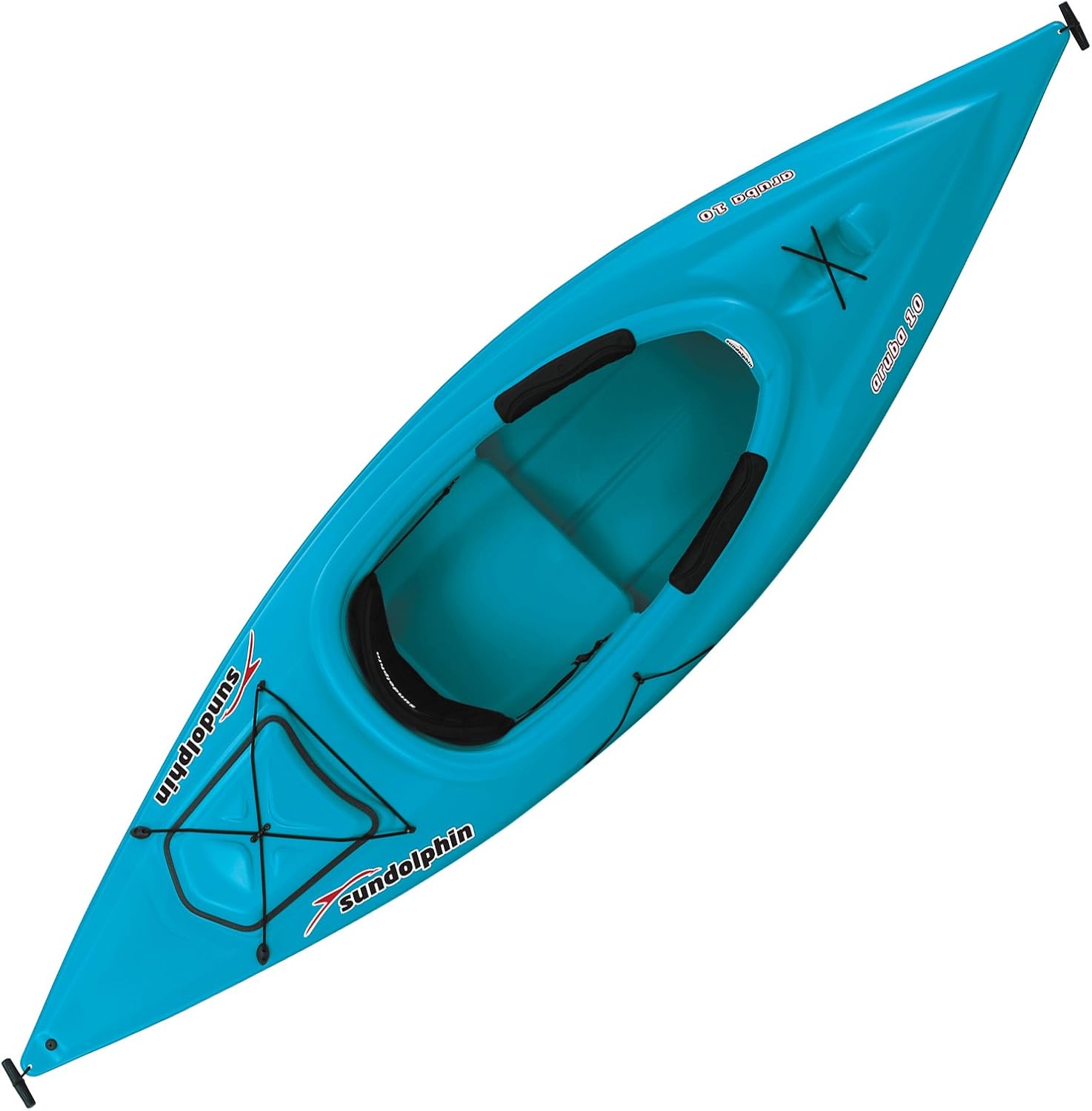
Sun Dolphin Aruba 10 Review
The Sun Dolphin Aruba 10 is a capable first kayak for calm flatwater paddling on a tight budget, but its low weight limit and soft tracking mean most paddlers will outgrow it quickly.
Walk into any Walmart, Dick’s, or Costco with a couple hundred dollars and a hatchback, and you’ll almost certainly see the Sun Dolphin Aruba 10 staring back at you. It’s been one of the best-selling beginner kayaks in North America for years — and not without reason. At around $250, it gives a first-time paddler a real sit-in hull, adjustable footrests, and a rear hatch without asking them to bet $800 on a hobby they’re not sure they’ll love.
We’ve put the Aruba 10 through its paces on flatwater lakes and slow-moving rivers, and what we found is a kayak that genuinely delivers on its core promise — getting a beginner on the water affordably — while showing very clear limits once you start pushing beyond weekend pond sessions. If you’re still deciding between a sit-in and a sit-on-top, our sit-in vs. sit-on-top guide is a good place to start before reading further.
Here’s the full picture: what works, what doesn’t, and who should buy this kayak versus who should stretch their budget.
Sun Dolphin Aruba 10 specs
| Type | Sit-in recreational |
| Length | 10′ |
| Max load | ~250 lb |
| Hull | HDPE |
| Storage | Rear hatch + bungee |
| Best for | Budget calm-water |
On the water & tracking
The Aruba 10’s hull is a classic recreational shape — wide, flat, and stable. Drop it in calm water and it feels immediately confidence-inspiring for someone who has never sat in a kayak before. Stability is the headline feature here, and it earns that reputation. You can shift your weight, reach for a water bottle, or swivel to look around without the boat threatening to dump you.
Tracking, however, is a different story. The short 10-foot length and flat hull mean the Aruba wants to wander. Without a skeg or any fin, every few strokes you’ll need to correct course with a sweep stroke — and beginners who haven’t learned that technique yet will find themselves zig-zagging across the lake more than paddling in a straight line. In even a light crosswind, the bow gets pushed around noticeably. If your home water is a protected pond or a narrow river channel where straight-line tracking doesn’t matter much, this is no big deal. On an open lake with any breeze, it gets tiring fast.
Top speed is limited, as you’d expect from any 10-foot recreational hull. Cruising pace sits around 2–2.5 mph for most paddlers. It’s not built for covering distance — it’s built for exploring coves, fishing in calm inlets, and getting comfortable on the water. For a deeper look at how this compares to other options in this class, see our best recreational kayak roundup.
Comfort & storage
The adjustable padded seat is one of the Aruba 10’s stronger features relative to its price point. It sits low in the cockpit and gives enough lumbar support for a 1–2 hour outing without complaint. Push past that — say a 3-hour lake exploration — and you’ll start to feel the firmness. The padding is adequate, not generous. Paddlers with back sensitivity may want to add a third-party seat cushion or backrest pad, which is a reasonable $20–$30 upgrade.
Foot braces are adjustable and plastic, running on a molded track. They do what they need to do: give your legs something to brace against and help you rotate properly. The range of adjustment accommodates most adult heights, though very tall paddlers (6’2″ and up) may find the cockpit a little snug.
Storage is split between the rear Portable Accessory Carrier (PAC) hatch and a bungee cord area on the rear deck. The PAC hatch is a small dry-ish compartment — handy for keeping keys, a phone in a waterproof bag, or a light jacket, but don’t expect to fit a full dry bag in there. The bungee deck rigging behind the cockpit handles a small cooler or rolled-up layer. Some trim levels include flush-mounted rod holders, which kayak anglers will appreciate for a casual fishing setup. There’s also a built-in paddle holder that keeps your paddle parked while you’re rigging a lure or eating lunch.
Build quality for the price
The hull is rotationally molded from UV-stabilized HDPE using what Sun Dolphin markets as Fortiflex material. In practical terms this means a hull that resists cracking better than cheaper alternatives, handles minor rock scrapes without gouging, and won’t degrade from sun exposure the way untreated plastics can. The UV stabilization matters if this kayak is going to live in a garage or on a rack outside — it’s a feature that cheaper no-name kayaks often skip.
That said, build quality is consistent with the price tier. Seams are functional rather than refined. Plastic components — the seat hardware, foot brace tracks, and hatch cover — feel utilitarian. Nothing is built to last a decade of hard use, but for a $250 kayak used seasonally on flatwater, the construction is appropriate. The 40-pound weight is another honest trade-off: manageable for a solo car-topper when you’re motivated, but heavier than comparable rotomolded hulls at slightly higher price points. Getting it onto a roof rack solo requires a technique or a helper.
At roughly 40 lb and 10 feet, most adults can handle it alone with a proper two-point carry or a kayak cart — but it’s not what we’d call a lightweight boat. The best kayaks under $500 that sit just above this price tier often shave 5–8 pounds and paddle noticeably better.
Who it's for (and who should skip it)
The Aruba 10 makes the most sense for a very specific buyer: someone who wants to try recreational flatwater kayaking for the first time, has a limited budget, and is paddling protected water — ponds, calm lakes, or slow rivers. If that’s you, this kayak does exactly what it promises. It’s stable, it’s affordable, it’s widely available, and it will teach you basic paddle strokes without making you nervous.
Kids and lighter adults (under 180 lb) tend to get the most out of it — the 250 lb max capacity sounds sufficient, but in practice the kayak paddles best when loaded to 60–70% of capacity. Heavier paddlers near the limit will notice reduced freeboard and even more sluggish tracking. Paddlers over 225 lb should look carefully at alternatives with higher weight ratings.
Who should skip it: anyone who already knows they want to cover distance on open water, paddle in any kind of wind or current, or progress past pond-level paddling within a season or two. If you’re reasonably fit, moderately athletic, or suspect you’ll get hooked, you’ll outgrow the Aruba 10 fast. Spending $100–$200 more now on a longer, better-tracking hull will pay dividends in enjoyment. Our best beginner kayak guide covers a range of price points if you want to compare. If you have any doubts about paddling safety fundamentals, the U.S. Coast Guard Office of Boating Safety has solid free resources on PFDs and safe paddling practices.
What we liked
- Excellent initial stability — very confidence-inspiring for first-time paddlers
- Affordable entry point at around $250 street price
- UV-stabilized Fortiflex hull resists cracking and sun degradation
- Rear PAC hatch keeps small valuables dry
- Adjustable foot braces and padded seat work well for short outings
- Flush rod holders (on select trims) make it usable as a light fishing platform
The catches
- Tracks poorly — the flat hull wanders without a skeg, especially in crosswinds
- Low 250 lb capacity limits options for heavier paddlers or anyone carrying gear
- Seat padding is adequate for 1–2 hours but firm on longer paddles
- At ~40 lb it's heavier than comparably sized kayaks at slightly higher price points
Frequently Asked Questions
Is the Sun Dolphin Aruba 10 good for beginners?
Yes, for the right kind of beginner. If you’re new to kayaking and plan to paddle calm lakes, ponds, or slow rivers, the Aruba 10 is a stable and affordable way to start. Its wide hull makes it very hard to tip, which builds confidence quickly. Where it falls short is tracking — it wanders without a skeg — so beginners paddling in wind or open water may find it frustrating sooner than expected.
What is the max weight capacity, and will it fit a bigger adult?
The stated max capacity is 250 lb, but in practice the kayak paddles best when loaded well below that ceiling. Paddlers in the 200–225 lb range will notice the hull sits lower in the water, which reduces stability and makes tracking even more sluggish. If you’re a larger adult, we’d recommend looking at 12-foot or longer recreational kayaks with 300+ lb ratings for a better on-water experience.
How does the Aruba 10 track — does it go straight?
Tracking is the Aruba 10’s biggest weakness. The short, flat hull wants to turn with every paddle stroke, and there’s no skeg or fin to help it hold a line. Expect to use corrective sweep strokes frequently, especially in any crosswind. On a small protected pond this is manageable. On an open lake with a breeze, it becomes tiring. Paddlers who prioritize straight-line efficiency should look at a longer hull.
Is the Sun Dolphin Aruba 10 stable — will I tip over?
Initial stability is one of its genuine strengths. The wide, flat hull feels very planted on calm water, and casual movement — shifting weight, looking around, reaching for gear — won’t threaten to flip you. Secondary stability (when the hull tilts past a certain point) is less forgiving, as with most flat-hulled rec kayaks. On calm flatwater with normal paddler behavior, tipping over is genuinely unlikely for most adults.
How heavy is it — can one person carry and load it?
The Aruba 10 weighs approximately 40 lb, which is manageable but not light. A fit adult can carry it solo using a two-point grip or a kayak cart, and loading it onto a car roof rack solo is doable with a rear-load technique or a small kayak loader. That said, it’s one of the heavier boats in its size class. If you’ll be solo car-topping regularly, factor that in — or budget for a foam block loader or a kayak cart.