
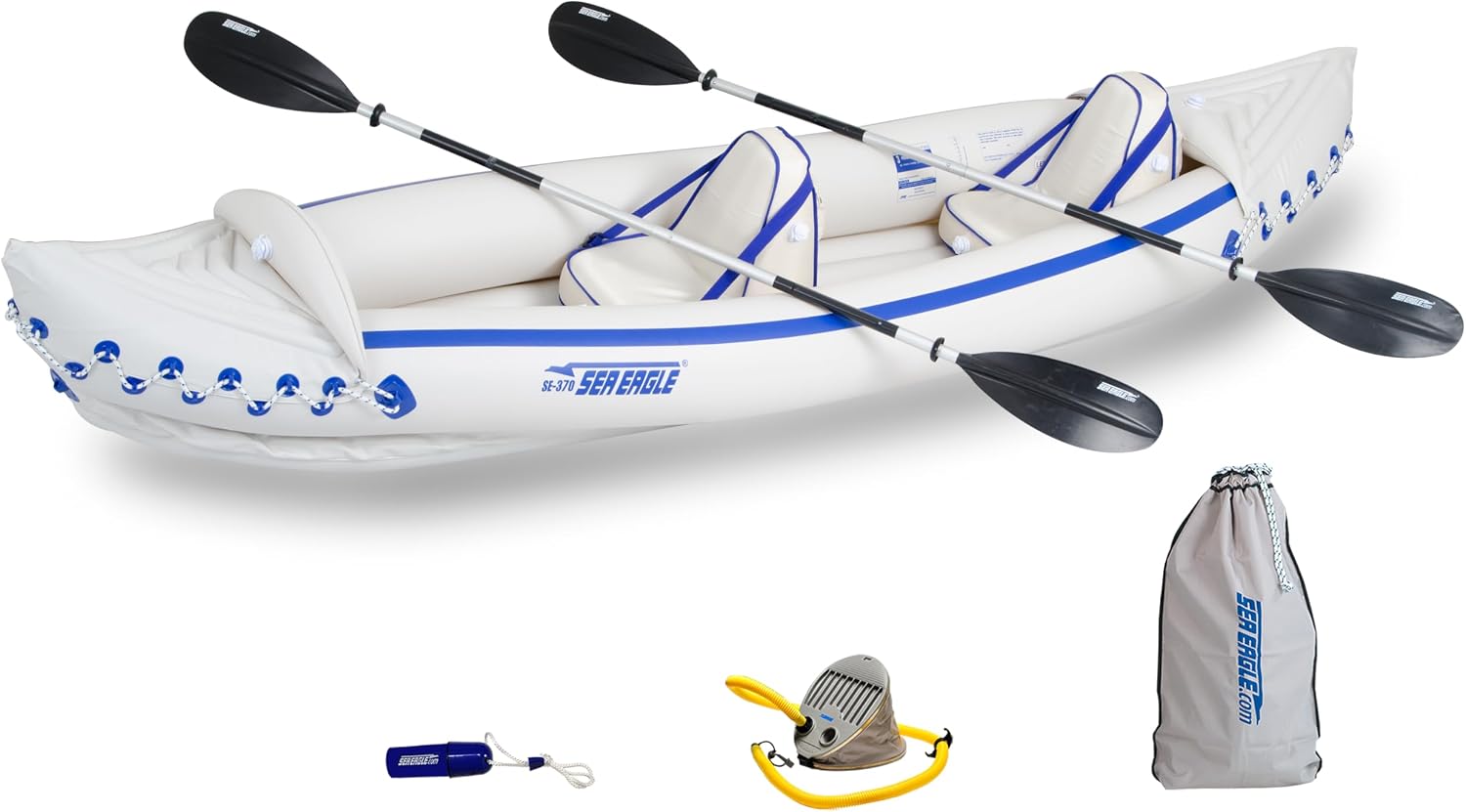
Sea Eagle SE370 Review
The Sea Eagle SE370 is one of the most versatile budget inflatables on the market — it handles flatwater lakes, moving rivers, and even Class III whitewater while packing into a bag small enough for a car trunk. For the price, it's hard to beat, though dedicated touring paddlers and speed-seekers will eventually want something more specialized.
We’ve paddled a lot of inflatables over the years, and the Sea Eagle SE370 keeps coming up in our rotation for one simple reason: it actually does what the box says. This isn’t a pool toy dressed up as a kayak. It’s a serious 12’6″ inflatable built from 38-mil PolyKrylar (K80) — the same kind of reinforced material you see on commercial whitewater rafts — rated for up to Class III rapids and a max load of 650 lb. At around $399 street price, that’s a legitimate value proposition.
The SE370 is designed for 1–3 paddlers, which makes it genuinely unusual in this price range. Solo day trips, a couple exploring a lake, a parent-and-two-kids weekend on the river — it handles all of those configurations. Whether you’re completely new to paddling or you’ve spent seasons on hardshells and want a packable backup, this boat earns a look. If you’re still figuring out what size or style fits you, our kayak sizing guide is a good place to start before pulling the trigger.
We ran the SE370 on flatwater reservoirs, moving Class II river sections, and a choppy coastal estuary. Here’s the honest rundown.
Sea Eagle SE370 specs
| Capacity | 1-3 person |
| Length | 12′ 6″ |
| Max load | ~650 lb |
| Hull | Reinforced PolyKrylar |
| Includes | 2 paddles, 2 seats, pump |
| Best for | Class III whitewater & touring |
On the Water
For a boat this wide — the SE370 is notably beamy to accommodate three riders — it tracks better than we expected on flat water. You’ll still notice more side-to-side drift than a dedicated touring kayak, but casual paddlers won’t find it frustrating. On a calm lake or slow river, you can establish a comfortable cruising pace without constantly correcting course.
The included AB30 paddles are a step above the plastic throwaways you find with cheaper inflatables. They’re aluminum-shaft fiberglass-blade paddles that are perfectly serviceable for casual outings, though intermediate paddlers will quickly want an upgrade. Paddle cadence felt natural and the boat responds predictably to sweep strokes.
Stability is a standout quality. With the two inflatable side chambers and the floor tube, the SE370 feels planted and forgiving. We intentionally shifted weight side to side in a tandem configuration and couldn’t flip it without serious effort. For beginners, that confidence matters more than the speed number. See our full list of the best inflatable kayaks if you want to see how it stacks up against the competition.
Whitewater and Big-Water Capability
The SE370’s Class III rating is real — Sea Eagle backs it with decades of reputation in the inflatable whitewater space, and the PolyKrylar hull earns that rating honestly. Self-bailing drain valves let water clear the cockpit area quickly on punchy drops, and the inflatable floor provides a cushioned base that takes rock strikes without damage.
We ran it through a Class II section with a few Class III lines and the boat handled confidently. It surfs waves well, responds to high braces, and the wide tube diameter gives you a stable platform for maneuvering in current. On continuous Class III with significant hydraulics, we’d want experienced paddlers in the boat and properly inflated tubes — this isn’t a boat to push to its limits with beginners aboard.
For ocean and bay use, the SE370 is solid in protected conditions. It handles light chop and coastal breezes fine, but in open-water swell or strong tidal current you’ll feel the limits of an inflatable hull — slower through the water and more susceptible to wind than a hard-sided touring kayak. The best touring kayaks list covers purpose-built options if that’s your primary use case. For most paddlers, though, lakes, slow rivers, and coastal bays are exactly where this boat shines.
One reassurance for new paddlers: the U.S. Coast Guard’s boating safety guidance recommends a properly fitted PFD regardless of boat type or water class — that applies here too, and Sea Eagle always includes that reminder.
Setup, Packing, and Durability
Inflation takes about 10 minutes with the included foot pump, which is compact and works reasonably well. If you paddle frequently, a quality hand pump or a 12V electric pump will make setup noticeably faster and easier on your legs. The three chambers — two side tubes and the floor — each have a Boston valve that holds pressure reliably. We inflated to the recommended PSI and checked after a full day of paddling; pressure was unchanged.
Packed down, the SE370 rolls into the included carry bag at a size comparable to a large hiking backpack. At ~32 lb it’s not ultralight — you’ll feel it over a long portage — but it fits in a car trunk, an overhead luggage compartment on some airlines, or a storage closet with room to spare. That packability is the entire value proposition over a hardshell.
Durability is where Sea Eagle’s 38-mil PolyKrylar hull earns its stripes. We deliberately scraped it over gravel bars, dragged it across rocky riverbanks, and left it in the sun for a full summer’s worth of outings. No punctures, no visible delamination. PolyKrylar is welded, not glued — the seams are fused, not adhesive-bonded — which matters for long-term reliability. Sea Eagle provides a repair kit and the patches work, but in real-world use you’re unlikely to need them on normal water. The included seats are inflatable and functional but fairly basic; Sea Eagle’s optional deluxe seats are worth the upgrade if you’re logging longer days on the water.
Who It's For (and Who Should Skip It)
The SE370 makes the most sense for paddlers who want maximum flexibility without a hardshell. If you live in an apartment, travel frequently, or want one boat that covers lake days, river trips, and occasional coastal paddling — this is your boat. It’s excellent as a first inflatable for beginners, especially couples or families who want to paddle together without buying multiple boats. The 650 lb capacity is generous enough for two adults plus a cooler, a dog, or a kid.
If you’re primarily a flatwater fitness paddler chasing speed and mileage, the SE370 will feel slow. Hardshells and purpose-built touring inflatables are faster and track better on open water. Likewise, if you’re an experienced whitewater paddler running technical Class IV or V, this isn’t the right tool — it’s a Class III boat for experienced paddlers, a Class II boat for casual ones.
Budget-conscious buyers should know that the base package is a solid starter kit, but you’ll likely want to budget another $50–$100 for a better paddle and possibly the upgraded seat. Even with those additions, the total comes in well under what you’d pay for a comparable hardshell inflatable from a specialty brand. If you’re comparing your options before committing, our beginner kayak guide covers the full landscape of entry-level picks across hardshell and inflatable categories.
What we liked
- Class III-rated PolyKrylar hull is tougher than it looks at this price point
- Fits 1–3 paddlers with a 650 lb load capacity — genuinely versatile
- Packs to carry-bag size at ~32 lb; easy trunk storage, no roof rack needed
- Self-bailing drain valves work well on moving water
- Excellent stability makes it confidence-inspiring for beginners
- Strong long-term value — Sea Eagle has decades of warranty and parts support
The catches
- Heavier and noticeably slower than a comparable hardshell kayak on flat water
- Included seats are functional but basic; upgrade cost adds to the real-world price
- Tracking on glass-flat water requires more correction than a purpose-built touring hull
- Foot pump is adequate but slow; a quality electric or hand pump is worth the extra spend
Frequently Asked Questions
Can the Sea Eagle SE370 really handle whitewater?
Yes, with the right expectations. Sea Eagle rates the SE370 for Class III, and the PolyKrylar hull and self-bailing design back that up. We’ve run it through Class II and light Class III without issue. For continuous Class III with technical lines, you want experienced paddlers in the boat and properly inflated tubes. It’s not a playboat for advanced whitewater, but it genuinely handles moving water far better than the cheap inflatables sold at big-box stores. Beginners should stick to Class I–II until they’ve built skills.
How many people fit in the SE370?
The SE370 is rated for 1 to 3 paddlers with a combined maximum load of 650 lb — gear included. In practice, two adults paddle it comfortably with room for a day bag and a cooler. Three adults is possible but tight, and you’ll feel the performance drop with max load. For regular tandem use, this is a strong value pick; our best tandem kayak guide covers how it compares to other two-person options if that’s your primary use case.
Is the SE370 good for ocean or bay paddling?
It works well in protected coastal conditions — calm bays, inlets, and estuaries with mild current and light chop. We paddled it in a coastal estuary on a breezy afternoon and felt confident. In open-ocean swell, significant wind, or strong tidal rips, you’ll hit the limits of an inflatable hull: it catches wind more easily than a hardshell and moves through water more slowly. For dedicated coastal touring or sea kayaking, a purpose-built sea kayak is the right tool. For casual coastal day trips, the SE370 is fine.
How long does it take to inflate the SE370?
With the included foot pump, plan on about 8–12 minutes to get all three chambers properly inflated to the recommended PSI. It’s not painful, but your legs will feel it by the third chamber. A 12V electric pump (not included) cuts that to 3–4 minutes and makes setup much less tiring if you paddle frequently. Deflation is faster — open the valves, roll the air out, and you can pack it up in about 5–7 minutes once you know the routine.
How durable is it — does it puncture easily?
In our experience, no — it doesn’t puncture easily under normal use. The 38-mil PolyKrylar (K80) hull is significantly tougher than the PVC used in budget inflatables, and the seams are welded rather than glued, which matters for long-term reliability. We’ve dragged it over gravel, bumped it on rocks, and left it out in summer sun for a full season with no issues. Sea Eagle includes a repair kit and punctures are patchable, but the more realistic durability concern is UV degradation over many years — proper rinsing, drying, and storage out of direct sunlight extend the lifespan significantly.