Common Beginner Paddle Board Mistakes
12 paddle board beginner mistakes — and the simple fixes that actually work.
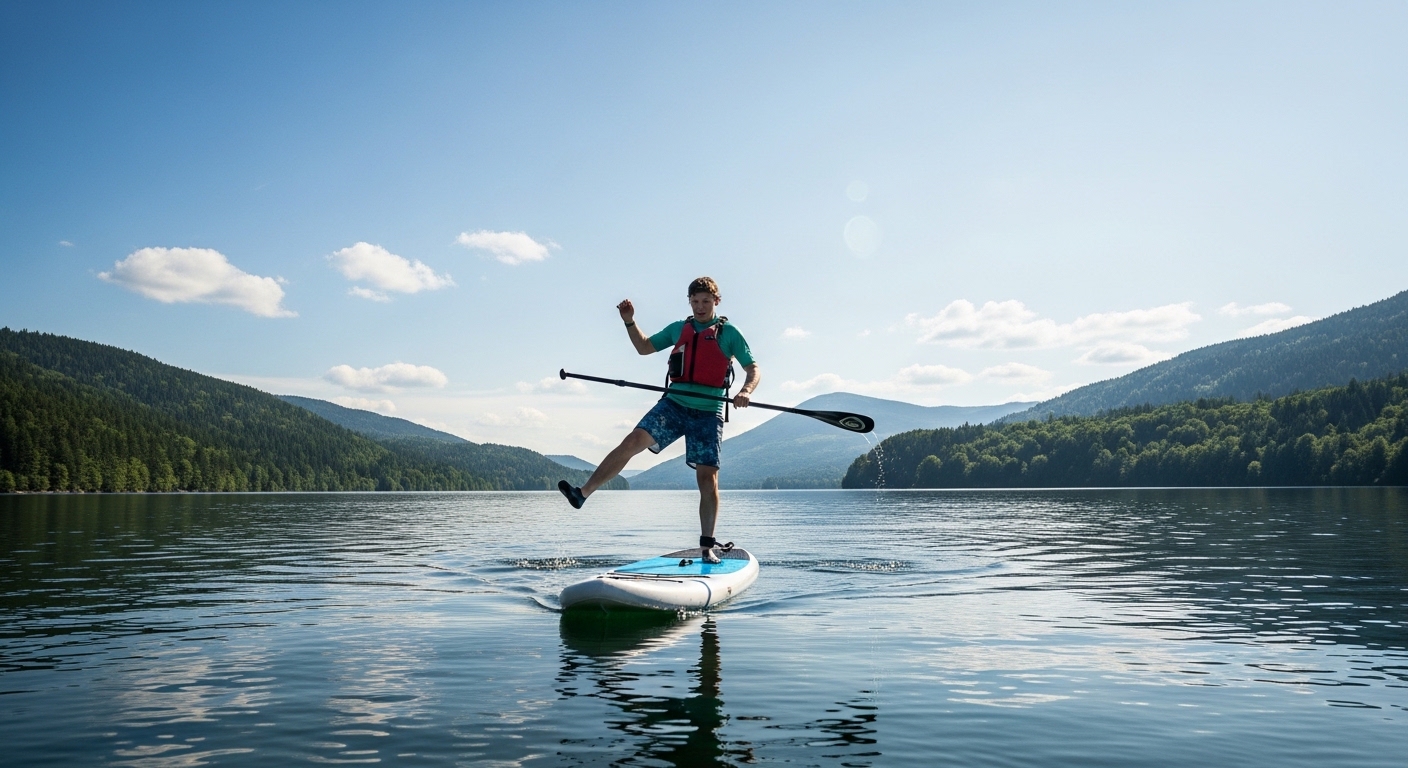
Beginner guideEvery SUP paddler has been there: wobbling around in ankle-deep water, wondering why nobody warned them. The truth is, most beginner struggles trace back to a handful of fixable habits. None of them require expensive coaching. They just require knowing what to look for. Here are the most common paddle board beginner mistakes — with honest, practical fixes for each one.
Stance and Body Position Mistakes
Your body position is the foundation of everything on a paddle board. Get it wrong and no amount of paddling technique will save you.
1. Looking Down at the Board
New paddlers almost always stare at their feet. It feels logical — you want to see where you’re standing — but it’s one of the fastest routes to falling in. Looking down drops your chin, rounds your shoulders, and shifts your weight forward. The board reacts by tipping.
The fix: Pick a point on the horizon and keep your eyes there. Let your feet feel the board. This one change alone dramatically improves balance because it keeps your spine upright and your weight centered.
2. Standing Too Far Back
When beginners get wobbly, instinct says “step back for control.” Unfortunately, standing behind the center handle causes the nose to lift and the tail to drag. You slow down, steer poorly, and fight the board the entire time.
The fix: Stand with your feet on either side of the center carry handle. That’s your sweet spot. If the board feels sluggish or hard to steer, check your foot position before anything else.
3. Feet Wrong — Parallel Instead of Shoulder-Width
Both feet lined up in a row (surf stance) looks cool but kills stability on flatwater. It also puts you sideways to your paddle, which makes every stroke awkward.
The fix: Stand with feet parallel to each other, hip-to-shoulder width apart, toes pointing forward toward the nose. Think of standing on a tightrope versus standing on a dock. You want dock-wide, not tightrope-narrow. Save the surf stance for waves.
Paddle Grip and Stroke Mistakes
The paddle is not a pool noodle. How you hold it and use it matters more than most beginners expect.
4. Holding the Paddle Backwards
This happens to nearly every first-timer. The blade angles forward — away from you — and beginners often flip it around thinking the curved scoop should face them. Paddling with the blade reversed kills efficiency and creates turbulence that throws off balance.
The fix: The blade should angle away from you, toward the nose. When you stroke, the flat back of the blade pushes water cleanly behind you. A useful cue: the logo on most paddles faces forward, toward the water.
5. Death-Gripping the Paddle
White knuckles, locked elbows, jaw clenched — you know the look. Squeezing the paddle too hard kills your endurance, creates arm fatigue within minutes, and actually makes you less stable because your upper body stiffens up.
The fix: Relax your grip to about 60% effort. Your top hand (the one on the T-grip) should be firm but relaxed. Let the paddle do the work. If your forearms are burning after five minutes, grip is almost always the culprit.
6. Paddling Only One Side
Beginners pick a side and stay there. The result: you go in slow circles. Paddling only on your right pushes the nose left, and vice versa.
The fix: Switch sides every three to five strokes. Before you switch, rotate the paddle so the blade angle stays correct for each side. Once this becomes habit, you’ll track straight naturally. For more fundamentals on stroke mechanics, see our full guide on how to paddleboard.
Gear and Equipment Mistakes
Bad gear decisions set beginners up to fail before they ever reach the water. These are the most common ones.
7. Buying a Board That’s Too Small or Too Cheap
The beginner instinct is often to buy the cheapest board or to grab a smaller “performance” shape because it looks cool. Both are mistakes. A board that’s too narrow, too short, or too flimsy will punish every small balance error and make learning miserable.
The fix: For most adults new to SUP, aim for a board that’s at least 10 feet long and 31–33 inches wide. Volume matters too — the board should float you with room to spare. A board rated for 50 lbs more than your body weight gives you the stability margin beginners need. Don’t optimize for speed on day one.
8. Wrong Inflation Pressure (PSI)
Inflatable SUPs — iSUPs — are fantastic for beginners, but only when inflated correctly. Under-inflated boards flex underfoot, feel spongy, and make balancing exponentially harder. Over a certain point, more PSI doesn’t help stability but it can stress seams.
The fix: Most iSUPs perform best between 12–15 PSI for average-weight adult paddlers. Always check the manufacturer spec printed on the board. Use a quality pump with a gauge and don’t skip the check before every session. Our paddle board PSI guide walks through the whole process.
9. Skipping the Leash and PFD
This isn’t a lecture — it’s math. A runaway board in open water can travel faster than you can swim, especially if there’s any wind. A leash keeps the board attached to your ankle so it becomes your flotation device the moment you fall. A PFD (personal flotation device) is required by law in most U.S. waters.
The fix: Ankle leash, every session. PFD on or accessible, every session. For flat calm lakes, a coiled leash avoids drag. For moving water or surf, use a straight leash attached to the ankle or calf. Review your local requirements in our guide to life jacket rules. According to the U.S. Coast Guard, SUP paddlers on open water are classified as vessel operators and must comply with PFD carriage requirements.
Conditions and Launch Mistakes
Where and when you paddle matters as much as how you paddle. Beginners consistently underestimate environmental factors.
10. Picking a Windy Day
Wind is the beginner’s worst enemy. It doesn’t take much — even 10 mph — to push an upright paddler downwind faster than they can paddle back. New paddlers also haven’t yet learned to read the water surface to gauge wind speed before launching.
The fix: Your first several sessions should be on calm days — ideally early morning when wind is lowest. Check a weather app that shows wind speed and direction, not just temperature. Anything over 10 mph is a tough day for beginners. Anything over 15 mph is genuinely difficult for intermediate paddlers. Start in the calmest possible conditions and level up gradually.
11. Standing Up Too Cautiously — or Too Fast
There’s a balance (literally) to the stand-up process. Some beginners rush and fall. Others hesitate so long they exhaust themselves staying in a crouch, then fall from fatigue. Neither approach works.
The fix: From kneeling, place your hands on the rails (sides) of the board near the center handle. Bring one foot up at a time to where your knees were. In one smooth, deliberate motion, rise to standing — don’t lurch. Keep your knees slightly bent and gaze forward. Fluid and committed beats slow and hesitant every time.
Board Care Mistakes Beginners Overlook
Small gear habits become expensive habits fast. This one mistake in particular causes hidden damage that most beginners don’t notice until it’s too late.
12. Dragging the Board or Ignoring Fin Damage at Launch
Fins look sturdy. They’re not. Dragging a board across gravel, sand, or concrete to the waterline is the fastest way to snap a fin, gouge the hull, or crack a fin box. A damaged fin destroys tracking — your board will spin instead of going straight — and a cracked fin box can become a leak point on inflatable boards.
The fix: Carry the board to the waterline rather than dragging it. If you must slide it, do so on soft, wet sand only and keep the fins in the air. Before every session, visually check your fin for cracks, chips, or looseness. Remove the fin for transport if you’re using a hard board. Most fin box damage is preventable with thirty seconds of attention at the launch.
The Bottom Line on Paddle Board Beginner Mistakes
None of these mistakes make you a bad paddler. They make you a normal beginner. The difference between people who love their first season and people who sell their board by September is usually just awareness — knowing what to watch for before it becomes a bad habit.
Run through the checklist mentally before each session, especially in your first few months: eyes up, feet centered and parallel, paddle facing forward, leash on, board properly inflated, conditions calm. That’s it. Those six checks will eliminate the majority of the paddle board beginner mistakes that frustrate and discourage new paddlers.
Keep sessions short at first — 30 to 45 minutes. Your stabilizing muscles fatigue before your ego does, and tired muscles mean more falls. Build up gradually, paddle in calm water, and give yourself permission to kneel down whenever you need a reset. Progress happens fast once the basics click.
Ready to go deeper on technique? Our full breakdown on how to paddleboard covers everything from your first stroke to reading currents.