
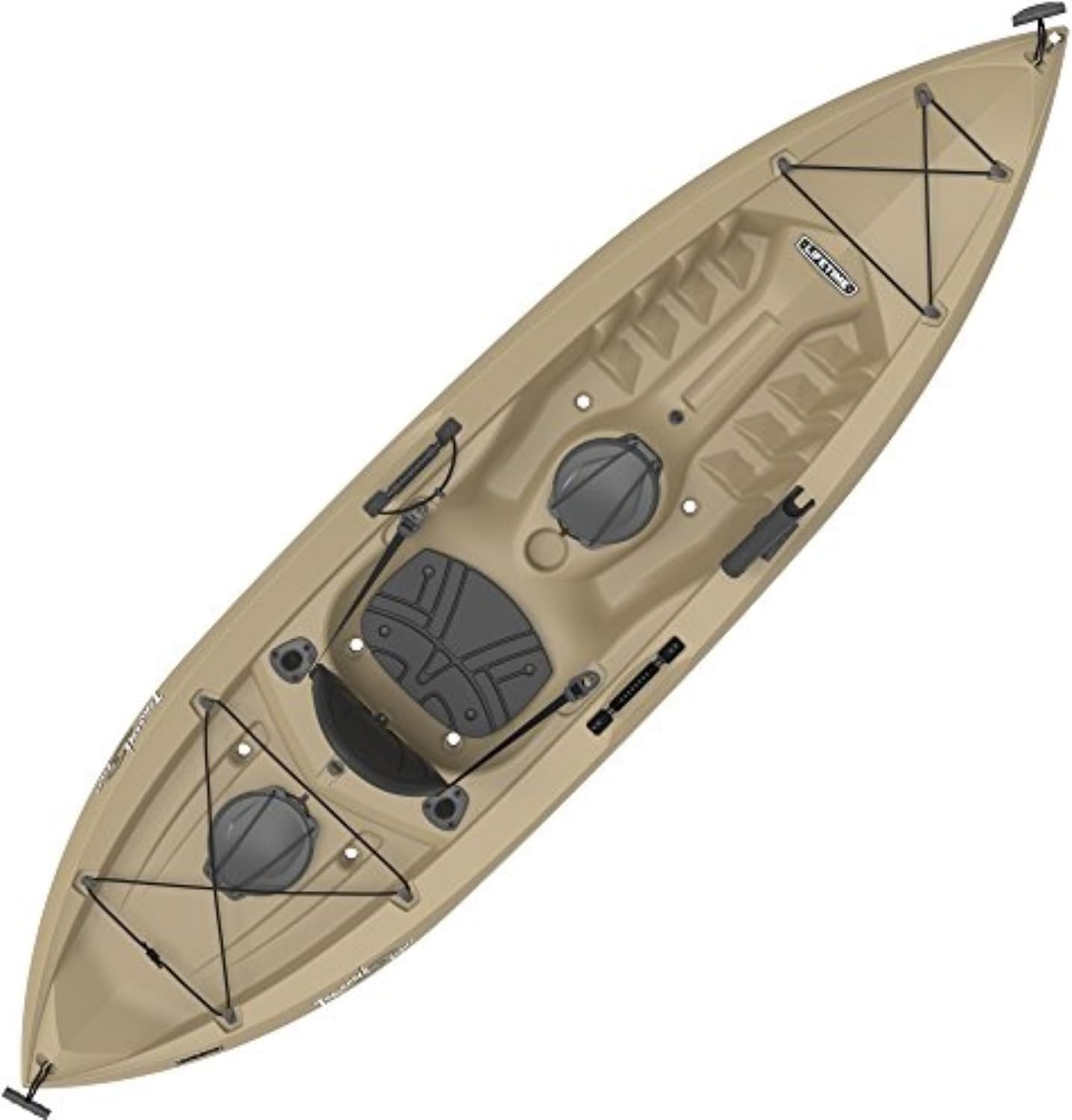
Lifetime Tamarack Angler 100 Review
The Lifetime Tamarack Angler 100 is an honest, capable budget fishing kayak that punches above its price tag on calm water — beginners and casual weekend anglers will find everything they need to get out on the pond. If you need speed, back support, or open-water range, step up; but for stable, affordable still-water fishing it's hard to fault.
We spent time on the Lifetime Tamarack Angler 100 across a handful of early-morning pond sessions and one slow flat-water river float, and our takeaway is straightforward: this is a genuinely useful fishing kayak for the money. At around $330 street price, it ships with a paddle, three rod holders, and enough stability to let you focus on the fish instead of your balance.
It’s built for beginners and budget-minded anglers who want to get on the water without dropping $700–$1,000 on a first boat. If you’re still figuring out whether kayak fishing is your thing — or you need a dedicated pond kayak that lives in the garage — the Tamarack Angler 100 deserves a serious look. Check our best fishing kayaks under $1,000 list for context on where it sits against the field, and our best kayaks under $500 guide if this price bracket is your target.
It isn’t a do-everything boat. It’s a 10-foot sit-on-top designed for lakes, ponds, and calm rivers — and within that lane it holds up well. Here’s what we found.
Lifetime Tamarack Angler 100 specs
| Type | Sit-on-top fishing |
| Length | 10′ |
| Max load | ~275 lb |
| Hull | HDPE polyethylene |
| Rod holders | 2 flush + 1 mount |
| Best for | Budget fishing |
On the water & stability
The Tamarack Angler 100’s primary stability is its biggest selling point, and Lifetime delivers. The wide, flat hull gives beginners the confidence to shift weight, reach over the side, and net a fish without white-knuckling the gunwales. We never felt genuinely tippy on flat water, and the molded footwells let you brace effectively when you lean to cast.
Secondary stability — what saves you if you lean too far — is decent but not exceptional. This is a flat-bottom hull, which means it tracks predictably up to a point, then gives you a sharper warning than a rounded hull would. That said, on the glassy pond water this kayak is designed for, we never came close to that edge.
Speed is not a strength. At 10 feet with a wide beam, the Tamarack moves at a leisurely pace. On a pond that’s irrelevant. On a longer river float or a large lake with wind chop, you’ll feel the limitation. For anything beyond calm protected water, you’ll want a longer hull — our kayak sizing guide breaks down exactly when length starts to matter.
There’s no rudder and no skeg, so you’ll correct course with your paddle. In wind, that gets old. Keep this one on sheltered water and it’ll rarely frustrate you.
Fishing features & rigging
Three rod holders for a $330 kayak is a legitimate value add. You get two flush-mount holders positioned mid-deck for trolling or staging rods, plus one adjustable top-mount holder up front that you can angle toward your casting hand. The flush mounts are molded into the HDPE hull — no hardware to rust, no aftermarket installation needed.
The front and rear shock-cord straps give you somewhere to stow a tackle bag, a net, or a dry bag without running gear across the deck. They’re not deep bungee wells, but they’re functional for a day trip. T-handles fore and aft make portaging and loading straightforward — critical when you’re carrying a 52-pound boat to a pond launch solo.
What’s missing: no gear tracks, no anchor trolley, no cup holder, and no dry storage hatch. The deck is clean HDPE with attachment points limited to the shock-cord straps. Anglers who like to dial in their rigging with RAM mounts, fish finders, or milk-crate setups will find the Tamarack’s deck a bit bare. You can drill and add gear tracks yourself — HDPE takes hardware well — but it’s worth knowing you’re starting with a clean slate. See the best fishing kayaks guide if you want a kayak that ships rigging-ready from the factory.
The included paddle is a basic flat-blade aluminum model. It’ll get you through the day, but most anglers who stick with the sport will swap it out for a lighter fiberglass or carbon option within a season. Budget another $50–$80 for a quality upgrade and you’ll notice the difference immediately.
Comfort, weight & transport
The seat situation is the Tamarack’s clearest weakness. You get a molded seat pan with a thin foam pad — it works for a two-hour session but starts to complain on longer days. There’s no backrest. After three to four hours on the water, most paddlers will feel it in their lower back. An aftermarket kayak seat cushion (around $30–$50) is a near-mandatory upgrade if you plan on full-day trips.
At approximately 52 pounds, this is not a light kayak. For context, that’s toward the heavier end for a 10-foot recreational boat — weight and capacity factors matter both for the water and for your car roof. One person can load it solo, but it takes effort and a good roof rack system or foam block setup. If you’re regularly going to be loading and unloading alone, practice the technique: lift one end onto the car, then hoist the other. The T-handles help.
The UV-protected HDPE hull is a genuine long-term value. Polyethylene is impact-resistant, forgiving of the occasional rocky launch, and doesn’t delaminate or crack under normal use. This kayak will outlast years of weekend abuse without demanding much maintenance beyond rinsing and storage out of direct sunlight. Lifetime backs it with a 5-year warranty, which is reassuring at this price point.
Car-top transport is manageable. At 10 feet it fits on most crossbar setups without overhang, and the T-handles give you a clean grip point when you’re lifting. It does not come with a cart, so if your launch is more than 50 yards from the parking lot, factor in a kayak cart — they run $25–$40 and are worth every cent with a 52-pound boat.
Who it's for (and who should skip it)
The Lifetime Tamarack Angler 100 is purpose-built for one type of paddler: someone who wants to catch fish on calm water without spending a lot of money. If that’s you — you’re a beginner, a casual weekend angler, or you just need a dedicated pond boat — this kayak makes a lot of sense. It’s stable, it ships with useful gear, and it holds up over time.
It also works well as a second or third kayak for a household. If your primary boat is a longer touring or fishing kayak and you want something the kids can use, or a guest boat that lives on the car rack, the Tamarack earns its keep without taking up mental bandwidth.
Who should skip it: experienced paddlers who want speed or open-water capability; anglers who run a full electronics setup and need gear tracks; anyone who plans to paddle more than two to three hours at a stretch without upgrading the seat; and larger paddlers near the 275-pound weight limit who want a comfortable margin. The sit-in vs. sit-on-top guide is worth reading if you’re still deciding on hull style, and the best fishing kayaks under $1,000 roundup will show you what another $200–$400 buys you in features and performance.
At $330, the Lifetime Tamarack Angler 100 doesn’t try to be something it isn’t. It’s a stable, fishable, durable entry-level platform — and for the right paddler, that’s exactly enough. The American Canoe Association recommends all new paddlers complete basic flatwater safety training before heading out solo, regardless of how calm the water looks, and we second that recommendation for anyone new to kayaking.
What we liked
- Excellent flat-water stability for beginners and casual anglers
- Three rod holders included at a $330 price point
- UV-protected HDPE hull is durable and low-maintenance
- Paddle included — ready to launch out of the box
- 5-year warranty provides real long-term peace of mind
- Compact 10-foot length fits most car-top setups without overhang
The catches
- Heavy at ~52 lb — solo loading onto a roof rack takes effort and practice
- Basic foam seat pad with no backrest; uncomfortable on trips longer than 2–3 hours without an aftermarket seat
- Short hull limits speed and tracks poorly in wind; not suited for large open water
- No gear tracks, no dry hatch, and no anchor trolley — deck rigging is minimal out of the box