
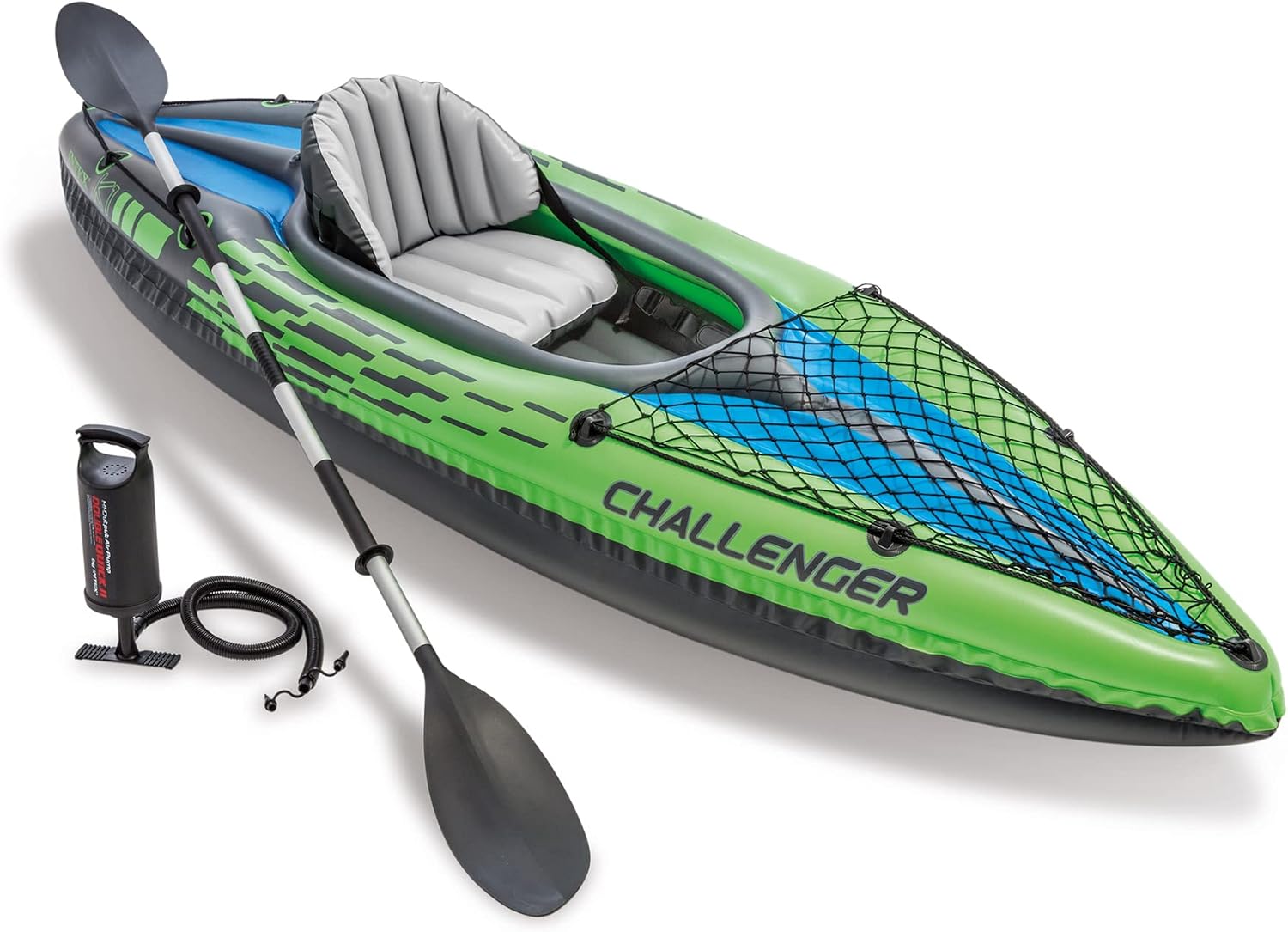
Intex Challenger K1 Review
The Intex Challenger K1 is the best ultrabudget solo inflatable for calm flat water — it earns its $75 price tag on quiet lakes and slow rivers, as long as you go in with clear eyes about what a vinyl boat at this price can and can't do.
We put the Intex Challenger K1 on a calm lake for an afternoon and came away with a simple truth: this kayak punches squarely at its weight class. For seventy-five bucks you get a real inflatable kayak — not a pool toy — that will take a solo paddler across a pond, down a lazy river, or along the calm shore of a lake. That’s exactly what it’s designed for, and on that kind of water it holds up its end of the bargain.
The K1 is a 9-foot single-person inflatable built from Intex’s standard vinyl construction. It ships with an 84-inch aluminum paddle, a hand pump, a small cargo net, and a grab line — everything a first-timer needs to get on the water the same afternoon the box arrives. That bundle matters at this price point. If you’re still figuring out whether kayaking is your thing, or you need a lightweight boat to keep in a truck bed for spontaneous paddles, the K1 makes a strong case for itself.
That said, it is not an all-conditions boat. If you’re shopping for something you can grow into, we’d point you toward our best inflatable kayak guide or the best beginner kayak roundup for options with more headroom. But if flat water and a tight budget are your real parameters, read on — this one might be exactly right.
Intex Challenger K1 specs
| Capacity | 1-person |
| Length | 9′ |
| Max load | ~220 lb |
| Hull | Vinyl inflatable |
| Includes | Paddle + pump |
| Best for | Flat-water beginners |
On the Water: What It Actually Feels Like
Setup takes about ten minutes with the included hand pump. The K1 has two main air chambers — the hull and the floor — and a separate inflatable seat. Inflation isn’t effortless; budget an honest ten minutes and some arm work. A 12V pump makes it faster if you have one.
Once inflated and on the water, the Challenger K1 feels surprisingly stable for such a small, light boat. At 9 feet it’s compact, and at roughly 27 pounds it’s genuinely easy to carry solo. Paddling on a calm lake with no wind, it moves predictably and requires only modest effort to maintain a comfortable pace — figure 2 to 3 mph for a casual paddler.
The removable skeg is the K1’s most underappreciated feature. Without it, tracking (holding a straight line) is noticeably soft — you’ll be making small correction strokes constantly. Snap the skeg on and the boat straightens out considerably. Don’t lose that skeg. Keep it attached in shallow water to avoid snapping it on rocks, but use it whenever the water is deep enough to let it run.
Stability and Tracking: The Honest Numbers
Let’s be direct about expectations. The Challenger K1 is wider than it looks — about 30 inches at the beam — and that extra width is what gives it beginner-friendly stability. We did not tip it during normal paddling, and a new paddler sitting upright and keeping their center of gravity low should feel reasonably secure. It is not a white-knuckle boat on flat water.
Tracking is the K1’s weakest performance trait. Even with the skeg installed, it wanders more than a rigid kayak or a higher-end inflatable would. Paddlers who alternate strokes left-right-left will manage fine. Paddlers who want to dig in on one side for a long pull will find themselves slowly turning. This is a physics reality of short, wide inflatable hulls, not a manufacturing flaw.
The 220 lb maximum load is the other number to take seriously. That’s paddler plus gear — not just paddler body weight. A 200 lb paddler plus a dry bag and a few water bottles is already brushing the limit. If you’re over 180 lb and planning to carry anything, check our kayak weight limit guide before you buy — this boat has a real ceiling and exceeding it makes stability worse fast.
Bottom line: stable enough for a beginner on calm water, trackable enough with the skeg, not a performance boat. That’s the accurate summary.
What You Get for Under $80
The K1 package includes the kayak hull, inflatable seat with a low backrest, an 84-inch two-piece aluminum paddle, a hand pump, a small cargo net at the bow, and a grab line at each end. For a sub-$80 kit, that’s a complete starter setup — you need no additional purchases to get on the water.
The paddle is basic aluminum and heavier than fiberglass alternatives. It gets the job done for a short outing but you’ll feel it in your shoulders on anything longer than an hour. If you plan to paddle regularly, budgeting another $40–$60 for a lighter paddle is money well spent.
The inflatable seat provides lumbar support and is adjustable fore-aft in a limited way. It’s comfortable for 30–45 minutes before you start noticing it isn’t an ergonomic kayak seat. On trips longer than an hour, a thin sit pad helps.
The vinyl hull is standard Intex gauge — the same material used in their above-ground pools. It will not puncture from a gentle scrape against a dock, but it will not shrug off a sharp rock the way a PVC-drop-stitch inflatable like a Sea Eagle or Aquaglide will. Treat it like the budget recreational boat it is: rinse it after every use, dry it completely before storage, and keep it out of direct UV storage for months at a time. The U.S. Coast Guard classifies inflatables of this type as recreational vessels — carry a PFD and follow your state’s registration requirements.
Who It's For — and Who Should Skip It
The Intex Challenger K1 is the right boat for a specific, real use case: a solo paddler under about 185 lb who wants to explore calm, protected water — ponds, small lakes, slow-moving rivers with no rapids — on a tight budget or with limited storage space. It’s also a solid choice as a beater boat to keep in a car or garage for spontaneous outings when you don’t want to put your nicer gear at risk.
It is not the right boat for ocean use, tidal inlets, rivers with significant current or any whitewater, windy days on open water, or paddlers who are close to the 220 lb limit. It is not the boat to buy if you plan to paddle consistently and improve — you’ll outgrow it within a season. For that buyer, see our best kayak under $500 guide for durable options that grow with your skill.
First-timers wondering about safety basics should review our guide on is kayaking safe — the K1 is safe on appropriate water with a PFD and basic precautions, and risky outside those conditions just like any kayak.
If the K1 matches your actual use case — and for many buyers it will — it’s an excellent value. If it doesn’t match, no amount of reviews will change the physics. Buy for where you paddle, not for where you wish you paddled.
What we liked
- Under $80 with paddle, pump, and cargo net included — genuinely complete starter kit
- Lightweight at ~27 lb, easy to carry and car-top solo
- Reassuringly stable for beginners on calm flat water
- Removable skeg meaningfully improves straight-line tracking
- Compact 9-foot footprint stores in a closet or trunk
- Easy setup — inflated and on the water in under 15 minutes
The catches
- Thin standard vinyl hull scratches and punctures more easily than PVC drop-stitch inflatables
- 220 lb max load (paddler + gear combined) leaves little margin for heavier adults or loaded trips
- Tracking is soft even with skeg — short, wide hull requires more frequent correction strokes
- Included aluminum paddle is heavy; shoulder fatigue sets in on paddles over an hour
Frequently Asked Questions
Is the Intex Challenger K1 good for beginners?
Yes, on calm water. The K1 is wide enough to feel stable for first-timers, and the included paddle and pump mean no extra purchases before your first session. Stick to ponds, small lakes, and slow rivers and it’s a genuinely welcoming starter boat. Beginners who try it on open or moving water without experience will have a harder time — not because the boat is defective, but because any kayak is harder to handle in those conditions.
Can a bigger adult use the Challenger K1?
The max load is 220 lb — paddler plus any gear combined. A paddler at or above 200 lb has very little margin before the boat rides too low and stability suffers. If you’re over 190 lb, we’d recommend stepping up to a kayak with a higher weight capacity. Exceeding the rated limit is both a safety and a performance issue: the boat will feel sluggish, track worse, and sit dangerously low in the water.
Can I use the Intex Challenger K1 in the ocean?
We don’t recommend it. The K1 is rated for calm, flat water — protected ponds, lakes, and slow rivers. Ocean conditions include surf, tidal currents, boat wakes, and wind chop that can overwhelm a short, light inflatable and a beginner paddler quickly. Even a calm-looking ocean beach can turn dangerous. If ocean paddling is your goal, look for a longer, purpose-built sea kayak with a higher freeboard and more directional stability.
Is the K1 easy to flip?
On calm flat water with a paddler sitting upright, the K1 is not prone to tipping — its wide beam provides good initial stability. Where it gets tippy is in chop, wakes, or when a paddler leans hard to one side. Like any kayak, it can flip if you push it. Keep your weight centered, don’t lean out past the rail, and avoid water conditions beyond its flat-water rating and you’ll stay dry.
Does the Intex Challenger K1 come with a paddle?
Yes. The package includes an 84-inch two-piece aluminum paddle, a hand pump, a small cargo net, and a grab line — everything you need to get on the water right out of the box. The paddle is functional but heavy; if you find yourself paddling more than a couple times a month, upgrading to a fiberglass or carbon paddle is worth the investment for comfort on longer outings.