
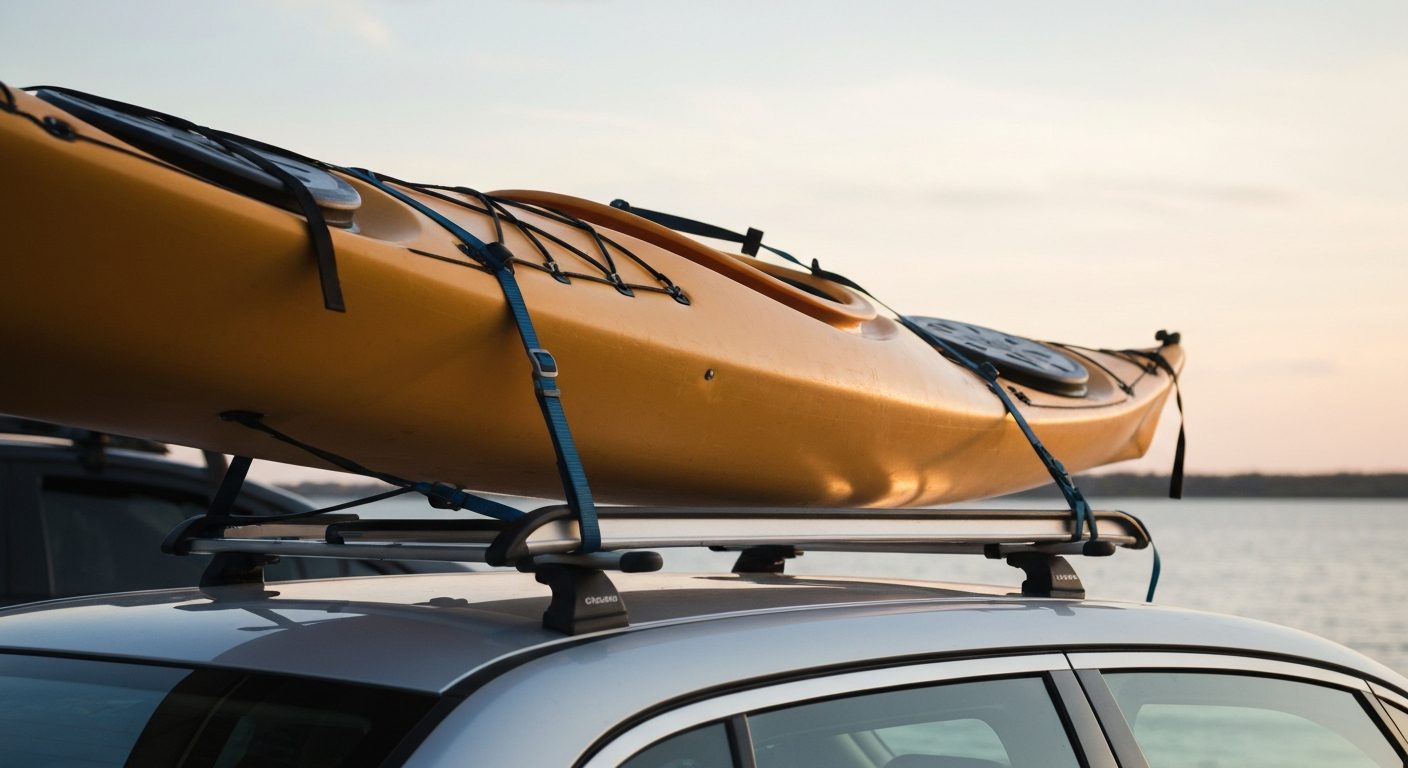
How to Tie Down a Kayak (Bow & Stern Lines)
Loop two cam-buckle straps over the hull and around your roof-rack crossbars, then run bow and stern lines to your car's tow points — and don't over-tighten.
How to transport a kayakTying down a kayak correctly takes about five minutes and uses two cam-buckle straps over the hull plus a pair of bow and stern safety lines. Transporting a kayak isn’t complicated, but skipping any of those steps is how boats end up on the highway.
What you need
You don’t need a truckload of gear. Here’s the short list of what actually works:
- Two cam-buckle straps (12–15 ft each): Cam buckles are preferable to ratchet straps for kayaks — ratchets make it too easy to crank down too hard and dent or crack the hull. Look for 1-inch webbing rated to at least 500 lbs.
- Two bow and stern lines (10–15 ft each): These are separate tie-downs that run from the kayak’s grab handles to your car’s hood loops or tow hooks. Flat nylon webbing or a dedicated bow/stern tie-down kit both work fine.
- A roof rack with two crossbars: Factory crossbars, aftermarket towers, or foam block carriers all work — the crossbars just need to be stable and at least 24 inches apart for a kayak this length.
- Optional — foam pads or saddles: If your crossbars are bare metal, foam pads protect the hull. Kayak saddles or J-cradles give you a better contact angle and are worth the upgrade if you haul frequently.
That’s it. Bungee cords, rope, and ratchet straps are the three most common mistakes we see in parking lots — avoid all three.
Step by step: strapping it to the crossbars
Load the kayak centered on your crossbars, hull-side down (or on edge in a J-cradle). Cockpit forward is the most aerodynamic position on most vehicles.
- Drape the first cam-buckle strap over the kayak just behind the cockpit, directly above one crossbar. Pass both ends under the crossbar and feed them back up through the cam buckle.
- Cinch the strap snug — firm enough that the kayak doesn’t shift side to side, but not so tight that the hull deforms inward. A good rule: you should be able to slide two fingers under the strap with light effort. If you can’t, it’s too tight.
- Repeat on the rear crossbar. Two straps, two crossbars, kayak centered and sitting level.
- Twist the loose tail of each strap two or three times before tucking it away. Loose webbing flapping at highway speed is loud and can work the buckle loose over miles.
- Give the kayak a firm shake from side to side and front to back. It should not move independently of the vehicle. If it shifts, re-tighten.
Check out our best kayak accessories roundup for specific strap brands we’ve used and trust.
Why bow and stern lines matter
The two crossbar straps hold the kayak down. The bow and stern lines stop it from sliding forward or backward if you brake hard or hit a bump. At highway speeds, that’s the difference between a startled moment and a serious accident.
The American Canoe Association and most state vehicle codes recommend bow and stern tie-downs as standard practice for any kayak or canoe transport over 10 feet — and most kayaks are longer than that.
Here’s how to run them:
- Locate your vehicle’s hood loops or tow hooks. Many modern cars have small anchor loops inside the front bumper fascia. Others have exposed tow hooks. Check your owner’s manual if you’re not sure.
- Attach one end of each line to the kayak’s bow and stern grab handles using a loop or a locking carabiner.
- Run the other end down to the hood loop or tow hook and cinch snug. These lines don’t need to be white-knuckle tight — just taut, with no sag.
- Tuck the excess line so it’s not dangling near the road or dragging on the paint.
If your car doesn’t have hood loops, aftermarket hood loop straps that feed through the door jamb are a $10 fix and they work well.
Common tie-down mistakes
We’ve seen these in parking lots and on the road. Most of them are fixable in two minutes.
- Ratchet straps cranked all the way down: The mechanical advantage of a ratchet strap is extreme. On a plastic or composite kayak, it will compress and dent the hull, sometimes permanently. Use cam buckles instead.
- Only using one strap: One strap in the middle gives the kayak room to pivot. Two straps — one forward, one rear — lock it in place.
- Skipping the bow and stern lines: The crossbar straps prevent lift. The safety lines prevent slide. You need both.
- Not re-checking after the first few miles: Straps settle and can loosen slightly after the load shifts on acceleration and braking. Pull over after 5–10 miles on your first trip and verify everything is still snug.
- Running straps over sharp edges: Route straps to avoid anything that can cut the webbing — exposed metal, roof rack edges, or sharp hull features. Chafed webbing fails without warning.
- Tying to the grab handles with rope: Grab handles are useful for bow and stern lines, but some cheaper handles aren’t rated for load. If yours feel flimsy, run a line through the hull’s carry toggle instead and test the attachment before you drive.
If you’re ever unsure about safety on or off the water, our is kayaking safe guide covers risk assessment from a practical standpoint.
Frequently Asked Questions
Do I really need bow and stern lines?
Yes. Crossbar straps prevent the kayak from lifting off the rack, but they don’t stop it from sliding forward under hard braking. Bow and stern lines handle that. Many states legally require them for loads that overhang the vehicle. At highway speeds, skipping them is a risk that isn’t worth taking — the lines take about two minutes to attach.
Can I tie a kayak down without a roof rack?
You can use foam block carriers that sit on the bare roof and thread straps through the car’s interior. It works for short trips at moderate speeds, but it’s less secure than a real rack. The straps press directly on the roof and can scratch paint over time. If you haul a kayak more than a few times a year, a basic aftermarket rack is worth every dollar.
How tight is too tight?
If you can’t slide two fingers under the strap with light effort, it’s too tight. Plastic hulls will dent under sustained over-compression, and composite (fiberglass, carbon) hulls can crack. Snug means the kayak doesn’t shift or wobble when you shake it — it does not mean maximum tension. With cam-buckle straps, firm hand pressure is enough; you shouldn’t need to muscle it.
Will straps damage my kayak's hull?
Cam-buckle straps used correctly almost never cause hull damage. Ratchet straps cranked tight are the main culprit for dents and cracks. Bare metal crossbars without foam pads can leave pressure marks on softer plastic hulls over a long haul. Use foam pads or saddles, choose cam buckles over ratchets, and don’t overtighten — your hull will be fine trip after trip.