How to Choose Your SUP Paddle Length
The right paddle length makes every stroke feel effortless. The wrong one wrecks your shoulders before you hit the halfway point.
Size chartPaddle length is one of those things that sounds complicated until someone explains it plainly. Most paddlers get it right on the first try once they know the basic rule — and spend five minutes testing it on the water. This guide covers the classic sizing method, how it shifts depending on what you’re doing out there, and what to look for if something feels off.
The Classic Rule of Thumb
The standard starting point: your SUP paddle should be roughly 6 to 10 inches taller than you are. If you’re 5’10” (70 inches), that puts you somewhere in the 76–80 inch paddle range. Simple enough.
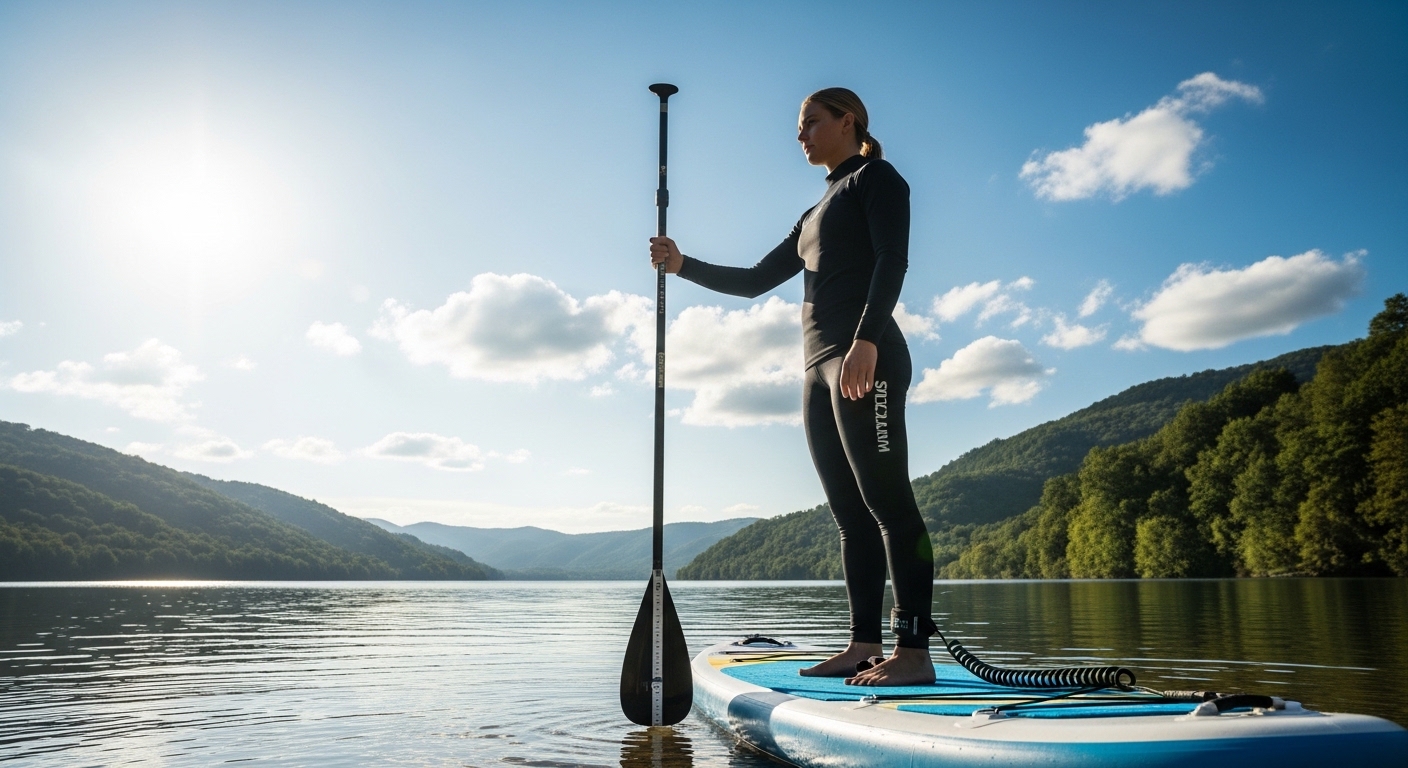
But numbers on a tape measure only get you so far. The more useful test is what’s sometimes called the reach-and-wrist method: stand the paddle upright in front of you, raise one arm straight overhead, and bend your wrist back slightly. The top of the grip — the T-grip or ergonomic handle — should land right at your wrist crease. Not the fingertips. Not the mid-palm. The wrist.
That position puts the blade at the right depth when you’re standing on a board and reaching forward into a stroke. Too high and you’re pulling air at the catch. Too low and you’re over-reaching and cranking your lower back to compensate.
For more context on how paddle sizing fits into your overall setup, the paddle board size chart covers board dimensions alongside paddle recommendations by paddler height and weight.
How Paddle Length Changes by Discipline
The 6–10 inch rule is a good baseline, but it assumes recreational flat-water paddling. Once you know what you’re mostly doing on the water, you can dial in from there.
All-around / recreational: The classic 8–10 inches over height works well here. You’re doing a mix of cruising, maybe a little light touring, and you want a comfortable upright stance with smooth, efficient strokes. This is the sweet spot for most casual paddlers.
Racing and touring: Longer — typically 10–12 inches over height, sometimes more. Why? In racing, you’re driving the board forward hard and want maximum blade reach with each stroke. Your stance also tends to be more aggressive and forward-leaning, which effectively shortens your reach unless you compensate with a longer shaft.
Surf SUP: Shorter — around 6–8 inches over height, sometimes even less. Surf paddling involves quick, reactive strokes in broken water. You’re low on the board, shifting your weight constantly, and a shorter paddle gives you faster cadence and better control in the pocket. A paddle that’s fine for flat water will feel like you’re fighting a broom handle in the surf.
Yoga and fitness paddling: Back toward the middle — 8–10 inches. You want stability and control, not reach. Many yoga paddlers even size down slightly so they’re not over-extending on balance-focused movements.
Learning how discipline affects your setup is part of understanding how to paddleboard effectively from day one — technique and gear are always connected.
Why Adjustable Paddles Are a Smart Starting Point
If you’re new to the sport, or if multiple people in your household use the same board, an adjustable-length paddle is genuinely worth it — not as a compromise, but as a practical tool.
Here’s why: most beginners don’t know yet whether they prefer touring posture, a more upright recreational stance, or something in between. Adjustable paddles let you experiment with a half-inch here and there until the stroke clicks. That’s hard to do when you’ve already cut a fixed shaft to length.
Quality adjustable paddles now use secure clamp systems or pin-lock mechanisms that don’t slip mid-stroke. The days of wobbly twist-lock collars are mostly behind us. You do pay a slight weight penalty compared to a fixed-length carbon shaft at the same price point, but for most paddlers that tradeoff is invisible on the water.
For families or rental setups, adjustable paddles are practically mandatory — one paddle can cover a 5’2″ parent and a 6’1″ teenager without buying two separate shafts.
Signs Your Paddle Length Is Off
You don’t always know immediately that your paddle is wrong — sometimes it takes a session or two for the signs to show up in your body. Here’s what to watch for:
Too long:
- Sore upper trapezius muscles and shoulder fatigue earlier than expected
- You’re reaching and pulling at an angle rather than a clean vertical stroke
- Your top hand is uncomfortably high, putting strain on your elbow
- The blade enters the water too far behind your feet instead of near the nose
Too short:
- You’re hunching forward to get blade depth, which kills your lower back
- Your cadence feels choppy and rushed rather than smooth and powerful
- The paddle exits the water too early and you’re getting a lot of splash
- Your top hand is down at chin level or lower during the stroke
Both problems compound quickly over distance. A session that should feel easy becomes grinding. If you’re consistently sore in the spots above, check your paddle length before assuming it’s a fitness issue.
Blade Offset and Angle — What It Does and Why It Matters
Most SUP paddle blades are offset — the blade face is angled forward relative to the shaft, typically between 7 and 13 degrees. This is not a defect. It’s intentional design.
The offset positions the blade more vertically when it enters the water at the start of a stroke, which improves power transfer. Without offset, you’d have to cock your wrists awkwardly to get the same blade angle, which is a fast path to tendinitis.
A smaller offset (7–9 degrees) suits surfing and faster-cadence paddling — the blade releases cleanly at the back of the stroke. A larger offset (10–13 degrees) works better for touring and all-around use where you want maximum forward drive per stroke.
Most beginner paddles split the difference around 10 degrees, which is a good neutral starting point. When you’re testing paddle length, be aware that offset can subtly affect how the stroke feels at different heights — another reason adjustable paddles are useful for dialing things in.
Carbon vs. Fiberglass vs. Aluminum Shafts
Shaft material affects weight, stiffness, and price — and the differences are real enough to matter on longer paddles.
Aluminum: The heaviest option, but also the cheapest and most durable for casual use. An aluminum paddle can take abuse, lives in rentals, and costs $30–60. The weight becomes noticeable after an hour of paddling, especially for lighter paddlers. Fine for occasional use, but not ideal for anyone logging serious time on the water.
Fiberglass: The mid-range sweet spot. Noticeably lighter than aluminum, with some flex that actually feels forgiving on the joints over long sessions. Most paddlers moving past the beginner stage land here. Expect to spend $80–150 for a solid fiberglass shaft with a quality blade.
Carbon fiber: Lightest and stiffest. Carbon transfers power efficiently — there’s no flex absorbing your stroke energy. Elite racers and serious tourers live here. The tradeoff is brittleness (carbon can crack on impact) and price ($150–400+). For most recreational paddlers it’s more paddle than they need, but for anyone doing regular distance work, the reduced arm fatigue is real.
Choosing the right shaft is part of building out a solid kit — the paddle board accessories guide covers paddles alongside leashes, fins, and other gear worth having before you hit the water.