How Long Does It Take to Learn to Surf?
Most people stand up on a surfboard within a few sessions — but riding real waves confidently takes a little longer, and that's perfectly normal.
How to surfThe honest answer is that how long it takes to learn to surf depends on how often you get in the water and what you’re aiming to do. Standing up on whitewater can happen in your first few sessions; linking turns on green waves is a project that typically takes 2–6 months of regular surfing.
A realistic timeline by milestone
Here’s what most people experience, assuming they’re surfing at least once or twice a week:
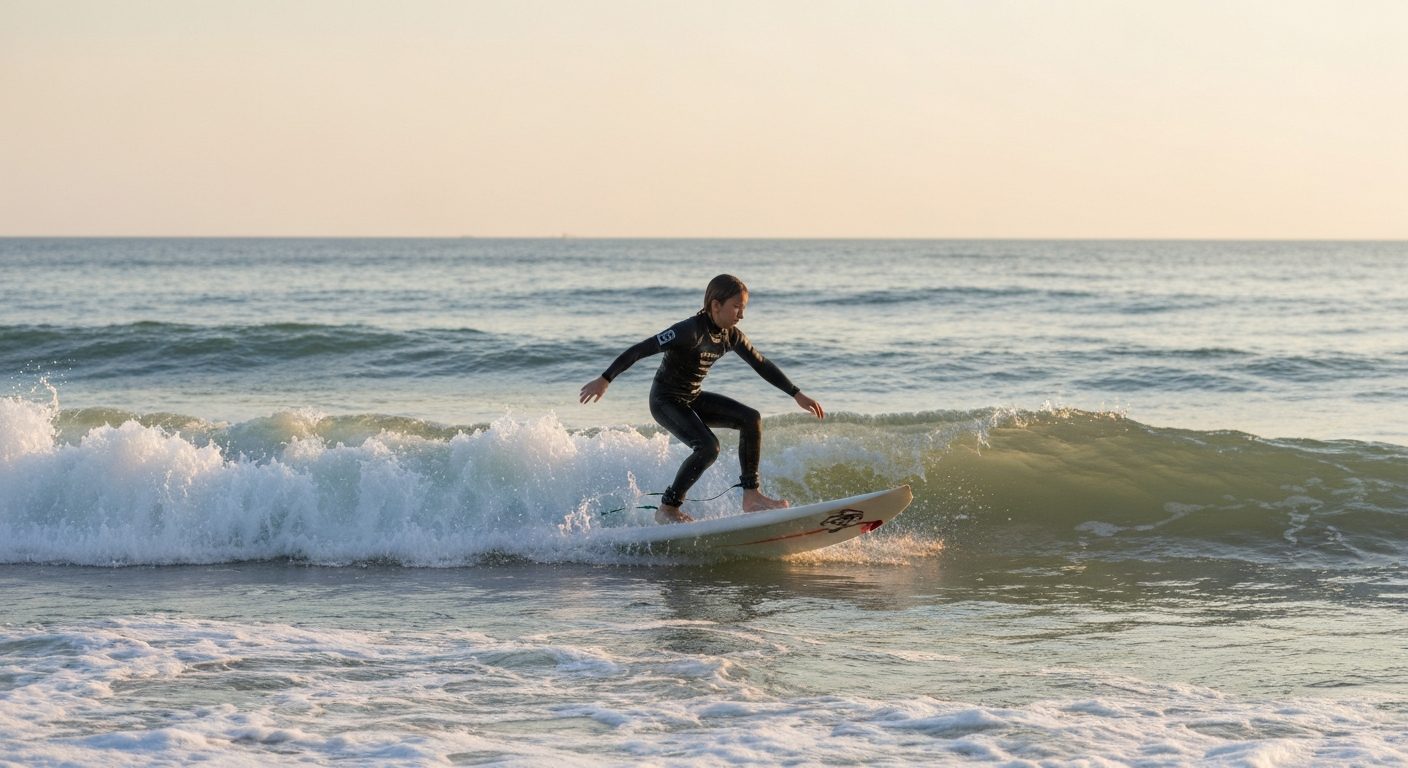
- First 1–3 sessions: You’ll pop up on whitewater (the broken, foamy stuff near shore) and ride it straight to the beach. It’s wobbly and exciting and a little chaotic — that’s exactly right.
- 2–4 weeks: Your pop-up gets more consistent. You start angling your board along the wave instead of just going straight. The ocean stops feeling entirely foreign.
- 2–6 months: This is the green-wave milestone. You’ll start paddling into unbroken waves, feeling the drop, and riding the face. It’s the moment surfing really clicks — and it’s worth every wipeout.
- 1–2 years: Genuine competence. You can read a lineup, pick off decent waves, and start working on turns. You’re no longer just surviving out there; you’re actually surfing.
- 3+ years: Intermediate surfing — bottom turns, cutbacks, positioning in bigger surf. The ceiling keeps moving. That’s part of why people surf for life.
What speeds up your progress
A few factors make a measurable difference in how fast you improve:
Frequency beats intensity. Three short sessions a week will advance you faster than one long weekend marathon session every month. Muscle memory and ocean awareness build through repetition, not volume on a single day.
Starting on the right board. This is huge and it’s where a lot of beginners lose months of progress. A big, thick, buoyant board — typically a longboard or a foam funboard — gives you more paddle power, more stability, and more waves caught per session. Catching more waves means more practice. Check our best beginner surfboards guide if you’re not sure what to ride, and use the surfboard size chart and volume calculator to dial in the right volume for your weight.
Lessons early on. Even two or three lessons with a qualified instructor saves you from ingraining bad habits that take twice as long to unlearn. The International Surfing Association sets the standard for surf instruction globally — look for ISA-certified coaches if you want structured progression.
Consistent, mellow waves. Learning in blown-out, choppy, or overhead surf is grinding. Small, clean, waist-to-chest-high waves let you focus on technique instead of survival. If you can choose your surf spots, prioritize gentle beach breaks over anything powerful.
Physical baseline. Swimming comfort, shoulder strength, and core stability all feed directly into surfing. You don’t need to be an athlete, but the more comfortable you are in the water, the faster everything else comes.
Why it varies so much person to person
You’ll hear stories of people standing up their first day and stories of people struggling for months. Both are true, and neither tells you much about your own trajectory.
Age plays a minor role — kids tend to pick up balance sports quickly, but adults are often more coachable and consistent. Athletic background helps, particularly if you’ve done skateboarding, snowboarding, or wakeboarding, since the balance mechanics translate. But plenty of people with zero board-sport experience become solid surfers within a year.
Geography matters more than most people admit. Someone surfing three days a week in warm, consistent, waist-high waves off a sandy beach in California or Costa Rica will progress dramatically faster than someone surfing cold, turbulent beachbreak in New England twice a month. It’s not just about wave quality — it’s about how many hours you actually rack up.
Equipment makes a real difference at the start. Beginners who start on shortboards (the small, thin boards you see pros riding) often stall for months simply because those boards are nearly impossible to paddle and catch waves on without advanced technique. If you’re gearing up, our beginner surfing gear checklist covers everything you actually need without the upsell.
Setting realistic expectations
Surfing has a long learning curve, and we think that’s one of its best qualities. There’s always something to work on. The first breakthrough — standing up and riding whitewater — comes fast enough to hook you. The next breakthrough, catching your first green wave and feeling the real speed of it, takes longer but hits harder. That rhythm of effort and reward is what keeps people surfing for decades.
Don’t benchmark yourself against the teenagers in the lineup who’ve been at it since age seven. Don’t assume you’re behind because your friend progressed faster. Consistency is the only variable you fully control.
If you’re just getting started, our how to surf for beginners guide walks through technique, safety, and etiquette so your early sessions are as productive as possible. The learning curve is real, but so is the payoff — and it starts sooner than most people expect.
Frequently Asked Questions
How long does it take to stand up surfing for the first time?
Most beginners stand up on whitewater within their first one to three sessions. It usually doesn’t take long at all — the pop-up is a learnable movement, and foam waves are forgiving. The challenge isn’t the first stand-up; it’s making it consistent and then translating it to real, unbroken waves, which takes considerably more time and practice.
Is surfing hard to learn?
The basics are accessible — most people can stand up and ride whitewater in a few sessions. What makes surfing genuinely challenging is the ocean itself: reading waves, timing your paddle, positioning in a lineup. Those skills take months to develop. Surfing rewards persistence more than natural talent, so the question isn’t really whether it’s hard, but whether you’re willing to stick with it through the awkward phase.
Can you learn to surf in a week?
You can learn the fundamentals in a week — pop-up mechanics, paddling technique, riding whitewater, basic wave selection. A week of daily lessons in good conditions is genuinely transformative for a beginner. What you won’t have after a week is consistency or the ability to surf independently without coaching. Think of a week as a strong foundation, not a finished skill.
Does the right board help you learn to surf faster?
Absolutely — board choice is one of the biggest factors beginners overlook. A longer, thicker, higher-volume board paddles into waves more easily and gives you more time to pop up and find your balance. Beginners on boards that are too small catch far fewer waves per session, which means far less practice. Starting on the right board can cut months off your learning curve.