
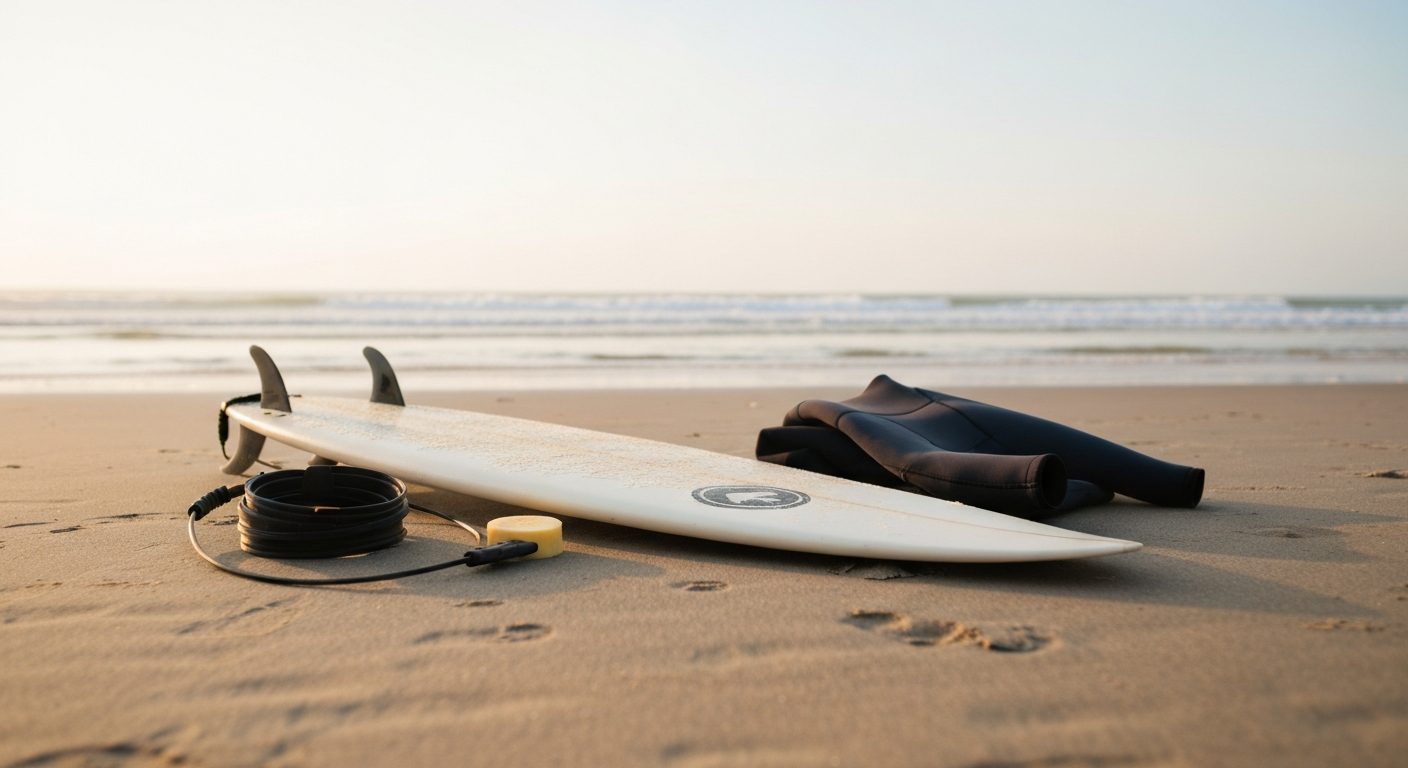
Surfing Gear for Beginners: The Complete Checklist
Everything a first-time surfer actually needs to paddle out, with no upsells and real costs.
Best beginner surfboardsWalking into a surf shop as a beginner is a fast way to spend money on the wrong stuff. The truth is you need surprisingly little to start surfing well, and a lot of what gets pushed on new surfers can wait or be skipped entirely. This checklist walks every essential item, what it costs, and where we’d tell a friend to save versus spend.
1. The Surfboard: Start On a Soft-Top
This is the single most important decision you’ll make, and the answer is almost always the same: get a soft-top, also called a foamie. A soft-top is a beginner board with a forgiving foam deck and rounded rails. It floats you easily, catches small waves with very little effort, and won’t crack your skull (or someone else’s) when it gets away from you. We have watched people fight a sleek hard board for a whole summer and barely stand up, then switch to a foamie and ride a wave on day one. The difference is float: a foamie carries your weight so well that you spend your energy learning to read waves and pop up, instead of just trying to keep from sinking.
Go big. For most adults, an 8-foot soft-top is the sweet spot, with heavier or taller surfers sizing up to 9 feet. More length and width means more float and more stability, which is exactly what you want while you’re learning to pop up. The Wavestorm is the board most of us cut our teeth on for good reason, and we break down why in our Wavestorm 8ft Classic soft-top review.
- What to buy: An 8-9 foot soft-top from our best beginner surfboards and best soft-top surfboards guides.
- Rough cost: $150-$350 new; often $80-$150 used.
- Skip for now: Any “performance” shortboard, fish, or hard epoxy board. You’ll graduate to one later.
Not sure on size? Our surfboard size chart and volume calculator takes your height and weight and gives you a target volume so you’re not guessing.
2. The Leash: Size It To Your Board
A leash is the cord that connects your ankle to the board so it doesn’t become a runaway missile every time you fall. It is non-negotiable safety gear, both for you and for everyone else in the water. The good news is most soft-tops come with one in the box, so you may not have to buy a leash separately at all.
The rule of thumb is simple: your leash should be roughly the same length as your board, or slightly longer. On a beginner board that means a long leash, which is also a thicker, more durable one. Thicker leashes drag a hair more in the water but they almost never snap, and that trade-off is exactly right for a learner.
- 8-foot board: 8-foot leash.
- 9-foot board: 9-foot leash.
- Cuff: Goes on your back ankle, with the rail saver and Velcro snug but not cutting off circulation.
Rough cost is $15-$30 if you need to buy one on its own. Buy a standard or “longboard” leash rather than a thin competition leash, which is built for small waves and breaks too easily for a beginner. Check the cord and the Velcro before every session; a worn leash is the one piece of gear that fails when you least expect it.
3. Wax and Traction Pad: Your Grip
Here’s a beginner gotcha worth knowing up front: most soft-tops have a textured deck and do not need wax at all. If that’s your board, you can skip this entirely and save the money. Wax matters once you move to a hard board with a smooth deck, where it’s the only thing keeping your feet and chest from sliding off.
If you do need wax, the two-step system is basecoat then topcoat. Basecoat is a harder wax that builds a bumpy foundation; topcoat is softer and provides the actual day-to-day grip. You rub basecoat on first in a crosshatch pattern until it beads up, then layer topcoat over it.
The catch that trips people up is that wax is temperature-rated. Wax that’s grippy in cold water turns to slime in warm water, and warm-water wax goes rock-hard and useless when it’s cold. Match the topcoat to your water:
- Tropical / warm: above ~75°F
- Warm: ~64-78°F
- Cool: ~58-68°F
- Cold: below ~60°F
A traction pad (a stick-on grip pad for your back foot) is a hard-board upgrade, not a beginner item. Rough cost: $8-$15 for a bar of wax, $30-$50 for a traction pad. Buy wax only if your board needs it; skip the traction pad for now.
4. The Wetsuit: Thickness By Water Temperature
Whether you need a wetsuit depends entirely on your water, not the air. A sunny 80°F day means nothing if the ocean is 55°F, and beginners spend a lot of time sitting still in the water getting cold. A wetsuit keeps you warm, keeps you in the lineup longer, and adds a little buoyancy and sun protection as a bonus.
Wetsuit thickness is written as two numbers, like 3/2mm, meaning thicker neoprene through the torso (3mm) and thinner at the arms and legs (2mm) for flexibility. Match the thickness to your water temperature:
| Water Temp | Wetsuit Thickness | Extras |
|---|---|---|
| Above 68°F | 2mm top / spring suit, or none | None needed |
| 58-68°F | 3/2mm full suit | None to light boots |
| 50-58°F | 4/3mm full suit | Boots; gloves optional |
| 43-50°F | 5/4mm full suit | Boots, gloves, hood |
| Below 43°F | 5/4mm+ with hood | Boots, gloves, hood required |
Buy boots, gloves, and a hood from the bottom of the table up, as the water gets colder. Below roughly 58°F your feet are the first thing to go numb, so boots come before gloves. Below 50°F most people want all three. Rough cost: $80-$200 for a quality 3/2mm full suit, $30-$50 for boots, $25-$40 for gloves.
5. Fins: Usually Already Handled
Fins are what give your board grip and direction in the water, and on a beginner soft-top they’re another item you likely won’t have to think about. Most foamies either ship with fins in the box or have soft fins permanently molded into the bottom. If yours came with fins, install them, make sure they’re locked in, and move on.
If your board uses removable fins, it’ll have a fin system (common ones are FCS or Futures) and the fins click or screw into boxes on the underside. A standard beginner setup is a thruster, meaning three fins: one center and two side fins. Push them in until they seat fully, tighten any screws, and tug to confirm they won’t pop out mid-wave.
- What to check: All fins present, fully seated, and not cracked.
- Rough cost: $0 if included; $40-$80 for a replacement fin set.
- Skip for now: Buying “upgrade” fins. The fins your board came with are completely fine for learning.
Don’t overthink this one. Fin tuning is a real rabbit hole, but it’s one for surfers who already know what they’re trying to change about how their board rides. As a beginner, the only fin mistake you can make is surfing without them. One quick habit worth building: rinse your fin boxes and screws with fresh water after salt sessions. Sand and salt seize up the hardware fast, and a stripped fin screw is an annoying, easily avoided problem that can sideline a board on the morning you most want to surf.
6. Board Bag, Sunscreen, and a Rashguard
This last group is the supporting cast: useful, but easy to over-buy. Prioritize ruthlessly.
Sunscreen is the one item here we’d call essential. You’re floating on a reflective surface for hours, and surfers get burned badly and fast. Use a water-resistant, reef-safe mineral sunscreen (zinc-based) on your face, neck, ears, and the backs of your hands and feet. A dedicated zinc face stick lasts longer than lotion in the water. Cost: $10-$20.
A rashguard is a snug shirt that stops the board from chafing your chest and ribs raw during pop-ups, and it adds sun protection. In warm water this can replace a wetsuit top entirely. Worth buying early if you’re surfing in board shorts. Cost: $15-$35.
A board bag protects your board in transit and from sun damage when stored. For a soft-top that lives in the garage and rides on a roof rack, it’s genuinely optional at first; a cheap padded sock or even an old blanket will do until you own a board worth babying. One thing a bag does matter for, though, is heat: soft-tops left in direct sun or a hot car can delaminate, where the foam separates from the skin and the deck bubbles up. If you can’t store yours in the shade, a reflective bag earns its keep. Cost: $30-$80 for a basic day bag.
- Buy now: Sunscreen, and a rashguard if you’re not in a wetsuit.
- Buy later: A board bag, once you upgrade boards.
With the board, a leash, sun protection, and a wetsuit matched to your water, you have everything you need. The rest you can add as you figure out what kind of surfer you’re becoming. When you’re ready to actually use it, our how to surf for beginners guide walks the pop-up and your first waves. And if you’d rather demo gear before committing, outfitters like REI rent wetsuits and boards by the day.
Frequently Asked Questions
What gear do I need to start surfing?
The real essentials are short: a soft-top surfboard, a leash, sun protection, and a wetsuit matched to your local water temperature. That’s it to paddle out safely. Most soft-tops include the leash and fins in the box, so a beginner can often start with just the board, a wetsuit, and sunscreen. Everything else, like a board bag or traction pad, can wait until you know you’re sticking with the sport.
Do I need a wetsuit to surf, and what thickness?
It depends on your water temperature, not the air. Above 68°F you can often surf in just a rashguard or a 2mm top. From 58-68°F a 3/2mm full suit is the standard. From 50-58°F move to a 4/3mm and add boots, and below 50°F a 5/4mm with boots, gloves, and a hood. Beginners sit still in the water a lot, so err toward warmer than you think.
How much should I spend on starter surf gear?
You can get fully kitted out for $200-$500. A new soft-top runs $150-$350 (less used), a quality 3/2mm wetsuit is $80-$200, and sunscreen plus a rashguard add $25-$55. Skip the traction pad, upgrade fins, and board bag at first to save money. If you’re unsure surfing will stick, buy a used board and rent a wetsuit for the first few sessions to keep your initial spend low.
What wax do I use?
First, check your board: most soft-tops have a textured deck and need no wax at all. If you do need it, use a two-step system, basecoat first in a crosshatch pattern, then a topcoat for grip. Crucially, match the topcoat to your water temperature, since cold-water wax goes slimy in warm water and warm-water wax turns rock-hard when it’s cold. Pick cool, warm, or tropical to match where you surf.
Do I need a leash?
Yes, always. A leash keeps your board attached to your ankle so it can’t hit you, hit another surfer, or wash to shore without you, which is both a safety must and basic etiquette. Size it to your board: an 8-foot board takes an 8-foot leash. Most soft-tops include one, so you may not need to buy it separately. Inspect the cord and Velcro before each session, since a worn leash is the piece most likely to fail.
Can I just rent gear first?
Absolutely, and we often recommend it. Renting or taking a lesson lets you confirm you enjoy surfing before spending a few hundred dollars, and a lesson usually includes a board and wetsuit. Outfitters and surf shops rent boards and wetsuits by the day or week. Once you’re hooked and know your local water temperature and the board size that suits you, you’ll buy smarter than you would have on day one.