
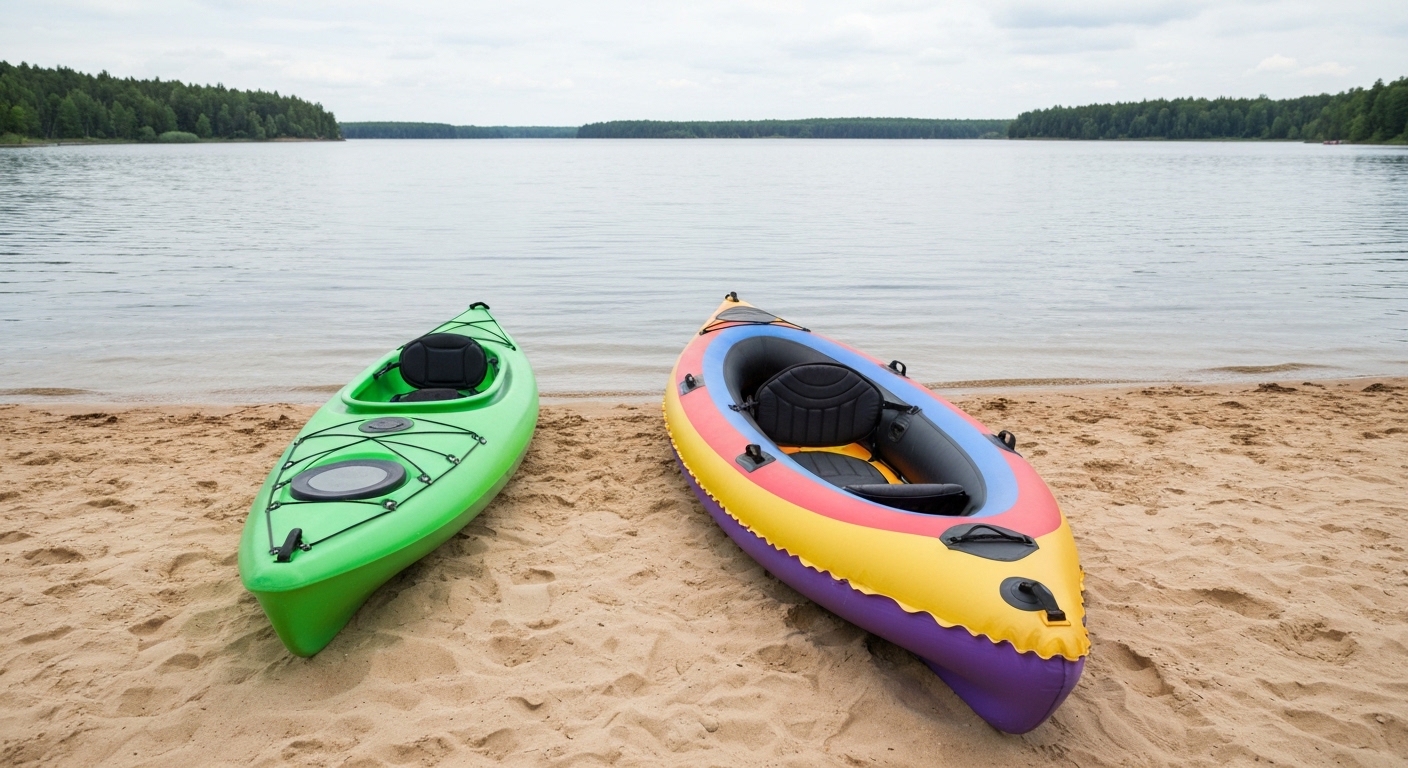
Hardshell vs Inflatable Kayak
Inflatable vs Hardshell Kayak: Which One Is Actually Right for You?
Best inflatable kayaksThe inflatable vs hardshell kayak debate comes down to one honest question: what does your life actually look like? If you live in a third-floor apartment with no roof rack, a 14-foot hardshell is a logistical nightmare. If you paddle four days a week and care about speed, a drop-stitch inflatable is going to frustrate you. Neither type is universally better — they solve different problems. This guide breaks down every category that matters, gives you a straight comparison table, and ends with a clear verdict so you can stop second-guessing and start paddling.
Performance, Speed, and Tracking
This is where hardshell kayaks win cleanly, and there is no point pretending otherwise. A rigid hull cuts through water with less resistance. The rocker, the chines, the hull shape — all of it is locked in place and responds exactly the same way every single stroke. Hardshells track straighter, accelerate faster, and hold a line in current or wind far more predictably than inflatables.
Inflatable kayaks, even premium drop-stitch models with rigid floors, have more flex in the hull. That flex absorbs energy. You will work slightly harder to cover the same distance at the same speed. The gap narrows a lot with high-end inflatables — something like an Advanced Elements AdvancedFrame or a Kokopelli sits surprisingly close to entry-level hardshells — but it never fully closes.
If you plan to paddle rivers with fast sections, do multi-day touring where efficiency matters, or want to keep pace with experienced paddlers in hardshells, a rigid boat is the honest answer. For flatwater recreation, mellow rivers, and casual lake trips, most paddlers will never feel the performance gap in a meaningful way.
Durability: Which One Actually Holds Up
The old assumption that inflatables are fragile and hardshells are tanks is outdated. Both types are durable when made well — they just fail in different ways.
Hardshell kayaks scratch, chip, and gouge. Polyethylene hulls (the most common material) are tough but heavy, and repeated dragging over rocky launches leaves permanent scars. Composite hulls — fiberglass, carbon, Kevlar — are lighter and faster but more expensive to repair when they crack. UV exposure degrades plastic hulls over years if stored in direct sunlight. That said, a hardshell stored properly can last 20 or 30 years without major issues.
Inflatable kayaks puncture, but less often than people expect. Modern PVC and Hypalon materials are extremely tough — the same technology used in military inflatable boats and commercial whitewater rafts. Entry-level inflatables from discount brands do blow out seams and develop slow leaks. Quality inflatables from brands like Sea Eagle, Advanced Elements, or Aire hold up to years of abuse including rocky whitewater. Most punctures are tiny and patch in under ten minutes with a kit that costs a few dollars and comes in the box.
The real durability edge for inflatables: they absorb rock impacts better than rigid hulls. A hardshell denting into a boulder can crack. An inflatable bounces. For whitewater specifically, this matters.
Storage and Transport: The Biggest Practical Difference
This is where inflatables change the math entirely for a huge slice of paddlers.
A 12-foot hardshell kayak is 12 feet long, always. You need a roof rack, a truck bed, a trailer, or a second person willing to help you wrestle it onto your car and carry it to the water. You need a garage, a shed, a storage unit, or a tolerant landlord. Even folded-down in a hatchback, most hardshells do not fit. The logistics cost is real and ongoing.
An inflatable packs into a duffel bag or backpack. A solo inflatable kayak typically compresses to roughly the size of a large hiking pack — around 20 to 30 liters when packed well. It fits in the trunk of a sedan, in an overhead bin on a plane, in a closet shelf in a studio apartment. You can fly to a destination, pick up your kayak at baggage claim, and be on the water the same day. That is not a theoretical edge case — it is why inflatable kayaks sell to travelers, apartment dwellers, and people who share vehicles that cannot carry a roof rack system.
Explore more options in our roundup of best inflatable kayaks and best recreational kayaks if you are still narrowing down which category fits your situation.
Setup Time: How Long Before You're on the Water
A hardshell is essentially instant. You carry it to the water, put it down, get in. That’s the whole process. With a roof rack already loaded, you can be paddling within two or three minutes of arriving at the launch. That low-friction entry is genuinely underrated — it means you paddle more often because there’s less activation energy required.
An inflatable takes longer. Budget 8 to 15 minutes for a realistic setup depending on the boat and the pump. Unpack it, unfold it, attach the skeg and any rigid pieces, inflate the floor and hull chambers with a hand or foot pump (or a battery pump, which speeds this up), snap in the seats. At the end of your paddle, reverse the process — deflate, rinse, dry as much as you can, pack it back up. Add another 10 to 20 minutes to your post-paddle routine.
This is not a dealbreaker for most people, but it is a real consideration if you tend toward spontaneous paddles or short sessions. Some paddlers find the setup becomes meditative and routine. Others find it annoying after the novelty wears off. Know yourself.
Price: What You Actually Pay
Both types span a wide range, so comparing them requires looking at equivalent tiers.
At the entry level, a basic recreational hardshell — think a 10-foot sit-in from a big-box outdoor retailer — runs $400 to $700. A comparable entry-level inflatable from a reputable brand runs $200 to $500. Inflatables win at the bottom of the market, partly because you are not paying for the heavy plastic hull and partly because shipping costs less.
In the mid-range ($700 to $1,500), you find solid hardshells with better outfitting and composite inflatables with drop-stitch floors that track decently. Both types offer good value here. At the premium tier ($1,500 and up), hardshells in fiberglass or carbon pull ahead in performance terms; premium inflatables like the Kokopelli Rogue or Aire Tributary match them in versatility but not raw speed.
One hidden cost with hardshells: getting the boat to and from the water. Roof rack systems run $200 to $600. Kayak carts, foam blocks, tie-down straps — it adds up. Inflatables need a good pump ($40 to $120 for a quality hand or foot pump, $80 to $200 for a battery pump). Factor in accessories when comparing real total cost.
See how different models stack up across both categories in our kayak guides.
Stability: Which Type is Easier to Balance
Stability depends more on hull width and design than whether the hull is inflatable or rigid — but inflatables have a structural advantage here. Because they are wider and have rounded, air-filled tubes for sides, most inflatables offer excellent primary stability (how steady the boat feels when you’re sitting still). Beginners often feel more secure in a wide inflatable than in a narrow hardshell touring kayak.
Hardshells can be extremely stable too — a wide recreational hardshell with a flat bottom will feel rock-solid on flatwater. The issue is that the most performance-oriented hardshells (touring, sea kayaks) are narrower and have a less forgiving initial stability in exchange for better speed and secondary stability (how the hull behaves when it tilts).
For beginners, the answer is simple: look at beam width, not material. A 30-inch-wide boat of either type will be stable. A 22-inch touring boat of either type will require more skill. Inflatables trend wider on average, so as a category they feel more stable to new paddlers — but it’s a correlation, not a rule.
Head-to-Head Comparison Table
| Category | Hardshell Kayak | Inflatable Kayak |
|---|---|---|
| Speed & Tracking | Better — rigid hull, less drag | Good at premium tier; slightly slower |
| Durability | Scratches, chips; lasts decades | Puncture-resistant; easy field repair |
| Storage | Needs 10–17 ft of space | Fits in a duffel or backpack |
| Transport | Roof rack or truck required | Fits in any car trunk or checked luggage |
| Setup Time | Near-instant (2–3 min) | 8–15 min to inflate; 15–20 min to pack |
| Entry-Level Price | $400–$700 | $200–$500 |
| Accessories Cost | Roof rack adds $200–$600 | Pump adds $40–$200 |
| Stability | Varies by design; can be very stable | Generally wide and stable; good for beginners |
| Whitewater Use | Capable; damage risk on rocks | Bounces off rocks; great for Class I–III |
| Travel-Friendly | Not practical | Excellent — flies as checked luggage |