
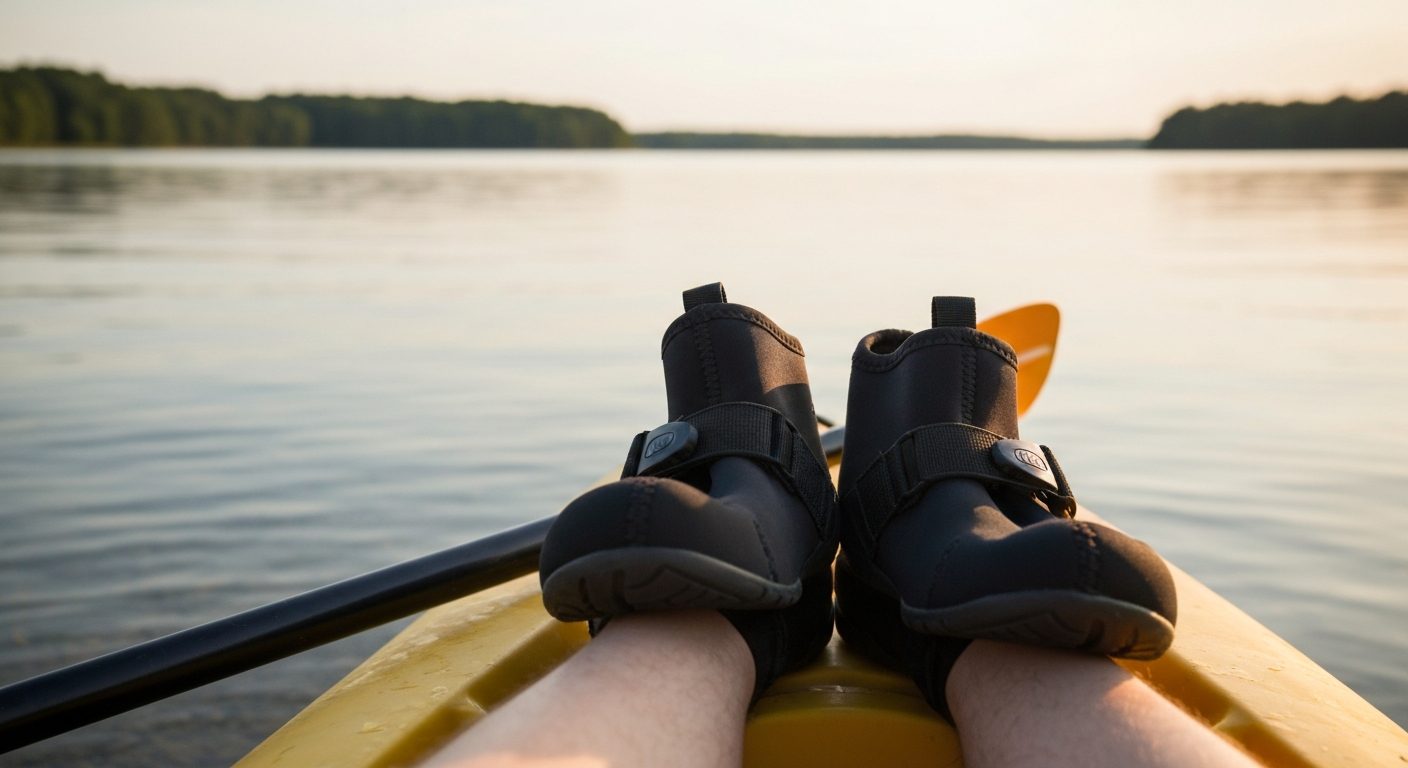
What Shoes to Wear Kayaking
The right footwear keeps your feet protected, warm, and firmly planted from launch to landing.
What to wear kayakingWe get this question constantly, and the short answer is easy: closed-toe water shoes or neoprene booties. The longer answer depends on water temperature, the type of kayak you’re paddling, and how rough your put-in is.
The best footwear options for kayaking
Two types of footwear cover nearly every kayaking situation: closed-toe water shoes and neoprene booties.
Water shoes (sometimes called aqua shoes or river shoes) are the workhorse choice for three-season paddling. They’re built with a mesh or quick-drain upper, a grippy rubber sole, and a snug fit that actually stays on your foot. Brands like Keen, Chaco, and Astral all make solid versions. Look for a sole with real tread — not the smooth-bottomed pool shoes you’d grab at a discount rack. You want grip when you’re stepping off a muddy bank or climbing back onto a sit-on-top.
Neoprene booties are the step up when the water gets cold or when you’re dealing with sharp terrain like oyster beds, barnacle-covered rocks, or broken shells. A 3mm bootie adds meaningful insulation without making your feet feel like they’re in ski boots. For cold-water kayaking — anything below 60°F — we reach for booties every time. They also pair naturally with a wetsuit or drysuit if you’re paddling in serious conditions.
For warm-water flatwater days on a sit-on-top, a lightweight water shoe is usually all you need. For touring, sea kayaking, or whitewater, lean toward booties for the extra protection and grip on uneven landings.
What to avoid (and why)
Let’s be direct about the footwear that causes problems on the water.
Flip-flops are the number one offender. They come off the moment you step into moving water, they provide zero grip on a wet hull or slippery ramp, and they offer no foot protection whatsoever. We’ve watched flip-flops float away at put-ins more times than we can count. Leave them in the car.
Bare feet might feel fine on a calm lake day, but one bad step on a barnacle-covered rock or a submerged shell and you’ll wish you’d worn shoes. Hidden hazards at launch sites — broken glass, rusty metal, sharp gravel — are a real concern, not an exaggeration.
Regular sneakers or trail runners aren’t ideal either. They absorb water and stay waterlogged for hours, which gets heavy and uncomfortable fast. More importantly, once soaked, the soles can lose grip on wet surfaces. If you’re doing a day hike combined with a paddle, change into dedicated water shoes at the put-in.
Sandals with heel straps are a middle-ground option some paddlers use on calm, warm-water days — but only if they have a proper rubber sole and a secure fit. Even then, they don’t protect your toes, which is usually where the damage happens.
Check out our full guide on what to wear kayaking for a head-to-toe breakdown beyond just footwear.
Cold-water and winter paddling
Cold water changes the equation entirely. The American Canoe Association consistently emphasizes dressing for the water temperature, not the air temperature — and your feet are part of that equation.
In water below 60°F, bare feet or thin mesh shoes aren’t enough. Cold water saps heat from your extremities fast, and numb feet are clumsy feet — exactly what you don’t want when you’re launching off a rocky shore or self-rescuing after a wet exit.
For cold-water paddling, here’s what we use:
- 3mm neoprene booties — the standard choice for most cold-water conditions, good down to around 45°F water temps with the right layering above the ankle.
- 5mm or 7mm booties — for winter paddling or icy water. Bulkier, but they keep your feet functional when the water is truly cold.
- Dry socks + water shoes — if you’re in a drysuit with built-in dry socks, a water shoe over the top adds sole grip without extra neoprene bulk.
If you’re still sorting out your cold-weather layering system, our wetsuit vs. drysuit guide covers how to match your full kit to conditions.
Features that actually matter
Not all water shoes are created equal. When you’re shopping, here’s what actually makes a difference on the water:
Closed toe. This is non-negotiable. Open-toe sandals leave your toes exposed to rocks, paddle shafts, and hull edges. A closed toe protects the part of your foot that hits things first.
Drainage. Look for drainage ports or a mesh upper that lets water flow out quickly. A shoe that holds water gets heavy and stays cold. Fast-draining designs feel more like wearing a shoe and less like wearing a sponge.
Sole grip. A sticky rubber outsole with real tread pattern matters more than almost anything else. You’ll use it stepping into and out of the kayak, crossing a slippery launch ramp, and climbing over rocks. Thin, smooth soles are a wet-surface liability.
Secure fit. Bungee laces, hook-and-loop straps, or a snug elastic entry all work — the point is that the shoe stays on your foot in moving water. Anything that can slip off, will slip off.
Ankle coverage. For rocky rivers or surf launches, a higher-cut bootie protects your ankle and adds stability. For flatwater, low-cut shoes are lighter and more comfortable all day.
If you want to round out your on-water setup, our best kayak accessories guide covers the gear that makes the biggest difference beyond footwear.