
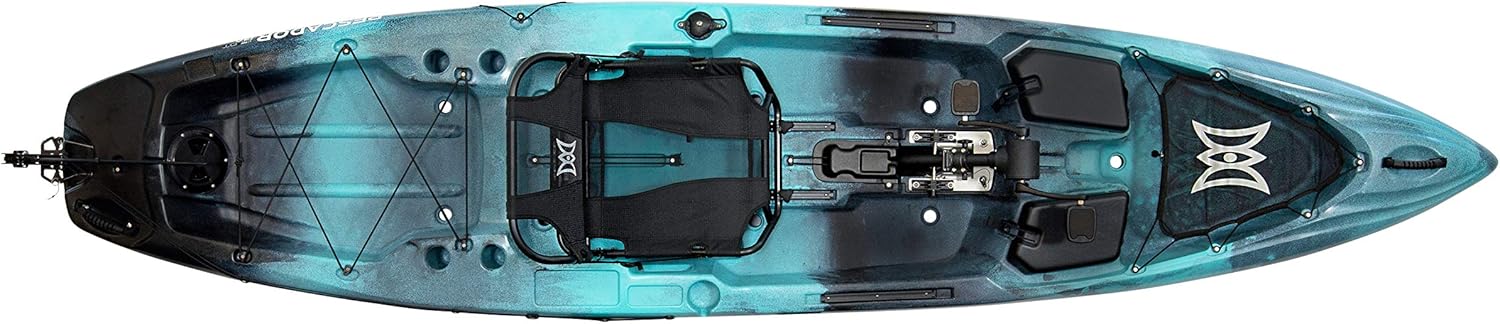
Perception Pescador Pilot 12 Review
The Perception Pescador Pilot 12 is the most accessible entry point into pedal fishing kayaks — the Pilot Drive is smooth, the reverse is real, and $1,500 buys you a genuinely capable hands-free angler. Just be honest with yourself about that 85-pound carry.
We spent time on the water with the Perception Pescador Pilot 12 across a mix of flatwater reservoirs and slow-moving river sections, and the short version is this: Perception figured out how to make a pedal kayak that doesn’t ask you to spend $3,000. The Pilot Drive propeller system works, the reverse is not a gimmick, and the hull is stable enough that a nervous beginner isn’t going to feel like they’re balancing on a log. If you’ve been eyeing the best pedal kayaks and flinching at the price of the big names, this is the kayak that should be at the top of your list.
That said, “affordable” comes with trade-offs we’re not going to gloss over. The Pescador Pilot weighs about 85 pounds with the drive unit installed, and it has a propeller — not a fin — which means shallow, weedy water is going to be a problem. If your home water is a grass-choked bass pond with 18-inch depths, you’ll want to read the full section on where this kayak struggles before swiping your card.
The Pescador Pilot is aimed squarely at anglers making their first move from a paddle kayak to a pedal kayak, and at recreational fishers who want to cover water efficiently without breaking the bank. If that’s you — and you have a truck or a cart — keep reading. We’ll tell you exactly what you’re getting for $1,500.
Perception Pescador Pilot 12 specs
| Type | Pedal fishing |
| Length | 12′ |
| Max load | ~475 lb |
| Drive | Pilot Drive prop + rudder |
| Reverse | Yes |
| Best for | Affordable pedal fishing |
The Pilot Drive on the water
The Pilot Drive is a propeller-based pedal system — you pedal forward and the prop spins, driving the kayak forward. That part is obvious. What matters more in practice is that it also goes in reverse: push the lever on the right side of the cockpit, pedal, and you back up. On a fishing kayak, this is genuinely useful. You drift past a target, back up, hold position without spinning around. Other entry-level pedal kayaks skip reverse entirely; Perception didn’t, and that decision alone separates the Pescador Pilot from cheaper alternatives.
Steering is handled by a hand lever that controls an integrated rudder. It’s light and responsive — small corrections happen quickly. The combination of hands-free propulsion and easy steering means you can hold a lure in the strike zone while the kayak does the work. After a couple of hours, working the pedals and rudder becomes automatic, and you stop thinking about it entirely. That’s the goal.
Pedaling effort is moderate. You won’t break a sweat on flat water at a comfortable cruise, but sustained headwind pedaling will work your legs. The prop is removable for transport and for poling through very shallow water, but in typical lake and river conditions you just leave it in and forget it. Top speed is respectable — faster than paddling, not as fast as a motorboat — which means covering ground between spots is genuinely efficient.
Stability, seat and fishing features
The 12-foot Pescador Pilot hull is a sit-on-top design with a beam wide enough to feel stable for anglers who aren’t already confident on the water. Standing to cast is possible for paddlers with some experience, though it rewards a planted, deliberate stance rather than casual movement. Beginners will feel secure seated; experienced anglers will appreciate that the hull doesn’t punish minor weight shifts during a hook set.
The seat is the highlight of the whole package. Perception uses a lawn-chair-style aluminum framed seat — padded, adjustable, and genuinely comfortable. It mounts at two heights: lower for a stable center of gravity on choppy water, higher for better visibility and casting clearance. After a full day on the water, we weren’t shifting around or suffering the lower-back fatigue that ruins trips in cheaper bucket-seat designs. The seat is also removable, which simplifies cleaning and transport.
Fishing-specific features are solid for the price. You get flush-mounted rod holders, side gear tracks for mounting accessories, a center console area with storage, and a rear tankwell that fits a small cooler or tackle crate. The layout is sensible — nothing feels tacked on. The gear tracks are the standard rail size, so aftermarket mounts work without adapters. None of this is as refined as a $3,000 purpose-built fishing kayak, but it’s more than enough to set up a functional fishing rig. If you’re comparing options in the best fishing kayaks guide, the Pilot holds its own in the sub-$2,000 range on features alone.
Weight, transport and maintenance
Here’s where we have to be straight with you: 85 pounds is heavy. The Pescador Pilot with its drive unit installed weighs roughly 85 lbs, and without the drive unit it’s still around 68 lbs. If you’re loading it solo onto a truck bed or roof rack, that’s a real workout and a real injury risk. A kayak cart is not optional — it’s a necessity for most users. Factor that into your budget.
The good news is that the kayak has decent handles at bow and stern, and the drive unit pops out without tools, which lets you split the load for a two-person carry. But if you fish alone and your launch is more than 50 feet from your parking spot, invest in a quality cart before your first trip. Understanding kayak weight limits also matters here: the 475-lb max load is generous, but that 85-lb hull weight means your effective gear-plus-angler capacity is actually 390 lbs — still plenty for most single anglers with a full load of tackle and gear.
Maintenance is more involved than a paddle kayak. The prop drive has moving parts — prop, shaft, seals — that need rinsing after saltwater use and periodic inspection for wear. Perception’s Pilot Drive is simpler than some competing systems, but “more parts” always means more things that can eventually need attention. The rudder cables should also be checked seasonally. Nothing here is exotic or expensive to fix, but it is something to budget time and attention for.
Who it's for (and who should skip it)
The Pescador Pilot 12 is the right kayak if you’re making your first move from a paddle fishing kayak to a pedal fishing kayak and you can’t (or don’t want to) spend $2,500 or more. It’s also right for recreational anglers on lakes, reservoirs, and slow rivers who want hands-free fishing without the complexity or cost of a motorized kayak. If you’re comparing it to options in the best fishing kayaks under $1,000, the Pilot costs more — but the pedal drive is a meaningful upgrade in fishing capability that’s hard to replicate at that price point.
Skip it if your home water is shallow, heavily vegetated, or has significant current. The propeller drive — unlike a fin-based drive like a Hobie MirageDrive — will pick up weeds, and in water shallower than about 18 inches the prop will bottom out or struggle. In those conditions, a fin-based pedal kayak or a paddle kayak is a better tool. Also skip it if you’re a solo angler without a reliable way to load and unload 85 pounds; the weight isn’t a minor inconvenience, it’s a real physical consideration. The American Canoe Association recommends paddlers always consider their ability to self-rescue with their chosen watercraft — at 85 lbs, a capsize recovery in deep water is significantly harder than with a lighter hull.
The ideal Pescador Pilot buyer is someone fishing from a truck or SUV with a cart, targeting open water, who wants hands-free pedaling and reverse without the premium price tag of Hobie or Old Town. If that’s you, $1,500 is a reasonable investment and this kayak will serve you well for years.
What we liked
- Real forward and reverse pedal drive at an accessible price point
- Comfortable, height-adjustable aluminum-framed seat handles full-day trips
- Integrated rudder gives precise, effortless steering via hand lever
- Generous 475-lb max load capacity accommodates heavier anglers with full gear
- Solid fishing layout: gear tracks, rod holders, rear tankwell
- Best affordable entry point into the pedal fishing kayak category
The catches
- Heavy at ~85 lbs — solo loading is difficult without a cart or vehicle mount
- Propeller drive struggles in shallow water (<18") and picks up weeds
- More moving parts than a paddle kayak means more maintenance and more potential failure points
- At $1,500 it's a meaningful spend — not cheap, even if it's affordable for the category