Is Kayaking Hard for Beginners?
Most beginners are moving across the water confidently within half an hour. Here's the honest breakdown.
Best beginner kayaksShort answer: no, kayaking is not hard for beginners — and it’s probably easier than you’re imagining. It’s one of the most approachable paddle sports out there. You don’t need to be athletic, you don’t need prior experience on the water, and you don’t need a lesson that lasts all day. Most people sit down in a stable recreational kayak on calm water and figure out the basics within 30 minutes. That said, “easy to start” doesn’t mean “nothing to learn.” There are a handful of things that feel awkward at first, and knowing about them ahead of time makes your first outing a lot less frustrating.
The Honest Answer: Kayaking Is One of the Easiest Paddle Sports to Start
Compare kayaking to, say, surfing, stand-up paddleboarding on choppy water, or whitewater canoeing. Those disciplines involve real balance challenges, unpredictable conditions, or steep skill curves before you can relax and enjoy yourself.
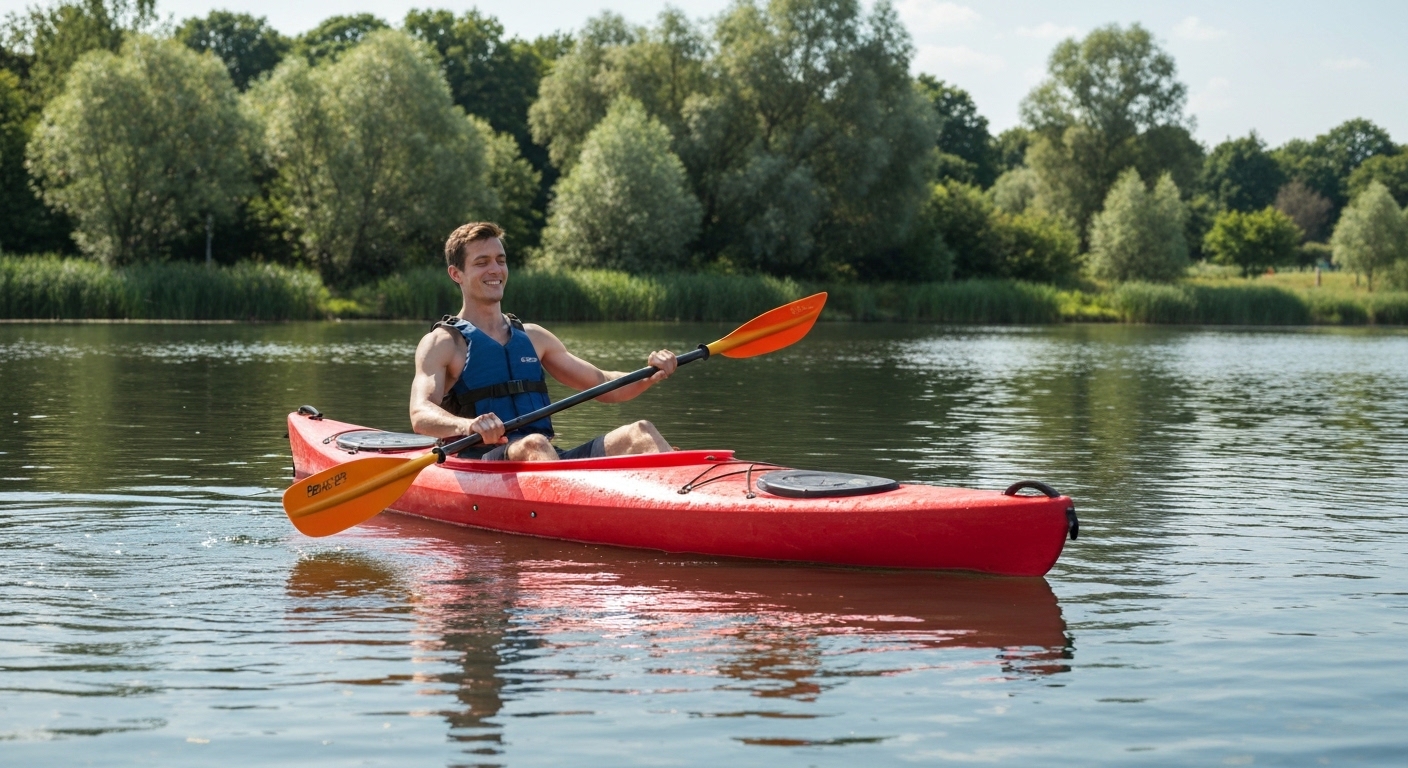
Recreational kayaking — meaning a sit-in or sit-on-top kayak on a lake, calm river, or protected bay — is different. The boats are wide, low, and stable. You’re seated, so your center of gravity is low. The paddle gives you natural outrigger balance on both sides. And flat water doesn’t fight back.
Most beginners report that within the first 15 to 30 minutes, the anxiety fades and it just starts to feel fun. That’s a fast learning curve by any outdoor sport standard. If you’re picking your first boat, the hull shape matters a lot here — wide, flat-bottomed recreational kayaks are specifically designed to be forgiving. Check out our guide to best beginner kayaks to see which designs make the easiest starting point.
What Actually Feels Tricky at First
Being honest about the friction points helps you prepare for them instead of being surprised. Here are the four things beginners most commonly struggle with on day one:
Going Straight
This is the number one beginner surprise. You push off, take a few strokes, and the kayak drifts sideways or spins. It feels like the boat has a mind of its own. The fix is learning to alternate strokes cleanly and use small corrective strokes — it clicks quickly, usually within the first 20 minutes. Longer kayaks track straighter naturally, which is another reason beginner-friendly kayak designs tend to be at least 10 feet long.
The Forward Stroke
It looks like you just dip and pull, but the efficient forward stroke uses your torso, not just your arms. New paddlers almost always rely on arm strength at first, which tires them out fast and produces a splashy, inefficient stroke. A five-minute tip from an experienced paddler — or even a short video before you go — makes a noticeable difference. Rotate your shoulders, plant the blade fully, and pull through with your core.
Getting In and Out
Boarding a kayak from a dock or a rocky shoreline feels unstable until you’ve done it a few times. The trick is to keep your weight low and centered, use the paddle as a brace if you need it, and move deliberately rather than quickly. Wet entry and exit — where you capsize and need to get back in — is a separate skill worth knowing before your first solo outing. We cover that in detail in our kayak self-rescue guide.
Wind
Calm water on a windless day: genuinely easy. Add even a moderate crosswind and the kayak wants to weathervane (turn into the wind). This isn’t dangerous on flat water, but it is annoying and tiring if you don’t know how to compensate. The solution is edging your boat slightly and using sweep strokes — techniques you’ll pick up naturally after a session or two. For your first time out, choose a low-wind day and a sheltered location.
What Makes Kayaking Easy: The Three Big Factors
Kayaking gets a reputation for being accessible because a few key variables line up in your favor right from the start.
Stable recreational kayaks. The rec kayaks most beginners rent or buy are built wide (28 to 34 inches) and flat on the bottom. They’re almost impossible to tip over on calm water without actively trying. This is a different experience than a narrow touring or sea kayak, which demands more body awareness. Start on a rec kayak and the balance question basically answers itself.
Calm, flat water. A sheltered lake or slow river removes almost every hazard that makes paddling feel difficult. No currents, no wake, no unpredictable wind. You can focus entirely on figuring out your strokes and getting comfortable in the boat.
A short lesson or a patient friend. You don’t need a multi-day course. Even one hour with someone who knows what they’re doing — or a guided rental where the outfitter runs a quick orientation — removes most of the confusion. The fundamentals of recreational kayaking are genuinely teachable in under an hour.
How Fit Do You Need to Be?
Less fit than you might think. Recreational kayaking on flat water is a low-intensity aerobic activity. A healthy adult paddling at a relaxed pace burns roughly 200 to 350 calories per hour — similar to a casual bike ride. The limiting factor for most beginners isn’t cardiovascular fitness; it’s technique.
If you’re using your arms correctly — meaning you’re engaging your core and torso rather than just yanking with your biceps — you can paddle for hours without exhausting yourself. If you’re doing it wrong, you’ll wear out your arms in 20 minutes. This is why technique matters more than strength.
That said, people with limited upper body mobility or shoulder issues should take it slowly at first and pay attention to stroke mechanics. The paddle shouldn’t be something you’re muscling through the water — it should feel controlled and rhythmic.
Age is not a barrier. Kayaking is popular with older adults precisely because the impact is zero and the fitness threshold is low. Kids as young as 5 or 6 paddle confidently in youth kayaks. The sport scales to almost any fitness level.
What the Learning Curve Actually Looks Like
Here’s a realistic timeline for a complete beginner:
First 30 minutes: You’ll find your balance, get a feel for the paddle, and start moving in roughly the direction you intend. You’ll make some crooked lines. That’s normal.
After 1 to 2 hours: Your strokes will be noticeably cleaner, you’ll be able to hold a reasonably straight course, and most of the awkwardness will be gone. You’ll start noticing the water instead of just managing the boat.
After a few outings: You’ll be paddling efficiently enough to cover real distance, read simple currents, and handle light wind. This is the point where kayaking stops feeling like a skill you’re learning and starts feeling like something you just do.
Beyond that, the learning never fully stops — there are always new skills to develop, from bracing and rolling to reading tides and navigating moving water. But those are optional depth levels. Enjoyable, basic recreational kayaking is available to you on your very first day.
It’s also worth thinking about safety from the start. Even easy paddling involves being on open water, and good habits — wearing your PFD, staying close to shore on your first outing, knowing what to do if you flip — matter regardless of your skill level. Our guide to is kayaking safe covers the real risk picture honestly.
Tips for Your First Time Out
A few practical things that make day one go better:
- Pick a calm, sheltered location. A small lake or a slow-moving river without boat traffic is ideal. Save the open bay or the exposed shoreline for after you’ve got the basics down.
- Dress for the water temperature, not the air temperature. If you go in, the water is what you’re soaking in. On cold water, a wetsuit or dry suit is worth considering even on a warm day.
- Wear your PFD the whole time. Not on the deck behind you. On your body. It only works if it’s on.
- Start with a rental or a demo. Don’t buy a kayak before you’ve paddled a few different types. Outfitters exist specifically to let you try before you commit. Our breakdown of beginner kayak options can help you narrow it down once you know what you like.
- Take a slow first hour. Resist the urge to immediately paddle to the far end of the lake. Spend time close to shore, practice turning, practice stopping, and get comfortable with how the boat responds. You’ll have more fun and you’ll learn faster.
- Know the self-rescue basics before you go solo. Capsizing in calm water is rarely dangerous, but knowing how to handle it — before it happens — removes a lot of anxiety. Read through our kayak self-rescue guide before your first solo trip.
Kayaking rewards curiosity and patience more than it rewards athleticism. Go in expecting to be a little clumsy at first, give yourself permission to make crooked lines, and you’ll almost certainly come off the water wondering why you waited so long to try it.