
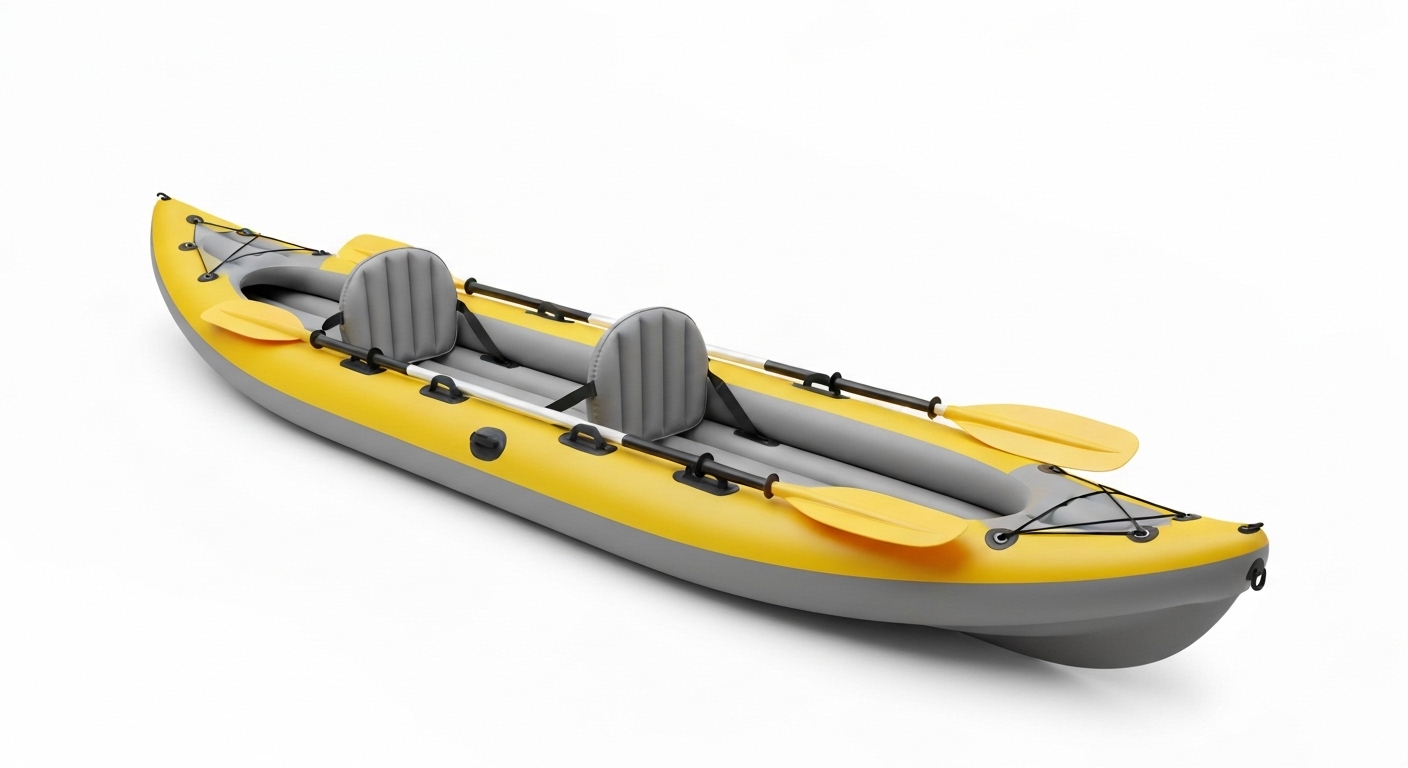
Intex Explorer K2 Review
The Intex Explorer K2 is the most accessible entry point into tandem kayaking — cheap, packable, and surprisingly fun on calm flatwater — but its soft vinyl and sluggish tracking mean it earns its budget-tier price tag honestly. Buy it to get two people on the water for under $100; don't buy it expecting hardshell performance.
We inflated, loaded, and paddled the Intex Explorer K2 on a dead-calm lake and a slow, meandering river section over two separate outings before writing a word of this review. At $90 it costs less than a single decent life jacket for a hardshell kayak, so our expectations were calibrated accordingly — and it still managed to surprise us in a few ways, good and bad.
The K2 is genuinely built for two beginners who want to share a low-stakes paddle on flatwater: a pond, a lake, a slow creek on a windless afternoon. If that describes you, keep reading. If you have whitewater on your bucket list, ocean bays on your local paddle rotation, or a paddling partner who weighs close to 200 lb by themselves, we’d point you toward our best tandem kayak roundup instead, where harder-shell and higher-load options live.
Everything below is based on our own time on the water, cross-referenced against the spec sheet. No manufacturer talking points, no sponsored praise.
Intex Explorer K2 specs
| Capacity | 2-person |
| Length | 10′ 3″ |
| Max load | ~400 lb |
| Hull | Vinyl inflatable |
| Includes | 2 paddles + pump |
| Best for | Calm ponds & slow rivers |
What's in the Box and How Fast It Sets Up
Intex packages the K2 as a genuine all-in-one kit: the kayak itself, two 86-inch aluminum-shaft grip paddles, a two-chamber hand pump with a pressure gauge, and a repair patch for field fixes. That’s legitimately everything you need to paddle on day one except a life jacket — buy those separately and wear them, always.
Setup in our testing ran 12–15 minutes for two people alternating on the hand pump. Solo inflation is possible but your arms will notice it. The kayak has two separate air chambers (a smart redundancy feature) plus an inflatable I-beam floor that stiffens the hull once fully pumped. Recommended pressure is printed on the boat; don’t skip checking it — an underinflated K2 is noticeably softer and harder to track. The removable skeg snaps into a slot at the stern; it takes about 20 seconds and makes a measurable difference in straight-line travel, so always attach it.
Deflation and pack-down take about ten minutes. The boat folds into its included carry bag, which is genuinely compact — it fits in a car trunk, a closet, or the cargo area of a small SUV with room to spare. That packability is a real advantage over any hardshell option at any price.
On the Water: What It Actually Feels Like
We launched on a calm lake with both paddlers aboard, total load around 330 lb. The K2 sits higher on the water than a hardshell of similar length, which is partly a byproduct of the inflatable hull and partly the relatively shallow draft. Forward momentum feels easy for the first 100 yards; past that you start to notice that paddling an inflatable tandem efficiently requires synchronized strokes. When paddlers are out of sync, the bow wanders noticeably.
Top-end speed is modest. We clocked roughly 2.5–3 mph at a comfortable cruising pace. A recreational hardshell tandem of the same length would outrun it easily at the same effort level, but we weren’t racing — we were out for an afternoon float and the K2 delivered that without complaint.
On the river leg, with light current behind us, the kayak handled well in a straight line. In any kind of crosswind it pushed off-course faster than we’d like, even with the skeg installed. Winds above 10–12 mph made the session frustrating rather than enjoyable. Keep that in mind when you’re checking the forecast.
Stability and Tracking
Initial stability — the resistance to tipping side to side when sitting still or doing a slow pivot — is quite good for an inflatable. The wide 36-inch beam creates a stable platform and neither of our test paddlers felt nervous at launch or landing. If you’ve never kayaked before, you’re unlikely to tip on flatwater just by shifting weight or reaching for a water bottle.
Secondary stability — how the boat behaves when it’s already leaning — is a different story. The soft vinyl hull has more flex than any hardshell, and if both paddlers lean the same direction with any momentum, the boat can edge unpredictably. We never fully capsized but we got wetter than expected on a couple of river bends. This is a known characteristic of entry-level inflatables; it’s not a flaw so much as a physics reality.
Tracking (the ability to go straight without constant correction) is the K2’s weakest attribute. The skeg helps considerably — seriously, always attach it — but compared to even a budget hardshell, this boat requires more active steering input. Experienced paddlers will compensate automatically; true beginners should expect a short learning curve on anything but dead-still water. For a deeper look at how kayak shape affects performance, the American Canoe Association publishes free paddling fundamentals resources worth bookmarking.
If you’re curious how load capacity affects stability and performance, our guide on kayak weight limit and capacity explains what those numbers actually mean in practice.
Who It's For — and Who Should Skip It
The K2 earns its place for a specific buyer: two adults who want to try kayaking together without a large upfront investment, have access to calm flatwater (lakes, ponds, slow rivers), and need something they can store in an apartment or toss in any vehicle. At $90 all-in with paddles and pump, the price-to-access ratio is genuinely hard to beat. It’s also a reasonable choice as a kids-and-parent boat, where load is light and splashing around is half the point.
Skip the K2 if any of these apply: you paddle regularly and care about efficiency; your combined paddler weight approaches 350–400 lb; you’re eyeing coastal bays, ocean inlets, or moving whitewater; or you want a boat that will last more than two or three seasons of regular use. The vinyl is thin, the seats lack lumbar support, and the hardware (paddle joints, valve caps) feels exactly as cheap as the price implies. For those use cases, our best beginner kayak guide covers options that cost more but hold up meaningfully better.
Bottom line on durability: treat it gently, rinse it with fresh water after every paddle, store it out of UV exposure, and the K2 can last several years of occasional use. Run it over a rocky put-in or leave it inflated in direct sun for weeks and you’ll be patching it sooner than you’d like.
What we liked
- Sub-$100 all-in price — paddles and pump included
- Compact packable size fits any vehicle or apartment closet
- Solid initial stability for first-time paddlers on flatwater
- Two separate air chambers add a basic safety redundancy
- Removable skeg meaningfully improves straight-line tracking
- Genuinely easy to share and transport as a tandem
The catches
- Thin vinyl is vulnerable to abrasion on rocky launches and landings
- Tracks poorly in any crosswind, even with skeg attached
- Low-profile seats offer no lumbar support on paddles longer than an hour
- Noticeably slower and less efficient than any comparable hardshell
Frequently Asked Questions
Is the Intex Explorer K2 good for beginners?
Yes, for the right conditions. On a calm lake or slow river with no wind, the K2 is forgiving enough for two complete beginners — it’s stable at rest, cheap enough to experiment with, and comes with everything you need. The catch is that beginners will notice the wandering tracking faster than experienced paddlers, so set realistic expectations for your first outing. Start on truly flat, protected water and you’ll have a good time.
Can two full-sized adults actually fit comfortably?
Two adults fit, but comfort depends on body size. The K2’s 400 lb capacity gives you technical room for two average adults plus a little gear, but at higher combined weights the hull sits lower, stability decreases, and paddling gets sluggish. Two paddlers each over 180 lb should look at a higher-capacity tandem. Legroom is adequate but not generous; paddlers over 6’2″ may find the cockpit cramped for longer trips.
Can you use the Intex Explorer K2 on the ocean?
We’d strongly advise against it. The K2 is designed and rated for calm flatwater — lakes, ponds, and slow rivers. Ocean conditions introduce swell, chop, tidal currents, and offshore winds that the boat’s soft hull and minimal tracking are not equipped to handle safely. Even protected ocean bays can turn dangerous quickly. If you want to paddle coastal water, you need a sea kayak or a much more capable inflatable built for open-water conditions.
Does the K2 puncture or flip easily?
Punctures are possible if you drag the hull over sharp rocks, sticks, or barnacled surfaces — the vinyl is thin. On smooth sandy launches or grass, it holds up fine. The included repair patch handles small punctures, and the two-chamber design means one puncture won’t sink you. Flipping on flat, calm water is unlikely for most paddlers, but the boat does edge unpredictably if both paddlers lean hard in the same direction simultaneously. Stay centered and you’re fine.
How long does it take to inflate the Intex Explorer K2?
Using the included hand pump, plan on 12–15 minutes with two people alternating or one person working steadily. The I-beam floor takes the longest to firm up. An aftermarket 12-volt electric pump — widely available for around $20 — cuts inflation to four or five minutes and is worth every penny if you paddle regularly. Always check the pressure markings on the hull; an underinflated K2 handles noticeably worse than a properly pressurized one.