How to Stand Up on a Paddle Board
Standing up on a paddle board takes about ten minutes to learn — if you know the exact sequence.
Read the full beginner guideTo stand up on a paddle board, start on your knees in the center of the board, place your hands on the rails, then rise one smooth motion — feet hip-width apart over the carry handle, eyes on the horizon, knees soft. Most people fall because they look down or stand too fast; fix those two things and you’ll be upright on your first or second try.
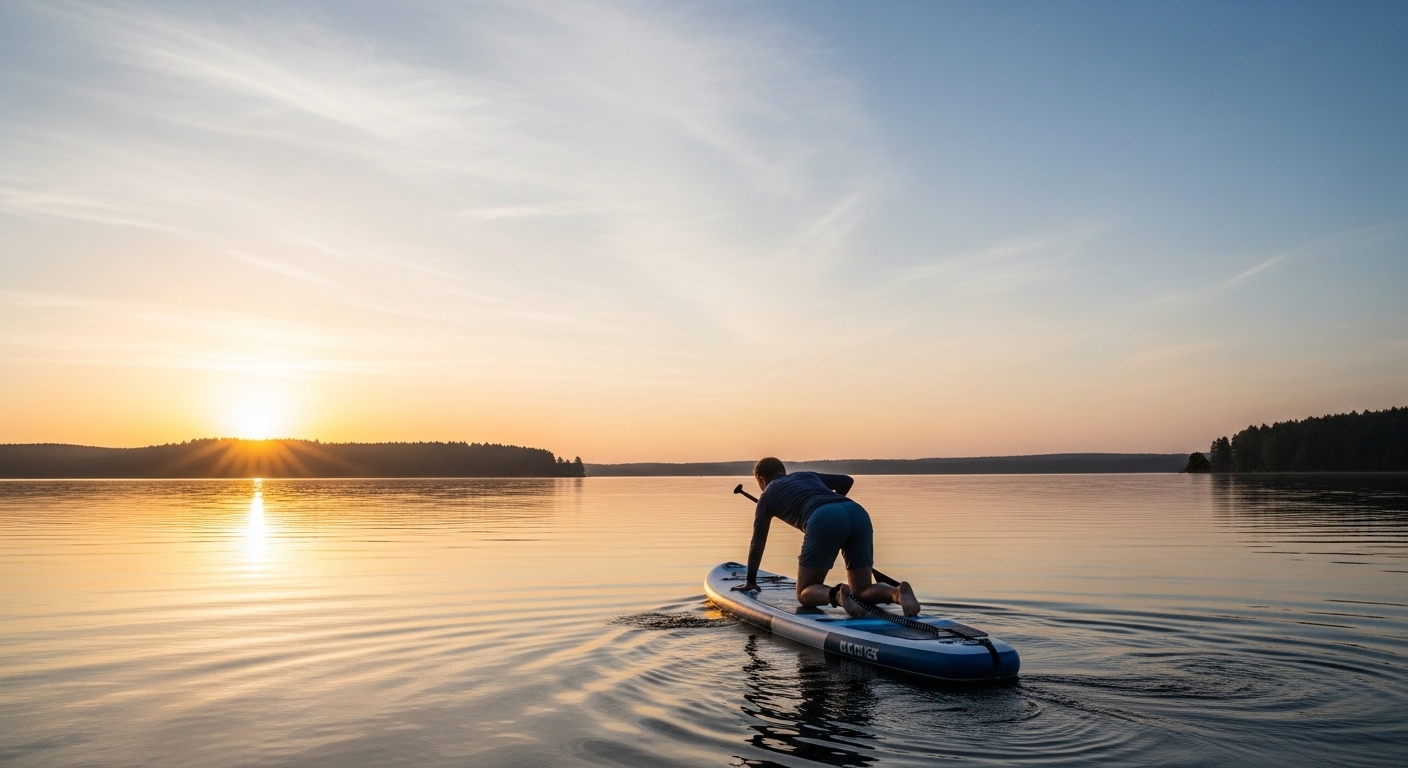
Start on Your Knees — Not Your Feet
Before you even think about standing, paddle out to calm, flat water away from shore traffic. Kneel on the board with your shins flat on the deck, centered fore-to-aft so neither the nose nor the tail dips. This kneeling position is your launch pad, not a compromise — it’s how every competent instructor teaches beginners, and it works because your center of gravity is low and the board is already balanced under you.
Spend sixty seconds just paddling from your knees. Feel how the board responds to your weight shifting forward and back. Notice that small movements cause small reactions. That feedback loop is exactly what you’ll rely on once you’re standing.
Hand Placement Before You Rise
This is the step most tutorials skip, and it’s why people nosedive. Before you attempt to stand, grip the rails — the side edges of the board — with both hands, roughly level with your hips. Your fingers wrap under the edge, thumbs on top. This hand position gives you two things: a push-up base that drives your hips upward instead of forward, and a stabilizing anchor that keeps the board from rocking sideways as your weight shifts.
Lay your paddle flat across the deck in front of you or tuck it under one arm. You cannot hold your paddle and the rails at the same time during the transition, and trying to manage the paddle mid-stand is one of the most common reasons first-timers end up in the water.
- Kneel centered, shins flat, hips over heels.
- Grip the rails at hip level, fingers under, thumbs on top.
- Tuck or set the paddle — not in your hands.
- Look up at the horizon. Not at the board. Not at your feet. The horizon.
The One-Smooth-Motion Stand
Here is the actual move: push through your hands, raise your hips, and bring your feet up to replace your knees — all in one continuous motion, not two or three jerky stages. Think of it less like a jump and more like a slow-motion burpee. The second you pause mid-way with your butt in the air, the board starts to wobble and your brain starts to panic.
Your feet land hip-width apart, toes pointing forward, positioned over the carry handle — that center carry handle molded into the deck is almost always the true balance point of the board. If your board doesn’t have a visible handle, aim for center-of-deck, roughly equidistant from nose and tail.
Once your feet hit the deck, straighten up — do not crouch and wait. A half-stand with a bent spine is less stable than simply standing up because your weight is concentrated low and forward. Rise, take a breath, and feel the board settle under you.
Foot Position, Eye Line, and Soft Knees
Once upright, three things keep you there: feet, eyes, and knees.
Feet: Hip-width apart, both feet parallel and centered over the carry handle. Avoid the instinct to stagger one foot forward — it feels stable on land but twists your hips on the water and makes every side-to-side ripple a bigger threat.
Eyes: Fix your gaze on a point at or near the horizon — a buoy, a tree on the far bank, a cloud. Looking down at your feet is the single fastest way to fall. Your vestibular system uses that horizon reference to make constant micro-corrections; take it away and the corrections stop.
Knees: Soft, not locked. A slight bend in the knee acts like a suspension system, absorbing small chop and wakes. Locked knees transfer every ripple straight up your spine and into your balance. You don’t need a deep squat — just unlock the joint so it can move.
Learning these mechanics well is the foundation of how to paddleboard at any level. Get them dialed here and every other skill — turning, surfing, downwinding — builds on top cleanly.
Recovering a Wobble Without Going In
The board will wobble. That is not a problem — that is the sport. What matters is how you respond.
When you feel a wobble coming, do not freeze or grab at the air. Instead: drop your gaze back to the horizon, soften your knees, and lower your arms out to your sides slightly, paddle in one hand, like a tightrope walker. That wider arm position drops your center of mass and dramatically increases rotational stability.
If the wobble intensifies, bend your knees more and get your weight slightly back over your heels — most people fall forward off the nose, not backward off the tail. A controlled knee-drop back to kneeling is never a failure. It is a skill. The American Canoe Association teaches controlled falling and recovery as core safety fundamentals — returning to your knees is part of the progression, not a step backward.
Common Reasons People Fall (and How to Fix Them)
After watching dozens of beginners learn this move, the same mistakes appear over and over:
- Looking down. Fix: tape a sticker at eye level on a dock post across the water and stare at it. Force the habit.
- Standing in two stages. Fix: say “one motion” out loud before every attempt. The verbal cue interrupts the instinct to pause mid-way.
- Feet too close together. Fix: before you rise, consciously widen your knees on the board so your feet naturally land hip-width when they follow.
- Wrong board for your weight or skill level. Fix: check our best beginner paddle boards guide — volume and width matter enormously for first-timers. A 10-inch-wide board that worked for your friend may be a liability for you.
- Tense upper body. Fix: shake your shoulders out while kneeling. Tension travels down into the board and amplifies every micro-movement.
- Choppy conditions. Fix: learn on glass-flat water before you attempt anything with wind or boat wake. Even a 5 mph wind on a small lake creates enough surface texture to make the learning curve twice as steep.
Balance drills that actually work: (1) While kneeling, shift your weight left and right until you can feel the rail touching the water without going over — this builds board-feel. (2) Standing, close your eyes for three seconds, open them, re-find the horizon — this trains your recovery reflex. (3) Have a friend create small wakes by pressing down on the nose or tail while you hold your stance — controlled chaos builds real stability faster than calm water alone.