
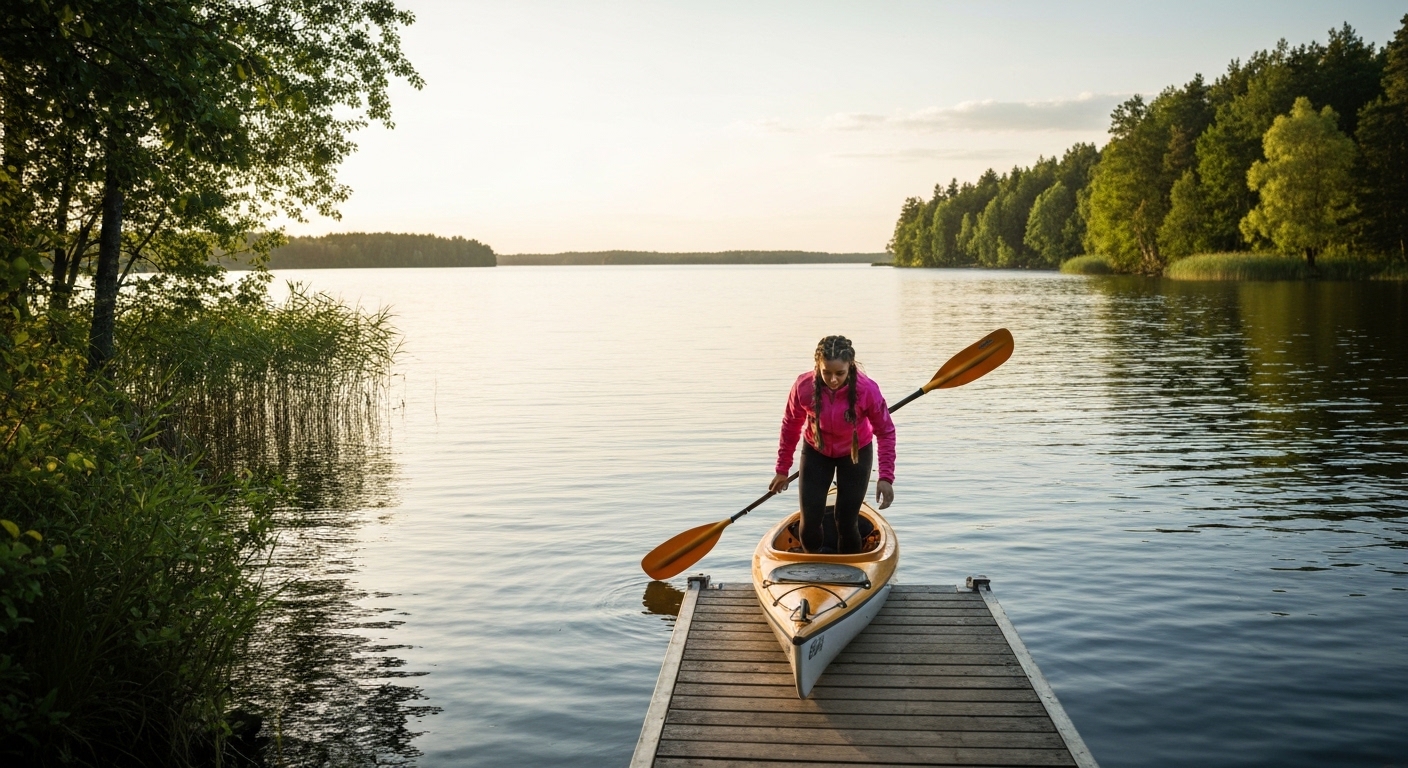
How to Get In and Out of a Kayak
Getting in and out of a kayak is the part nobody warns you about — and the part that ends most beginner sessions with a wet seat and a bruised ego.
Best beginner kayaksPaddling itself is the easy part. The tricky moments are right at the edge of the water: one foot in the kayak, one foot on the dock, paddle going everywhere, boat slowly drifting away. Every paddler has been there. This guide covers the honest, practical techniques for getting in and out of a kayak from a beach, a dock, or deep water — including the specific differences between sit-in and sit-on-top designs, and what to do if your knees or balance make this harder than it looks.
The Three Principles That Apply Every Time
Before covering entry methods, it helps to burn three rules into muscle memory. Break any of them and the kayak will remind you immediately.
- Stay low. A high center of gravity is your enemy. Drop your body toward the boat — don’t stand over it.
- Keep weight centered. A kayak tips sideways, not forward or back. The moment you load one side — a heavy step, a leaning arm — the boat rolls toward that side. Keep your weight directly over the centerline.
- Maintain three points of contact. At any moment during entry or exit, three of your four limbs should be touching something stable — the boat, the shore, the dock. Two points is manageable; one point is a swim.
These principles apply whether you’re getting into a sit-in vs sit-on-top design, launching from sand or rock, or climbing back in from the water.
Getting In from a Beach or Shore
A beach entry is the most forgiving launch. The boat sits on soft ground, can’t drift, and you have solid footing. There are two techniques that work well.
The Straddle Method
Position the kayak so the cockpit is in shallow water — just an inch or two of depth, enough that the hull floats but the stern is still grounded on the sand. Stand directly behind the cockpit, straddling the boat with one foot on each side of the hull. Lower yourself straight down into the seat, keeping your weight centered as you descend. Once your backside hits the seat, lift one leg at a time and slide your feet into the cockpit. This works well for sit-in kayaks with a defined cockpit and is the technique most instructors teach first.
The Sit-Then-Swing Method
Sit on the back deck of the cockpit — not inside it yet, but on the solid plastic or fiberglass just behind the seat rim. Put both hands on the coaming (the cockpit rim) beside your hips for support. Lift your feet off the ground together and swing them into the cockpit in one motion, then lower yourself into the seat. This keeps your center of gravity low the whole time and is especially useful on uneven shorelines where straddling is awkward.
For sit-on-top kayaks, the process is simpler: the open deck means you can straddle the boat mid-hull, lower your weight onto the seat, and swing one leg at a time over the side. There’s no cockpit rim to navigate.
Getting In from a Dock
Dock entries are trickier because the dock is elevated, the water is typically deeper, and the kayak can drift. Low docks are easier; high docks require more caution.
Low Dock Entry
Position the kayak parallel to the dock edge, cockpit lined up with where you’ll be sitting. Place your paddle behind the seat, lying across both the dock and the rear deck of the kayak — this creates a third point of stability and keeps the paddle from floating away. Crouch or sit on the dock edge. Put your nearest hand on the paddle shaft where it crosses the cockpit, grip the dock with your other hand. Lower yourself into the seat using your arms to control the descent, keeping weight centered as you move from dock to kayak. Once seated, lift your legs in. The paddle-behind-the-seat trick is the single most useful dock technique beginners don’t know.
High Dock Entry
If the dock sits more than 18 inches above the water, belly down is safer than sitting down. Lie on the dock edge and lower yourself feet-first into the cockpit, using your arms to control the movement. It looks awkward but keeps your weight low and reduces the risk of tipping.
Getting out from a dock is the reverse: use the paddle-behind-the-seat for stability, place both hands on the dock edge, and push yourself up and onto the dock in one smooth motion. Pause in a crouch before standing fully upright — standing from a kayak onto a dock in one motion is how people fall in.
Sit-In vs Sit-On-Top: What Changes
The mechanics of entry and exit shift depending on which hull style you’re paddling.
Sit-on-top kayaks are inherently more beginner-friendly for entry and exit. The open deck means you can approach from any angle, there’s no cockpit to thread your legs through, and if you do tip, reboarding is straightforward. The trade-off is that your legs are exposed and the boat rides higher on the water, making it slightly less stable in choppy conditions.
Sit-in kayaks require more precision during entry — you’re lowering yourself into a defined hole and threading your legs under a deck. They’re also harder to re-enter from the water without practice. The payoff is a lower center of gravity, better control in rough water, and protection from the elements.
If you’re choosing your first kayak and entry/exit ease is a priority, check out our guide to best beginner kayaks — hull shape and cockpit size vary significantly between models and have a real impact on how easy launch and landing feel.
Deep Water Re-Entry
Capsizing happens. Knowing how to get back in from deep water is not an advanced skill — it’s a safety fundamental, and you should practice it in a controlled setting before you need it in the wild.
Sit-on-top re-entry is the simpler case. Right the boat if it flipped, approach from the side amidships (the middle), kick your legs to generate upward momentum, and lever yourself up and over onto the deck like you’re climbing out of a pool. Once your belly is on the deck, rotate to the seated position.
Sit-in re-entry is harder and usually requires a paddle float, a piece of foam or inflatable gear that slides onto your paddle blade and acts as an outrigger. The full self-rescue sequence is detailed in our guide to kayak self-rescue — cover that before paddling in water that’s cold, deep, or far from shore.
For both hull types: empty as much water from the cockpit or deck as possible before climbing back in. Trying to board a half-flooded kayak is exponentially harder.
Tips for Bad Knees, Limited Flexibility, and Balance Issues
The standard entry techniques assume a functional range of hip and knee flexion. If you’re working around an injury, recovering from surgery, or just finding the low-to-the-ground movements uncomfortable, there are adjustments that help.
- Use a dock over a beach. Beach entries require getting down to near-ground level. A low dock keeps you higher and lets you slide in with less deep knee bend.
- Keep a paddle float or a second paddle for support. Extending the paddle-behind-the-seat setup with a float gives you a wider, more stable outrigger to lean on during entry.
- Try a sit-on-top with a high seat. Some recreational sit-on-tops have raised, chair-style seats that reduce how far you have to lower yourself.
- Use a kayak launch cart or dock step. A few outdoor retailers sell folding kayak dock steps — essentially a small platform that bridges the height gap between dock and waterline.
- Don’t rush. Most entry-related falls happen when paddlers try to move quickly through the awkward phase. Slow is smooth; smooth is dry.
What Not to Do
The fastest way to end up swimming is to ignore the basics. A short list of common mistakes:
- Don’t stand up inside the kayak. Not at the dock, not on shore, not to grab something you dropped. Kayaks are not designed to support a standing human — the hull will roll the moment your center of gravity rises above the gunwales.
- Don’t load weight to one side. Reaching across the boat, stepping in on the left while holding the right rail, tossing gear bags onto one side — all of these create an off-center load that the hull will correct for by rolling.
- Don’t let the boat drift before you’re in. On a dock, always secure the kayak to a cleat or have a partner hold it before you begin entry. A boat that’s moving laterally away from you as you sit down will win every time.
- Don’t skip the paddle setup. Getting into a kayak and then realizing your paddle is behind you, floating away, or tangled under the dock is a frustrating and sometimes dangerous situation. Get the paddle positioned and accessible before you get in.
- Don’t get out by standing on the seat. Push yourself up from the cockpit rim or the dock edge — not the seat itself. Kayak seats are not designed as step platforms and can crack or detach under direct downward force.