The honest answer: anywhere from $200 to well over $2,000. But the real question isn’t “what’s the cheapest board I can find” — it’s “what price gets me a board that won’t ruin my first season?” This guide breaks down every tier, what you actually get for the money, and where most people should land.
Budget Boards: $200–$400
This tier exists, and some of it is fine. But it comes with a warning label.
Boards under $300 — especially the ones flooding Amazon with four-star reviews and stock-photo lifestyle shots — are almost always single-layer PVC construction. That means a thin, flexible shell that wobbles underfoot, loses pressure on hot days, and has a lifespan measured in seasons rather than years. Paddlers who buy here often describe the feeling as “standing on a pool toy.” That’s not an exaggeration. At $250, that’s largely what you’re getting.
The $300 mark is a genuine danger zone. You’re paying real money for something that behaves like a toy, and it creates the false impression that SUP isn’t fun — when the board is the problem, not the sport.
That said, there are legitimate boards in the $350–$400 range from brands like paddle board brands such as Thurso and ROC that use fusion or double-layer construction. If your budget is hard-capped at $400, shop carefully, read construction specs (not just star ratings), and stick to brands with real return policies. These boards work fine for calm water, occasional use, and lighter paddlers.
Mid-Range Boards: $400–$900 — Where Most People Should Shop
This is the sweet spot, and it’s not even close.
At $400–$900, you get double-layer or fusion-layer drop-stitch construction — boards that hold pressure reliably, feel stable and rigid underfoot, and last five to ten years with normal care. The difference between a $280 board and a $550 board isn’t marginal; it’s the difference between fighting your equipment and actually learning to paddle.
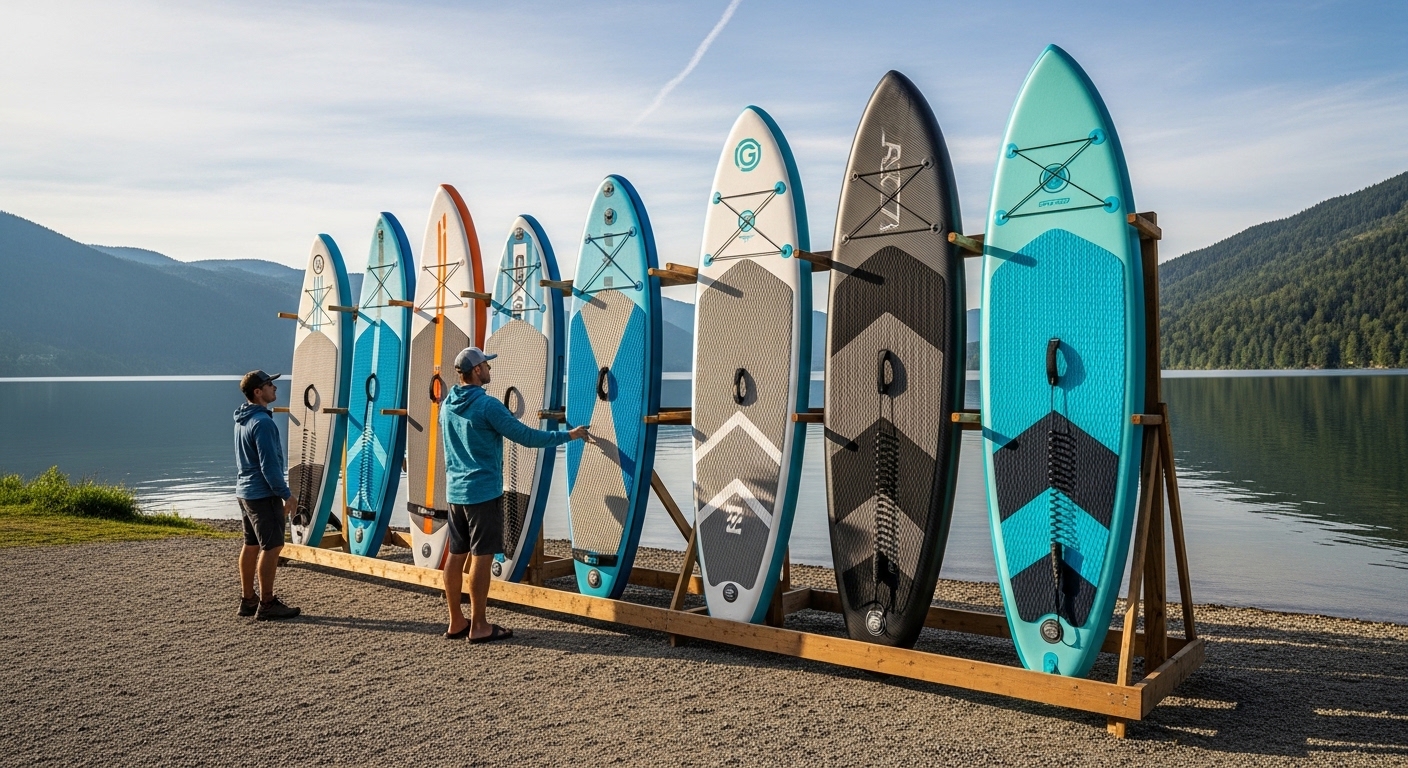
Most quality all-around inflatables — the 10’6″ to 11′ boards that work for flat water, light surf, yoga, and touring — live in this range. Brands like iRocker, Bluefin, Atoll, and Gili all offer well-built boards between $450 and $750. Our full breakdown of the best paddle boards is weighted heavily toward this tier for exactly that reason.
What you typically get in a mid-range bundle:
- The board itself (inflatable or entry hard board)
- A 3-piece aluminum or fiberglass paddle (often adjustable)
- A hand pump or dual-action pump
- A leash
- A carry bag or backpack
Not every bundle is equal — check whether the paddle is adjustable and what the pump max PSI is. A pump that tops out at 12 PSI when your board needs 15 PSI is a problem you’ll notice immediately.
Premium Inflatables: $900–$1,800+
At this level, you’re paying for materials, precision, and longevity — not just a brand name.
Premium inflatables use woven or carbon-reinforced drop-stitch cores, which produce a noticeably stiffer ride than standard double-layer construction. Boards from Red Paddle Co, Starboard, Fanatic, and Mistral in this range are measurably closer to hard board performance. The rails are tighter, the nose rocker is more purposeful, and the fins are often touring-grade.
Carbon fiber paddles — which you’ll want at this level — are sold separately and typically cost $150–$400 on their own. The bundled paddle in a $1,200 kit is usually still fiberglass, so budget accordingly.
Specialty boards also enter the picture here: dedicated touring boards (longer, narrower, faster), race boards, fishing-specific platforms with extra D-rings and cooler mounts, and yoga boards with full-deck traction pads. If you know your use case well and paddle multiple times a week, the premium tier makes financial sense over time.
Hard Boards: $600–$3,000+
Hard (epoxy or fiberglass) boards are a different product category entirely, and price ranges reflect that.
Entry hard boards — typically epoxy “soft-top” construction — start around $600 and offer excellent stability and durability. They’re popular for rentals and surf-oriented paddling. Mid-range hard boards from brands like Tower, BIC, and Bark run $800–$1,400 and cover all-around and surf shapes. High-end carbon race and touring boards from Naish, Starboard, and C4 Waterman can push $3,000+.
Hard boards perform better in surf, feel more responsive, and glide more efficiently at speed. The tradeoffs: they’re heavy (20–30 lbs vs. 17–25 lbs for inflatables), require roof rack transport, and are harder to store. For most recreational paddlers, the convenience of an inflatable outweighs the performance difference. For surfers or competitive paddlers, hard boards are worth the logistics.
Hidden and Ongoing Costs to Budget For
The board price is rarely the full cost. Here’s what commonly gets added:
- PFD (personal flotation device): Required by the Coast Guard in most situations. A decent SUP-specific belt PFD runs $80–$130. Don’t skip this.
- Better paddle: The aluminum paddle that ships with most bundles is heavy. Upgrading to a carbon or high-grade fiberglass paddle ($120–$350) makes a noticeable difference after 30 minutes on the water.
- Electric pump: Hand pumps work, but inflating a board to 15 PSI by hand takes real effort. A quality electric pump (Shark, Outdoor Master) runs $60–$120 and pays for itself in convenience immediately.
- Roof rack or car-top carrier: If you own a hard board or want to transport an inflated board, add $80–$200 for foam blocks or a proper rack system.
- Sun protection and storage: Board bags, UV-protective covers, and fin replacements are small but real line items over time.
A realistic “total cost to get on the water properly” for a mid-range inflatable setup: $600–$800 after accounting for the board, PFD, pump, and an upgraded paddle.
Renting vs. Buying — and What Boards Resell For
Renting makes sense if you’re trying the sport for the first time or paddling somewhere once. Rental rates run $20–$50 per hour or $75–$150 per day depending on location and board quality. After five to eight rental sessions, you’ve spent enough to buy a solid mid-range board outright.
If you paddle more than once a month during the season, buying wins economically within the first year.
On resale: quality mid-range inflatables hold value reasonably well. A $600 board in good condition typically resells for $250–$375 after two to three years. Boards in the $200–$350 range resell for almost nothing — $75 to $125 if you’re lucky — because the used market is flooded with them and buyers know what they are. That’s another reason the budget tier is a false economy: you lose more money in resale.
Premium inflatables from Red Paddle Co and Starboard hold value better than most — 40–55% of original price after several years of use is common if the board is well-maintained.
Looking for specific model recommendations at each tier? Our guide to the best budget paddle boards covers the top picks under $500, with construction specs verified before every recommendation.