
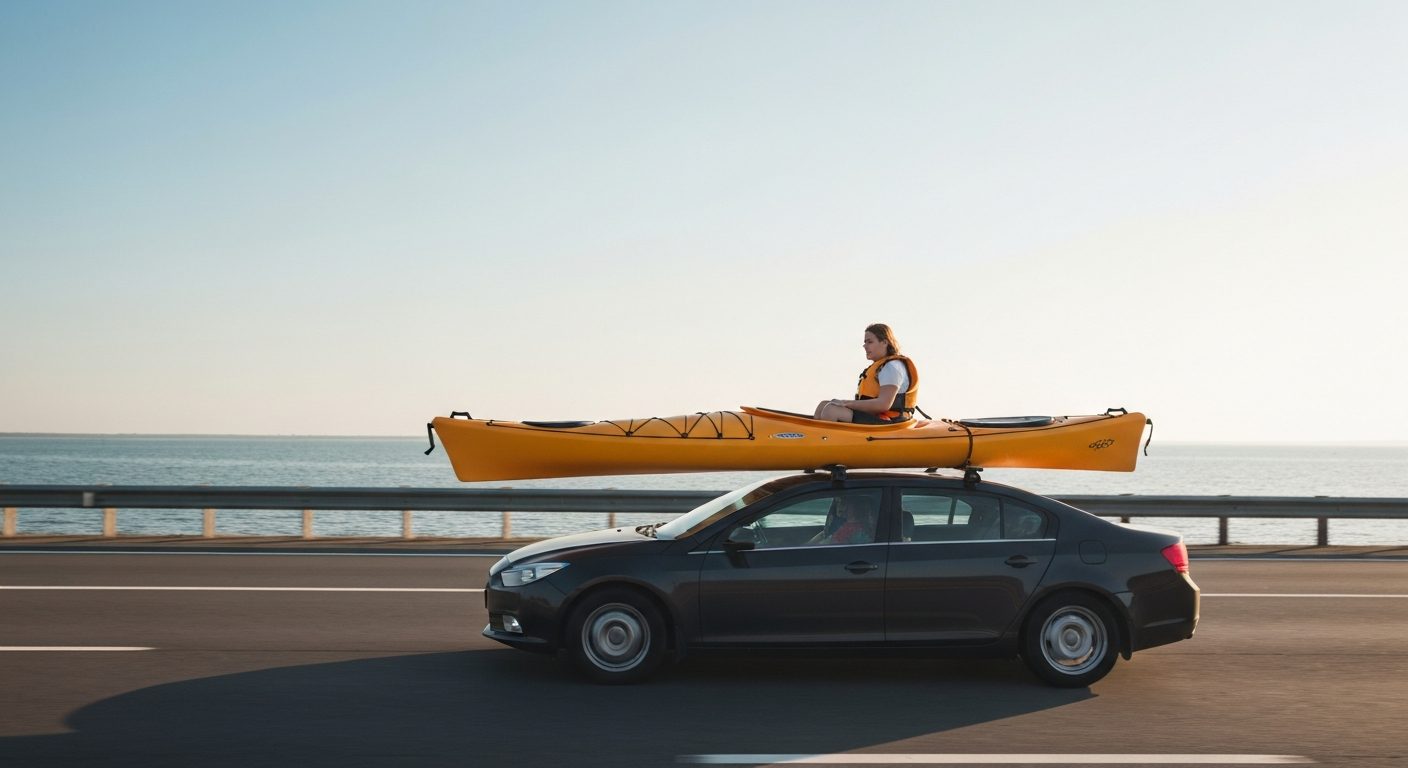
How Fast Can You Drive With a Kayak on the Roof?
Rack manufacturers rate their systems up to 80 mph, but once a kayak is on top, most experienced paddlers keep it under 65–70 mph — and slow down further when the wind picks up.
How to transport a kayakWe have hauled kayaks on everything from budget foam blocks to full Thule and Yakima rail systems, and the question we hear most before a road trip is: how fast is too fast? The honest answer depends less on your speedometer and more on how well your boat is tied down and what the wind is doing.
What the rack manufacturers actually say
Thule and Yakima both publish load ratings for their roof rack systems, and the numbers are more generous than most people expect. Many crossbar setups are engineered to handle dynamic loads at highway speeds up to 80 mph. That sounds reassuring until you realize those ratings assume a secure, aerodynamic load — not a 14-foot recreational kayak sitting broadside to a 20-mph headwind on I-95.
The rack rating is a ceiling, not a target. Rack engineers are accounting for the structural integrity of the crossbars and feet, not for the lift and drag forces a large hull generates at speed. Think of it the way you think about a car’s top speed: technically capable, practically inadvisable under real-world conditions.
Our rule of thumb: if the rack is rated to 80 mph, we treat 65–70 mph as the realistic highway ceiling with a single kayak loaded. That buffer gives us room to deal with gusts, truck wake, and the occasional lane change without white-knuckling the steering wheel.
Why slower is safer — wind load explained
Speed and wind load do not scale in a straight line. Aerodynamic drag increases with the square of velocity, which means going from 55 mph to 75 mph does not just add a little stress to your straps — it nearly doubles the aerodynamic force acting on that kayak. Add a natural crosswind of 15–20 mph and the effective wind speed hitting your hull can exceed 80 mph even if your speedometer reads 65.
A kayak is essentially a sail bolted to your roof. The hull catches air from the front, sides, and beneath the boat, generating both drag (pulling backward) and lift (pushing upward). Lift is the dangerous one. If your bow and stern lines are loose or missing, lift can work its way under the hull and start bouncing the boat — a precursor to a strap failure.
According to the American Canoe Association, improperly secured boats are a leading cause of roof-rack incidents on the highway. The speed limit on the road is not the speed limit for your load.
Securing a kayak for highway speeds
Good security changes everything. A properly tied kayak at 70 mph is safer than a sloppily loaded one at 50. Here is what proper looks like:
- Two cam straps over the hull: Loop each strap around a crossbar, over the kayak, and cinch until snug — not crushing-tight, but with zero play. Twisted straps hum and loosen at speed; keep them flat.
- Bow and stern lines: These are non-negotiable on the highway. Run a line from the bow toggle to a tow hook or bumper anchor on the front of the vehicle, and repeat at the stern. Bow and stern lines prevent the front of the kayak from lifting and the whole boat from shifting forward or backward under braking. See our full walkthrough in our guide on how to tie down a kayak.
- J-cradles or saddles over foam blocks: Cradles hold the hull in a fixed orientation and reduce wind catch. Foam blocks work, but they allow more hull movement and put more stress on the straps alone.
For a deeper look at carriers and accessories that make highway transport safer, our best kayak accessories roundup covers the top-rated cradles and strap kits we have actually used. You can also review the full transport setup process in our guide on how to transport a kayak.
Signs your load is not secure
Even a well-loaded kayak can shift during a long drive. Here are the warning signs that mean you should pull over and re-check:
- Audible strap hum or flapping: Straps that whistle or slap at highway speeds have loosened or twisted. Both reduce holding force.
- Visible hull movement in your mirrors: The kayak should look locked in place. Any rocking, bouncing, or lateral wiggle is a red flag.
- Steering feels lighter than normal: Significant lift under the hull can subtly reduce front-end tire contact. If your steering feels unusually vague, slow down and stop.
- A strap has shifted off the hull: Straps can migrate toward the cockpit opening or off the edge of a flat-decked hull at speed. Check strap position at every fuel stop.
We make it a habit to pull over after the first 10–15 miles of any road trip and do a full visual check. Straps that felt tight in the driveway often need a half-turn of cinching after the initial highway vibration settles the load. It takes three minutes and it has saved us more than once.
Frequently Asked Questions
Is it safe to go 70 mph with a kayak on top?
Yes, if the kayak is properly secured with two cam straps and bow and stern tie-down lines, 70 mph is within the safe operating range for most quality roof racks. The risk rises sharply if lines are missing or straps are loose, or if you encounter sustained crosswinds. On gusty days, we keep it at 60–65 mph as a precaution.
Can wind rip a kayak off the roof?
It can, and it has happened. A combination of high speed and a strong crosswind creates enough lift and lateral force to overcome loose or improperly routed straps. Bow and stern lines are the main defense against this — they resist the lifting and twisting forces that cam straps alone cannot fully counter. Always use them on highway trips.
Do foam blocks change the safe speed?
Foam blocks are a legitimate short-term option, but they are less secure than J-cradles or saddles at sustained highway speeds. They allow the hull to shift slightly under load, which puts more stress on your cam straps. If you are using foam blocks, we recommend staying under 60 mph and making more frequent stops to re-check strap tension and block position.
Should I slow down in crosswinds?
Absolutely. Crosswinds are more dangerous than headwinds because they push the kayak laterally, which cam straps are not primarily designed to resist. In crosswinds above 15–20 mph, drop your speed to 55 mph or less. If you feel the vehicle being pushed sideways or see the kayak moving in your mirror, slow down immediately and find a sheltered spot to re-secure the load.