
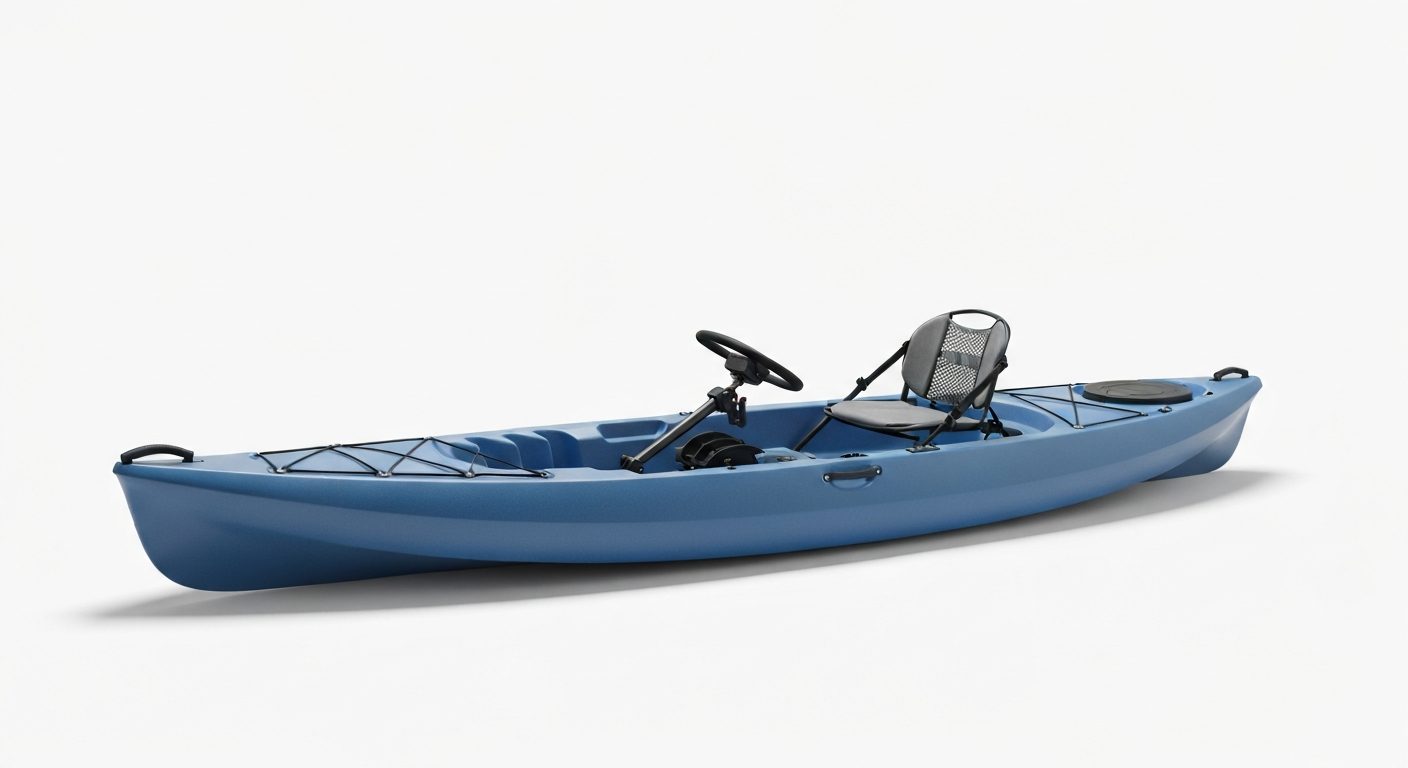
Hobie Mirage Passport 10.5 Review
The Hobie Mirage Passport 10.5 delivers the legendary MirageDrive pedal experience at the lowest price Hobie offers — and for hands-free fishing, birding, or photography in calm to moderate water, it earns every dollar. Just know what you're trading away: no rudder, no reverse, and 75 lb to haul.
We’ve tested a lot of pedal kayaks, and the question we get most often is: Do I really need to spend Hobie money? After putting the Mirage Passport 10.5 through its paces — flats fishing, estuaries, lake paddles, and one very weedy pond — our answer is: if hands-free propulsion is your priority, yes, the Hobie system is genuinely different. The Passport is the door into that ecosystem, and it opens surprisingly wide.
This is a sit-on-top kayak built for anglers, photographers, and casual explorers who want their hands free while the boat keeps moving. At 10’6″ and rated to 325–400 lb, it fits a wide range of paddlers. If you’re sorting out which drive style suits you best, our best pedal kayak guide runs the full comparison. But if Hobie’s fin drive has already caught your eye, read on — this is the honest breakdown.
Street price runs around $1,400 rigged, which is the lowest Hobie has ever charged for a MirageDrive boat. That context matters: you’re not comparing this to a $700 recreational sit-on-top. You’re comparing it to entry-level pedal kayaks from Perception, Old Town, and Pelican — and in that field, the Passport holds its own on the water even if the spec sheet looks leaner.
Hobie Mirage Passport 10.5 specs
| Type | Pedal sit-on-top |
| Length | 10′ 6″ |
| Max load | ~325-400 lb |
| Drive | MirageDrive kick-up fins |
| Reverse | No (fin drive) |
| Best for | Budget entry to Hobie pedal |
The MirageDrive fin pedal system
Hobie invented the fin-drive pedal kayak, and the MirageDrive is still the benchmark. Instead of a propeller spinning underwater, you push two curved fins back and forth in a wing-flap motion — the same mechanical principle dolphins use. The result is a smooth, quiet, fuel-efficient stroke that pulls you forward with almost no turbulence. On the water it feels closer to swimming than cycling.
The Passport ships with Hobie’s standard MirageDrive 180 — the same core drive unit used across most of the Hobie lineup. What makes it special for real-world fishing and exploring is the kick-up fin design. Hit a submerged rock, a oyster bar, or a thick weed mat, and the fins fold back automatically, then snap back into position. You don’t stop. You don’t reach down. The boat just keeps moving. For anyone who’s ever rammed a prop drive into grass and had to reach over the side to clear it, that difference is enormous.
Pedaling is comfortable at cruising pace — expect 3 to 4 mph on flat water with moderate effort. Sprint cadence gets you close to 5 mph, though that’s hard to sustain. One real limitation: the MirageDrive doesn’t reverse. To back up, you physically lift the drive unit, spin the boat with your paddle, or use a paddle stroke. Prop-drive competitors like the Old Town Sportsman PDL can pedal backward, which is genuinely useful when positioning near a dock or holding a line. The fin drive wins on shallow-water clearance and weed performance; it loses on maneuverability in tight quarters. Neither is objectively better — they’re different tools.
Stability, seat, and fishing features
The Passport 10.5 runs on a wide, flat hull that prioritizes initial stability over speed. Stand-up fishing isn’t the goal here — the hull is narrower than a dedicated stand-up platform — but sitting stability is excellent. We felt confident reaching, casting, and leaning to net fish without any alarming secondary rock. Beginners on flatwater should feel at ease within minutes.
The seat is a highlight. Hobie uses a breathable mesh design that keeps air circulating under you on warm days — a small detail that matters a lot after four hours in July. Height adjustment is simple; you can raise or lower it to dial in your pedal reach and sight angle over the water. Lumbar support is adequate, not exceptional. If you’re doing marathon sessions, you may want to add a backband pad, but for half-day trips it’s comfortable out of the box.
Fishing features are practical rather than premium. Two flush-mount rod holders are standard. Gear tracks on both sides accept compatible Hobie and aftermarket accessories — rod holders, fish finders, cup holders, camera mounts. Bow and stern storage wells give you spots for a soft cooler, tackle bag, or dry bag. There’s no built-in tackle storage or ruler inlay, but the platform is genuinely fishable without modification. If you want to go deep on rigging, our best fishing kayak guide covers what separates a casual fishing hull from a purpose-built rig.
Weight, transport, and value
The Passport comes in around 75 lb rigged. That’s heavy for a 10’6″ kayak — most 10-foot rec boats weigh 45 to 55 lb. The MirageDrive unit itself accounts for a big chunk of that weight, and you can remove it for transport, but the hull alone is still solidly built fiberglass-reinforced plastic. Plan your launch logistics accordingly. If you’re solo launching from a beach, a kayak cart is essentially mandatory. A roof rack is doable with two people; alone, it’s a workout.
Hobie sells a wheeled cart designed to fit the Passport’s hull, and it’s worth the extra spend. Kayak trailers are another option if you’re hauling multiple boats regularly. The kayak weight and capacity guide has more on load math if you’re calculating how much gear you can realistically carry alongside your own body weight — the Passport’s 325–400 lb limit is generous, but that ceiling shrinks fast with coolers, tackle, and electronics.
Value is honestly the most nuanced part of this review. At $1,400, the Passport is expensive for a 10-foot sit-on-top. A comparable-length fishing kayak with a prop pedal drive from a competing brand often runs $900 to $1,100. What you’re paying for is the MirageDrive system, Hobie’s build quality, and access to an ecosystem of compatible accessories that holds resale value well. Used Passport 10.5s regularly sell for $900 to $1,100 — stronger resale than most competitors. If you buy it, fish it hard for two years, and decide you want to step up to a Compass or a Pro Angler, you’ll recoup a meaningful portion of your cost. That calculus is harder to make on cheaper brands.
For broader context on choosing the right size, the what size kayak guide walks through hull length, intended use, and storage constraints in plain terms.
Who it's for (and who should skip it)
The Hobie Mirage Passport 10.5 is built for anglers, wildlife photographers, and casual explorers who want their hands free on calm to moderate water — lakes, ponds, protected bays, slow rivers, and tidal flats. The fin-drive shines in shallow, weedy environments where a prop would foul constantly. If that describes your local water, the Passport is a serious option at its price point.
It’s also a legitimate beginner’s kayak in the sense that it’s stable, intuitive to pedal, and forgiving in calm conditions. That said, “beginner” doesn’t mean “cheap.” If you’re brand new to kayaking and not sure whether pedal propulsion is for you, consider renting a MirageDrive kayak before committing $1,400. The sit-in vs. sit-on-top guide can also help you confirm that an SOT platform suits how you plan to paddle.
Who should skip it: If you fish in tight quarters — narrow creeks, busy marinas, dock-side casting — the lack of reverse will frustrate you regularly. If you need to cover open water at speed or handle significant chop, a longer hull will serve you better. If weight is a real constraint (solo roof loading, limited storage), 75 lb is a genuine burden to manage. And if you’re tempted by the Passport purely on budget, know that the next step up in the Hobie lineup — the Compass 12 — adds a rudder, more storage, and meaningfully better tracking for a few hundred dollars more. For dedicated fishing use, the Compass is worth stretching for if you can. The Passport makes sense when $1,400 is truly the ceiling, or when shorter length and maneuverability in tight coves matter more than open-water performance. According to the American Canoe Association, fit-to-use-case matters more than brand prestige — and that’s exactly right here.
What we liked
- MirageDrive fin system is quiet, shallow-running, and self-clearing in weeds — a genuine advantage over prop drives on flats and estuaries
- Breathable mesh seat stays comfortable on half-day sessions
- Gear tracks and flush rod holders make fishing-ready rigging easy
- Strong resale value compared to most competing pedal kayaks
- Lowest price point to enter the Hobie MirageDrive ecosystem (~$1,400)
- Generous weight capacity (325–400 lb) accommodates most paddlers with full gear
The catches
- No reverse — the fin drive cannot pedal backward; repositioning requires paddle strokes
- No rudder on the base model, which reduces straight-line tracking compared to pricier Hobie models
- ~75 lb rigged weight is heavy for a 10'6" hull; solo car-topping and beach launching require planning
- Premium price for the hull size — longer, feature-richer kayaks exist at lower prices from competing brands