Catch Surf Odysea Skipper Review
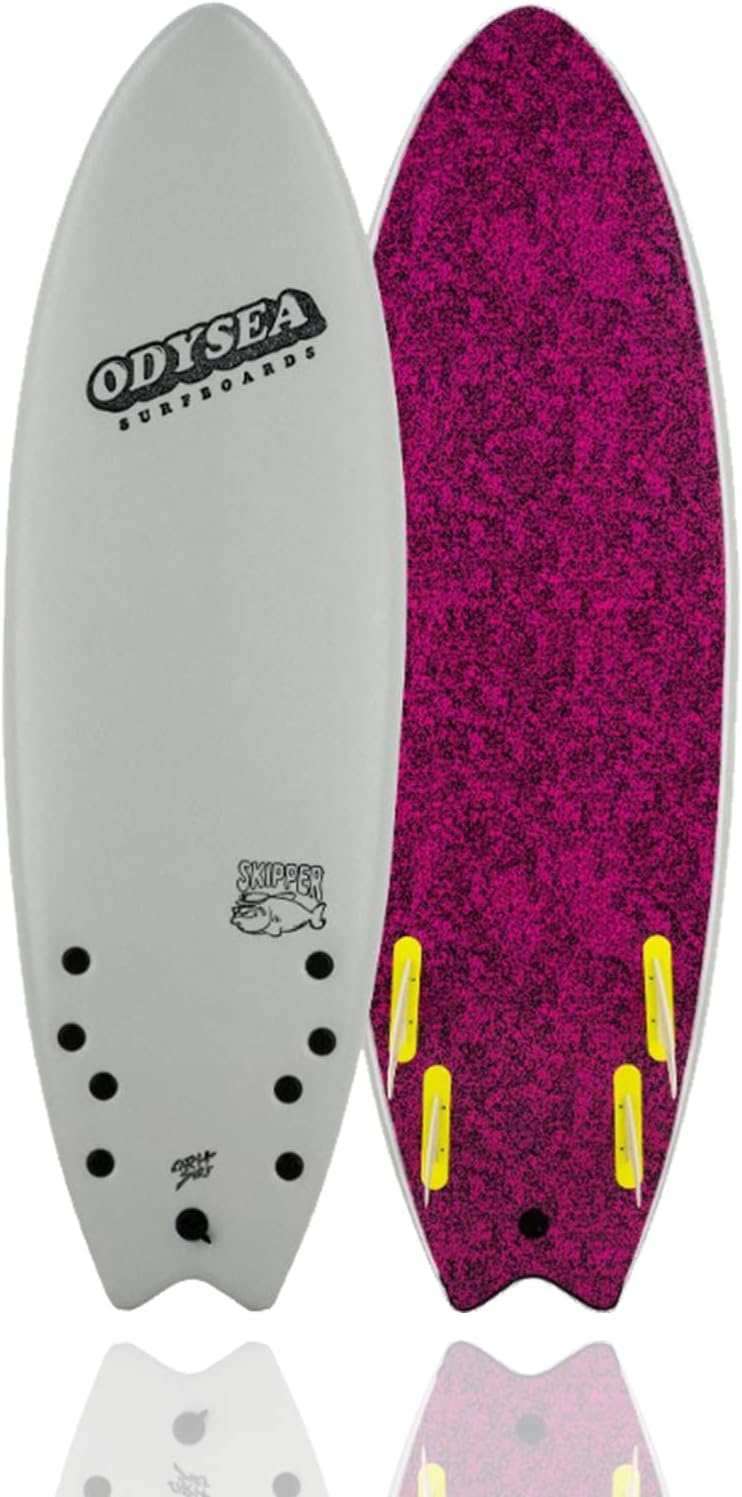
The Odysea Skipper is the foamie for surfers who've outgrown gliding and want to actually generate speed and throw turns — its wide fish outline, quad-fin drive, and swallow tail make it a genuinely responsive small-to-medium wave board, not just a soft beginner plank. Total first-timers should start with the Log; everyone else will find the Skipper a step up in every direction that matters.
Most soft-top surfboards are built around one idea: make it hard to mess up. Wide nose, long rails, single or thruster fin setup — stability first, fun second. The Catch Surf Odysea Skipper has a different philosophy. It’s a fish-outline foamie with a quad-fin setup and a swallow tail, and it’s built to go fast and turn. That’s a meaningfully different thing from what most foamies offer, and it opens the door to a genuinely different kind of session.
At around $340 in the 6’0″ and 6’6″ sizes, the Skipper sits squarely in the premium soft-top surfboard category alongside its Odysea siblings. The fish outline gives it a wider, shorter profile than the Odysea Log — less straight-tracking glide, more drive off the tail and pivot through turns. Where the Catch Surf Odysea Log wants to trim nose-to-tail and teach you positioning, the Skipper wants you to read sections, generate speed, and commit to your turns. Different boards for different stages of surfing.
We rode the Skipper across a range of small-to-medium beach break conditions — the kind of everyday surf most people actually get, not the pumping sessions you only remember. Here’s what the board actually does, and who it’s for.
Catch Surf Odysea Skipper specs
| Length | 5’6″-6’6″ |
| Type | Soft-top fish |
| Tail | Swallow |
| Fins | Quad (incl.) |
| Rider | Improver-intermediate |
| Best for | Faster, looser foamie |
On the water — speed, drive, and what the quad setup actually means
The first noticeable difference from a standard foamie is how quickly the Skipper picks up speed. The wide fish outline planes early, and once you’re on the wave the quad-fin configuration pushes you down the line with noticeably more drive than a twin or thruster setup on a soft-top. Quad fins move water in a way that generates speed without requiring you to pump constantly — the board almost surfs itself to the fast part of the wave.
The swallow tail is the other half of that equation. It breaks the tail into two pivot points that release cleanly through turns, which is what gives fish shapes their characteristic loose, snappy feel. On a soft-top this is less extreme than a glassed fish, but the basic physics still apply: the Skipper turns faster and pivots more easily than a straight-tailed longboard-style foamie.
The trade-off is forgiveness. On a log or longboard-style foamie, the length and straight rails catch waves almost by accident and hold a line without much input from the rider. The Skipper is a little more demanding. In really small, weak surf it takes more effort to generate drive, and riders who haven’t developed any footwork yet will find it harder to control through the turn. That’s not a flaw — it’s the same trait that makes it a better board for someone past the beginner stage.
Construction — what you get for the money
Catch Surf builds the Skipper with what they call a dual-composite core — a stiff polypropylene inner structure paired with twin maple-wood stringers running most of the length of the board. Two stringers is less than the Log’s three, but the dual-composite core more than compensates: the Skipper feels stiff and lively underfoot, with minimal torsional flex through your turns. It doesn’t have that noodle-like give that kills energy transfer on cheap foamies.
The deck is a high-density PE foam that’s soft enough to be comfortable on your knees and belly during pop-ups and wipeouts, but firm enough to hold your feet without squishing out. The bottom is a hard HDPE slick that lets the board release cleanly off the wave face and planes efficiently at speed. Seams and fin boxes are well-finished for a foam board at this price.
What’s in the box
- Odysea Skipper board (your chosen size)
- Hi-performance quad-fin set (removable, included)
- Leash plug pre-installed — leash itself not included
The fins are a genuine high-performance set, not the afterthought rubber tabs you get with budget boards. The fin boxes accept standard FCS-style fins if you want to experiment, though the included set is a solid starting point for most conditions.
Sizes and who fits each
The Skipper comes in three sizes. Each one suits a different weight range and wave type, and picking correctly matters more on a fish shape than on a longboard-style board because volume management is less forgiving.
5’6″ — 42 liters (21″ x 2.875″)
The shortest, lowest-volume option. Best for lighter surfers (roughly under 130 lbs) or experienced riders who want a genuinely performance-oriented setup. This size requires real commitment on the wave — it doesn’t catch for you. Not recommended as a first or early foamie.
6’0″ — 48 liters (21.5″ x 3″)
The sweet spot for most improvers. Enough volume to catch waves confidently without paddling heroics, small enough to feel lively and turnable on the wave face. Most riders in the 130–175 lb range will find this the most versatile option. This is the size we’d recommend first for someone graduating from a log-style board.
6’6″ — 55 liters (22″ x 3.125″)
The high-volume, high-stability end of the line. Better for heavier or taller riders (175 lbs+), or for surfers in weaker, mushier surf who need extra float to generate any momentum at all. Still turns better than a log-style board, but the extra length softens the fish feel somewhat.
Skipper vs Log vs Beater — picking the right Catch Surf
Catch Surf makes three distinct personalities in the Odysea line, and they’re not interchangeable. If you’re trying to decide between them — or if you’re already in our reviews for the other boards — here’s the honest breakdown.
The Odysea Log is the stability-first option. Long rails, longboard feel, forgiving for complete beginners. It catches waves easily and holds a straight line well. Great for learning pop-up and positioning. The downside is it doesn’t generate much speed and doesn’t turn quickly — that’s the trade-off for all that forgiveness.
The Catch Surf Beater is the opposite end of the spectrum — short, skatey, twin-fin, and deliberately reactive. It’s a fun novelty board for intermediates in small surf, not a board you learn on or progress from.
The Skipper sits between them and is the most practical step-up choice. It catches waves more easily than the Beater, surfs faster and more responsively than the Log, and has enough volume to be accessible to someone at the improver stage. If the question is “I’ve learned the basics on a log-style board and I want something that actually lets me turn” — the Skipper is the answer. See our best beginner surfboards guide and best surfboards for beginner adults for full context on where these boards sit in the broader market.
What we liked
- Quad-fin setup generates real speed and drive down the line — noticeably faster than a thruster or twin foamie
- Wide fish outline with swallow tail turns and pivots more responsively than longboard-style soft-tops
- Dual-composite core and twin maple stringers keep the board stiff — energy transfers through turns instead of getting absorbed
- Three sizes (5'6", 6'0", 6'6") cover a useful range of rider weights and skill levels
- Hi-performance quad-fin set included — no extra purchase needed
- Tough HDPE slick bottom and dense PE deck handle the abuse of regular use without delaminating
The catches
- Less forgiving than the Log for total beginners — the fish outline and quad feel require some existing pop-up and balance skills
- Shorter sizes (especially 5'6") demand real wave-reading ability; not a catch-anything board
- Quad-fin feel takes adjustment if you're used to thrusters — more speed and pivot, but a different kind of engagement under your feet
- No leash included despite the leash plug — add ~$20-25 to your budget