
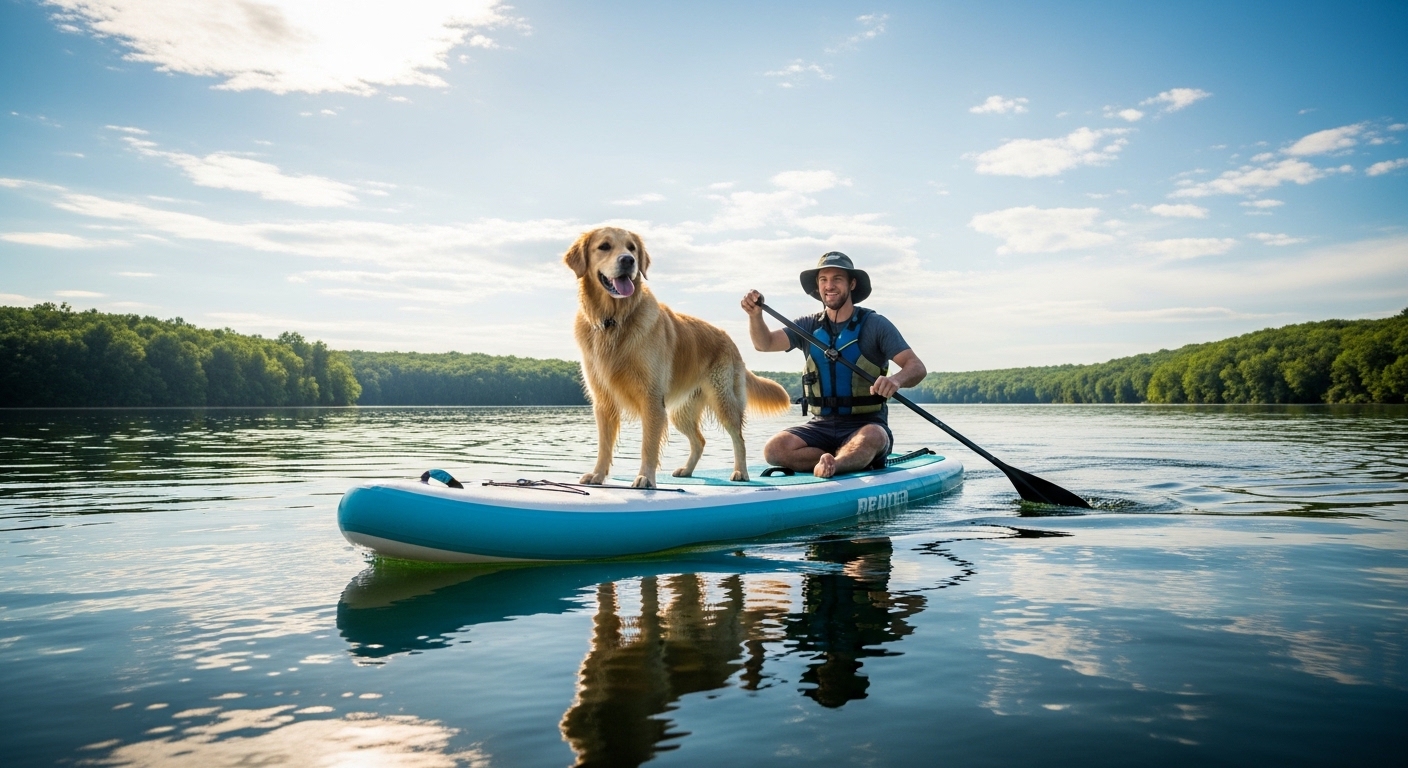
Best Paddle Board for Dogs
Paddling with your dog is one of the best things you can do on the water — but not every board is up to the job. Here's exactly what to look for.
Best 2-person boardsYour dog can absolutely come paddleboarding with you. Thousands of people do it every summer. The trick is picking a board that was built — or at minimum well-suited — for a passenger who has four legs, claws, and zero concept of staying still. Get the specs wrong and you’ll spend the whole session bracing for balance instead of actually paddling. Get them right and you might end up with a dog who tries to jump on the board before you do.
Width: The Single Most Important Spec
If you take nothing else from this guide, take this: board width matters more than almost anything else when you’re paddling with a dog. A dog — even a well-trained one — shifts weight unpredictably. They lean over the rail to sniff the water, spin around when they spot a bird, and occasionally launch themselves at a passing kayaker. You need a platform that absorbs those micro-corrections without tipping.
The minimum you want is 33 inches wide. For most dogs and most paddlers, 34 inches or wider is the sweet spot. Boards in that range have a genuinely stable platform you can kneel, sit, or stand on while your dog moves around. Go narrower and you’re fighting the physics every time your dog shifts position.
Wide all-around shapes (think 10’6″ to 11’6″ boards in the 34″–36″ range) are the most popular choice and the easiest to find. If you have a large dog — anything over about 60 lbs — or you want room for two dogs, look at tandem boards, which run 12′ to 14′ and can be 35″ wide or more. We cover those in detail in our best 2-person paddle boards guide, where you’ll find boards that work just as well for a paddler-plus-dog combo as for two adults.
Deck Pad: Full Coverage, High Grip
The deck pad is where your dog actually stands, sits, and digs in when the board rocks. A cheap or undersized deck pad is a problem in two ways: it gives their paws nowhere safe to grip, and it leaves bare board surface exposed where claws can scrape and scratch.
Look for a full-length EVA foam deck pad that covers as much of the top surface as possible — ideally from the nose kick pad to the tail kick pad with minimal gaps. The texture matters too. Diamond-groove and traction-cut patterns give paws something to hold onto without being so aggressive that they’re uncomfortable. Smooth or minimal-texture pads turn into skating rinks when wet.
Some boards market themselves as dog-friendly specifically because of expanded deck pads. Pay attention to the actual dimensions in the product specs, not just the marketing language. A pad that covers 60% of the board is meaningfully worse than one that covers 85%.
Weight Capacity and Durability: Don't Fudge the Math
Weight capacity on an inflatable SUP is the maximum the board will support before it sits too low in the water and handles like a barge. You need to account for your own weight, your dog’s weight, any gear you’re carrying, and a realistic buffer.
A useful rule: add your weight plus your dog’s weight, then choose a board rated for at least 50–75 lbs more than that total. This keeps you well above the “works but barely” zone where stability and performance both suffer. A 180-lb paddler with a 65-lb Lab needs a board rated for at least 295–320 lbs minimum — ideally more.
Our high-capacity paddle boards roundup is a good starting point here. Those boards are built to handle real-world loads, which translates directly to better performance with a dog on board.
On the durability side: look for double-layer or fusion PVC construction. Single-layer boards can handle light use fine, but dog claws — even trimmed ones — are harder on a board surface than shoes. Double-layer construction is thicker, more rigid when inflated, and significantly more resistant to puncture and abrasion. It also holds its shape better over years of use.
D-Rings, Bungees, and Accessories Worth Having
Most quality inflatable SUPs come with bungee cargo areas and multiple D-rings. For dog paddling, these are more useful than they might first appear.
D-rings near the nose let you attach a dog ramp — a low-angle floating ramp that makes it easy for your dog to climb back on the board if they fall off or jump in. This is especially valuable for older dogs, heavier dogs, or breeds that aren’t natural swimmers. The ramp clips to the D-rings and floats alongside the board at a gentle angle.
Rear D-rings or a grab handle at the tail are useful for securing a leash while your dog is learning. You can clip a short line to keep them tethered without restricting your own movement too much.
Bungee cargo areas at the front also give you a place to stash a small dry bag with treats, water, and a collapsible bowl — all things you’ll want on a longer session.
Getting Your Dog Comfortable: A Simple Training Progression
Even the perfect board won’t help if your dog panics the moment it starts moving on water. A short training progression makes the difference between a dog who loves paddling and one who leaps off at the first ripple.
Step 1 — Introduce on land. Put the inflated board flat on the ground (or on grass). Let your dog sniff it, walk on it, and get used to the texture. Reward with high-value treats every time all four paws are on the board. Do this for several sessions before ever getting near water.
Step 2 — Calm, shallow water. Move to a calm, shallow spot — a lake beach or flat inlet. Put the board in ankle-deep water and repeat the treat game. The slight movement underfoot is new; let them get comfortable at their own pace.
Step 3 — Short trips, low expectations. Get on the board yourself first, then invite your dog up. Kneel (lower center of gravity) and paddle a short distance. Keep the first few sessions under 15 minutes. End while things are still going well rather than pushing until something goes wrong.
For a broader introduction to being on the water, our how to paddleboard guide covers the fundamentals that apply to both you and your dog — balance, posture, and reading conditions.
Safety Essentials: PFDs and Nail Care
Dog PFD (life jacket). If your dog is going on the water with you, they wear a life jacket. Full stop. Even strong swimmers can get disoriented in current, exhausted on a long session, or knocked under by a wave. A well-fitted dog PFD has a grab handle on the back so you can haul them out of the water quickly — this alone is worth the cost. Measure your dog’s girth (widest point behind front legs) and neck, and buy accordingly. Sizing varies significantly between brands.
Nail care for the deck. Trimmed nails don’t just protect your board — they protect your dog. Overgrown nails catch on the EVA foam texture and can pull at an awkward angle when your dog shifts weight, which is uncomfortable at best and potentially injurious. A basic nail trim every 4–6 weeks is good practice for any active dog. You don’t need to grind them down to nothing — just keep them short enough that they don’t hook into the foam.
Some paddlers also use dog boots for added protection on both the deck pad and the dog’s paws. Results are mixed — many dogs refuse them — but if yours tolerates boots, they’re worth trying on longer sessions in hot weather when the board surface can get warm.