Wavestorm 7' Surfboard Review
The Wavestorm 7' is a nimble, well-priced foam board that suits lighter beginners, teens, and kids better than the bulkier 8'. If you weigh under 160 lbs and want something easy to carry and quick to turn, this is a smart buy — just know that heavier riders or total novices will get more out of the longer version.
We’ve spent time on a lot of foam boards, and the Wavestorm 7′ keeps coming up as one of the better buys in its price range. At around $280, it punches well above its weight for anyone who doesn’t need the full float of the 8-footer. Lighter surfers, older kids, and teens especially get a lot out of this board because it actually responds when you shift your weight — something the bigger version doesn’t do as crisply.
That said, this isn’t a “better” board than the 8′ in an absolute sense — it’s a different tool for a different rider. We’ll break down exactly who benefits from the shorter length, what the water feel is like, how the construction holds up, and where the board falls short. If you’re still sorting out which size makes sense, our guide to the best beginner surfboards has a full size-matching section worth reading first.
Bottom line upfront: if you’re lighter, more coordinated, or graduating from an even longer board, the 7′ Wavestorm is one of the best values in soft-tops right now. Read on for the full picture.
Wavestorm 7' specs
| Length | 7′ |
| Type | Soft-top / foam |
| Fins | 3 (thruster) |
| Rider | Lighter / younger |
| Skill | Beginner |
| Best for | Kids & smaller riders |
On the water
The first thing you notice on the 7′ Wavestorm is how much easier it is to maneuver than the 8′. Paddling out, it cuts through whitewater with less resistance, and getting it duck-dived or punched through a wave is far more manageable. For lighter surfers, that translates directly to less energy spent fighting the board and more energy catching waves.
Catching waves is where the size trade-off becomes real. The 7′ has noticeably less float, which means you need a bit more paddling speed and better timing to get into waves cleanly — especially smaller, weaker ones. On a solid chest-high wave with some push to it, though, this board feels alive in a way the 8′ doesn’t. It responds to weight shifts, lets you redirect down the line, and even allows a basic cutback if you’re riding with some momentum.
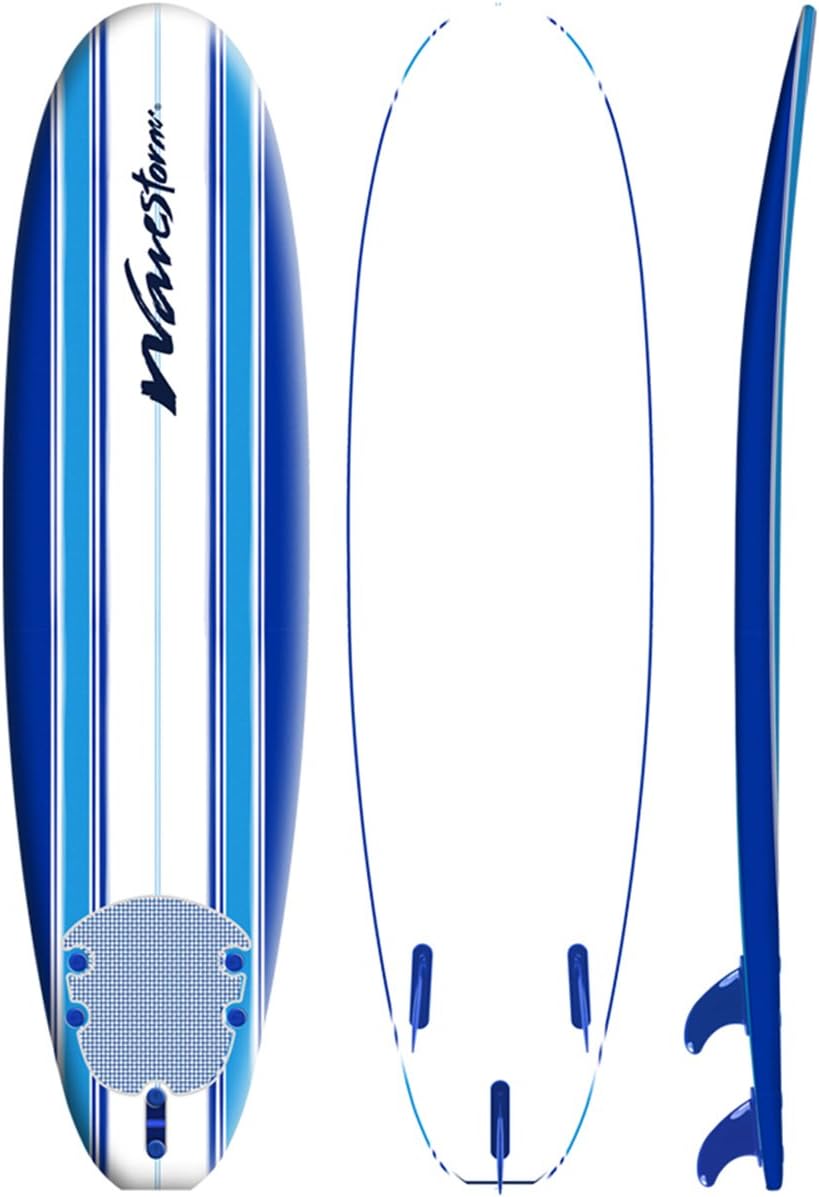
The three-fin setup (two side fins, one center) gives it solid straight-line tracking without locking you in. We didn’t notice any significant tail slide or unpredictable behavior, which is what you want on a beginner-to-intermediate foam board. The slick HDPE bottom moves through water efficiently, and the board doesn’t feel sluggish even when you’re riding at moderate speed.
One honest note: in weak, crumbly surf — the kind you often find at crowded beginner beaches — this board is harder to ride than the 8′. It requires more commitment and a better read of the wave. Total beginners will find more success on longer, higher-volume boards. Lighter beginners who’ve taken a few lessons and understand basic timing? This is a great next step.
7' vs. 8' — which Wavestorm?
This is the question we get most often, and the honest answer is: it depends entirely on your weight and experience level. The 8′ Wavestorm is the better first board for most adults. It has more volume, more stability, and a more forgiving paddle that makes wave-catching easier when your timing isn’t dialed yet. Heavier beginners — roughly anyone over 170 lbs — should default to the 8′ without much debate.
The 7′ makes more sense when one or more of these applies to you: you’re under 150–160 lbs, you’re a teenager or older kid who’s done a few surf lessons, you’ve already put time on a longer board and want something with a bit more response, or you’re buying for a lighter adult who has some athletic background and catches on quickly.
From a portability standpoint, the 7′ is meaningfully easier to transport and handle on the beach — lighter, shorter, simpler to manage in a crowded lineup. That’s a real practical benefit, especially for younger riders or anyone navigating a surf break solo. Our roundup of the best soft-top surfboards compares the full Wavestorm lineup alongside other foam boards if you want a broader look at the options.
If you’re genuinely on the fence between the two sizes and you’re a complete beginner of average adult weight, go with the 8′. You can always move down to a shorter board as your skills develop. Upsizing after the fact is rarely the issue — undersizing is.
Construction & durability
The Wavestorm 7′ uses the same construction as the rest of the Wavestorm lineup: an EPS (expanded polystyrene) foam core, a soft EVA foam deck, a slick HDPE bottom, and internal wood stringers running the length of the board. It’s the same basic recipe that’s made Wavestorm boards popular since Costco started carrying them, and it works.
The EPS core keeps the board light and buoyant without the weight of a traditional PU foam blank. The EVA deck provides grip without wax and softens falls, which matters a lot for beginners who are still making contact with the board more than they’d like. The HDPE bottom is fast, holds up to sandy beach drag, and doesn’t ding the way a fiberglass board would.
Durability is generally solid for the price. We’ve seen these boards take a lot of punishment — dings from rocks, repeated wipeouts, storage in hot cars — and hold together reasonably well. The fins can loosen over time with heavy use, and the deck will show compression dents in high-traffic areas, but neither of those affects performance meaningfully. The leash plug is standard and reliable.
What won’t hold up: leaving it in direct sun for extended periods will degrade the foam and cause delamination over time. Store it in the shade or with a board bag. The construction also isn’t designed for punchy reef breaks — this is a beach break board. As Surfrider Foundation’s ocean safety guidelines note, matching your equipment to the conditions is as important as the gear itself.
Who it's for (and who should skip it)
The Wavestorm 7′ is the right board for a specific type of rider, and being honest about that matters more than selling the board. Here’s who gets the most out of it:
Good fit: Lighter adults (under 160 lbs) who want a foam board with more maneuverability than the 8′; teenagers learning to surf with some athletic ability; kids who’ve outgrown a soft-top mini board; intermediate riders who want a beater board for small days; parents buying a board that can genuinely grow with a young surfer for a few years.
Not the right fit: Heavier beginners who need maximum float and stability; absolute beginners of average adult size who haven’t surfed before and want the easiest possible learning curve; surfers looking to progress quickly into performance shortboarding (at that point, a foam board isn’t the right tool anyway); anyone surfing powerful beach breaks or anything with consequence — this is a mellow-conditions board.
At $280, it’s priced competitively for what you get. You’re not going to outgrow the construction quality — it will hold up for years of regular use. What you will outgrow is the size, which is actually a feature: it means you’ll be ready for a performance board sooner than you think. Check our full surfboard guide for what to consider when that progression happens.
What we liked
- More maneuverable and easier to turn than the 8' Wavestorm
- Lighter and easier to carry, especially for younger riders
- Same proven EPS + EVA + HDPE construction as the full Wavestorm lineup
- Great value at ~$280 for a durable foam board
- Three-fin setup provides good tracking and directional control
- Well-suited for lighter adults, teens, and kids who have some wave experience
The catches
- Less float and stability than the 8' — harder for heavier beginners to ride
- Requires better timing and paddling technique to catch smaller waves
- Not suitable for heavier adults or complete novices who need maximum volume