
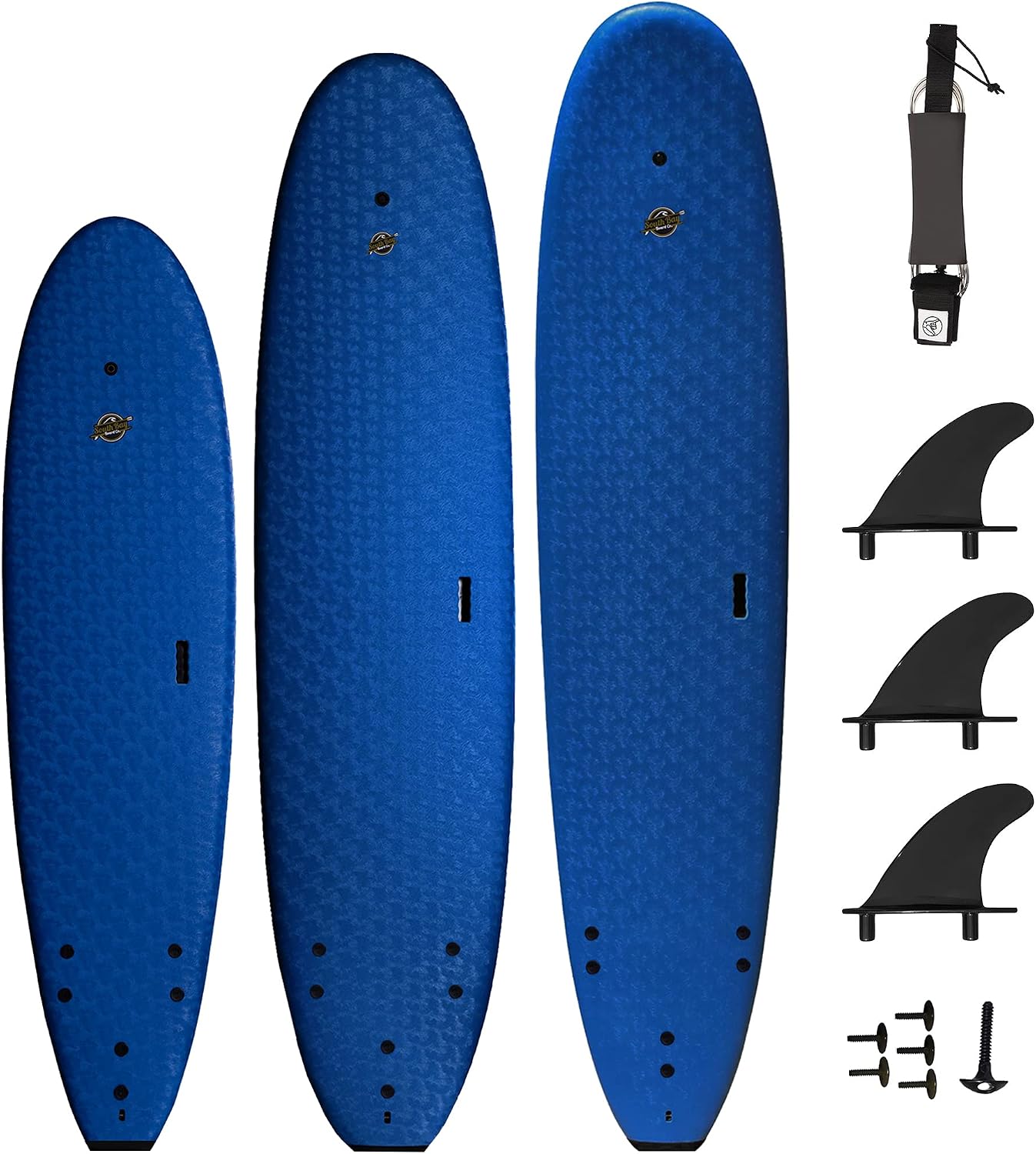
South Bay Board Co. Heritage 9' Review
The South Bay Heritage 9' is one of the few soft-tops genuinely built to carry heavier and taller adult beginners without feeling sluggish — it paddles early, stands up forgiving, and comes with everything you need out of the box. The trade-off is real bulk on land, but in the water that volume is exactly the point.
Finding a beginner surfboard when you’re over 200 pounds isn’t as easy as the surf shop makes it sound. Most foam boards top out around 80 liters and start to feel waterlogged under a bigger rider. The South Bay Board Co. Heritage 9′ is one of the few soft-tops that actually addresses that gap — 98 liters of volume in a 9-foot hull, stiffened with triple maple stringers, and priced around $500 as a complete kit.
We spent several sessions riding the Heritage in waist-to-chest-high beach break and some mellow point surf. Our testers ranged from 190 to 235 pounds, all of them either returning to surfing after years off or picking it up for the first time. Here’s what we found.
If you’re still comparing options, our guides to the best soft-top surfboards and best surfboards for beginner adults cover the wider field — but if a big foam longboard is what you need, the Heritage deserves a close look.
South Bay Board Co. Heritage 9' specs
| Length | 9′ |
| Type | Soft-top longboard |
| Volume | ~98 L |
| Rider | Tall / heavy adults |
| Skill | Beginner+ |
| Best for | Big riders & stability |
On the water — stability & glide
The first thing you notice paddling out on the Heritage is how little work it takes to keep moving. At 9 feet and 98 liters, the board sits high in the water and planes early. For newer surfers, that buoyancy translates directly into confidence: the board isn’t trying to tip you, and you have a few extra seconds to pop up before the wave moves past you.
Wave entry was the real standout. We caught waves that a shorter or lower-volume board would have let slide by, and that matters enormously at the beginner stage when mistimed paddle-ins are the number-one frustration. Once you’re up, the Heritage holds a line well — it’s not a performance board, but it tracks cleanly and gives you room to shift your feet and experiment with trim.
Turning is slow and deliberate, as you’d expect from a longboard of this size. That’s not a complaint — it’s appropriate for the board’s purpose. If you want to start cross-stepping or working toward nose riding, the length gives you a platform to practice on. For pure wave-catching and first-year progression, the Heritage does exactly what a foam longboard should do.
Volume & sizing for bigger riders
Volume is where the Heritage separates itself from generic foam boards. Most beginner soft-tops in the $300–$400 range hover around 70–85 liters, which is fine for lighter adults but starts to feel marginal above 180 pounds. At 98 liters, the Heritage gives heavier riders the same float advantage that lighter surfers get on smaller boards — meaning you’re not fighting the board just to stay stable while you sort out your pop-up mechanics.
The general rule of thumb from ISA Surf for beginner volume is roughly 100% of your body weight in liters, give or take based on fitness level. The Heritage hits that mark for riders up to about 220–230 pounds and stays functional well beyond that for calmer conditions. We had a 235-pound tester on it in waist-high waves and the board handled the load without bogging down on takeoff.
If you’re shopping in this category for the first time, also check out our best longboard surfboards guide for a broader comparison of foam and hard longboards at this size range.
Build, kit & transport
The Heritage ships as a complete kit — fins, leash, and fin key included. That’s worth calling out because plenty of boards at this price point sell accessories separately, and for a first-time buyer who doesn’t know what to order, that adds both cost and friction. South Bay keeps it simple.
The triple maple stringer construction is what gives this board its stiffness relative to other soft-tops. Most foam boards flex noticeably underfoot, which can feel unstable and bleeds energy out of your paddle strokes. The Heritage has a more solid feel — not rigid like a fiberglass board, but noticeably less noodly than single-stringer competitors. The deck is soft foam (safe for wipeouts, no wax needed) and the bottom is a slick HDPE skin, a standard and functional setup.
The honest downside is weight and size. A 9-foot foam board is a lot to carry, especially solo, and getting it onto a roof rack or into an SUV without a second set of hands is awkward. It’s not unusually heavy for its length, but if you’re comparing it to a 7-foot foamie you can tuck under one arm, the logistics are genuinely different. Plan accordingly — a roof rack or a truck bed makes life easier.
Who it's for (and who should skip it)
The Heritage 9′ is a strong pick for taller or heavier adult beginners — say, anyone over 5’10” or 180 pounds — who want a soft-top that won’t feel maxed out under their weight. It’s also a reasonable choice for beginner families where multiple people of different sizes will share the board, since 98 liters covers a wide range of riders. The complete kit format makes it an easy first purchase if you don’t already own surf gear.
Who should skip it? Lighter beginners (under 150 pounds) will likely outgrow this board’s length sooner and might be better served by a slightly shorter foam longboard that’s easier to maneuver and transport. Intermediate surfers looking to progress into performance surfing will also find the Heritage limiting fairly quickly — it’s built for stability, not for carving rail-to-rail. And if storage or car transport is a genuine constraint (city apartment, small vehicle), the 9-foot length is a real logistical consideration before you buy.
At around $500 as a complete kit, the Heritage sits in a reasonable price band for what it offers. It’s not the cheapest foam board on the market, but the stringer construction, volume, and included accessories make the price defensible. Take a look at our best surfboards roundup if you want to see how it stacks up across board types before committing.
What we liked
- 98 liters of volume handles tall and heavier adult beginners comfortably
- Catches waves early — forgiving and confidence-building for beginners
- Triple maple stringers add stiffness without sacrificing the soft-top safety feel
- Complete kit (fins, leash) — no additional purchases needed to get in the water
- Long, stable platform gives room to experiment with footwork and trimming
The catches
- Heavy and bulky — solo carrying and car transport takes effort
- Slow to turn — not suited for surfers ready to progress into performance moves
- 9-foot length requires roof rack or large vehicle; not easy to store in small spaces