
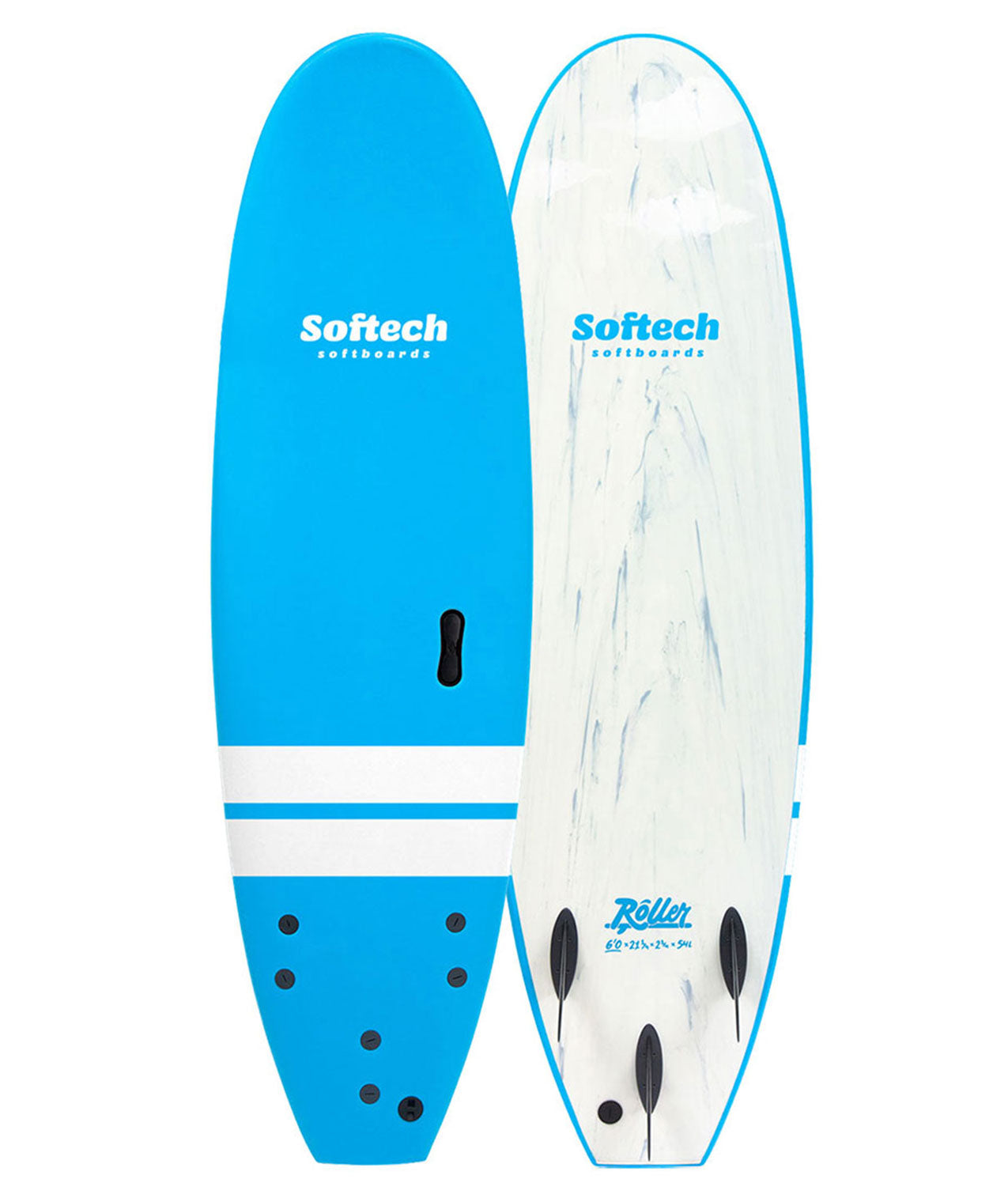
Softech Roller Soft-Top Review
The Softech Roller is the foamie for surfers who've outgrown a Wavestorm but aren't ready to commit to a glass board — it paddles easier, turns more decisively, and holds up better than entry-level soft-tops without pretending to be something it's not. If you want a durable, capable everyday board that you'll never cry over on a shallow reef day, this is a very smart buy.
Most foam surfboards ask the same question: how cheap can we make this and still have it float? The Softech Roller asks a different one — how good can a soft-top surfboard actually get before you hit the ceiling of the category? It’s a real distinction, and you feel it the first time you drop into a wave and the board actually responds instead of just pointing in the general direction you’re leaning.
The Roller is a hand-shaped foam board built around a 100% waterproof EPS core, an HDPE high-speed slick bottom, and dual maple wood stringers that run nose to tail. At ~$300–$425 depending on size and retailer, it’s priced well above a Wavestorm and in the same conversation as entry-level epoxy boards. That’s exactly the tension we’re going to resolve for you here. We’ve ridden this board in beach break from knee-high to head-high, and we know exactly who it’s for and who should skip it.
Available in sizes from 6’0″ through 8’4″, the Roller covers a range of rider weights and skill levels. The 6’6″ and 7’0″ sizes suit the improving beginner or lighter intermediate who wants something responsive. The 7’6″ and 8’0″ are the volume play — maximum wave-catching ease and stability for heavier riders or people still building their pop-up. Our beginner surfboard guide walks you through how to pick the right size for where you are right now.
Softech Roller specs
| Length | 6’6″-7’6″ |
| Type | Performance soft-top |
| Bottom | HDPE slick skin |
| Fins | Tri-fin (incl.) |
| Rider | Beginner-intermediate |
| Best for | Step-up foamie |
On the water — how it actually rides
The first thing the Softech Roller does better than a budget foamie is paddle. The EPS core and HDPE slick bottom let the board glide cleanly rather than drag, and the extra stiffness from the dual maple stringers means your paddle strokes actually move the board instead of just flexing it. You catch waves early. In small, punchy beach break that’s not a minor thing — it’s the difference between getting into a wave on the peak and chasing it on the shoulder.
Once you’re up, the Roller has an opinion about where it’s going. Rail-to-rail transitions feel connected rather than vague, and there’s enough drive off the tail to actually link turns in weaker surf. That responsiveness is real — it comes from the stringer stiffness limiting torsional flex through your turns. Budget foamies tend to absorb that energy and deliver nothing back. The Roller delivers something back.
That said, you’re still on a soft-top. On steep, fast waves this board won’t keep pace with an epoxy or glass step-up. The flex ceiling exists — it just sits higher than most foamies in this price range. If you want to compare where the Roller lands across the soft-top field, our soft-top surfboard roundup puts it in context alongside the full competition.
Construction & fin setup
Softech builds the Roller around a 100% waterproof EPS foam core — meaning the core won’t soak up water if the outer skin takes a ding, which is a meaningful durability advantage over boards that use lower-grade foam. The top deck is a soft EVA foam skin that’s easy on knees, shins, and wrists during wipeouts. The bottom is HDPE slick skin, the same material used on higher-end foamies, which reduces drag and gives the board a lively feel under your feet on the face of a wave.
The dual maple wood stringers are the construction detail that sets this board apart. Two stringers distribute the stiffness more evenly than a single center stringer would, and they prevent the deck from oil-canning under your back foot — that dead, trampoline feeling that plagues cheap foamies mid-turn. The result is a board that feels planted and connected rather than soft and undefined.
Fin setup
The Roller ships with a VFS (Versatile Fin System) tri-fin setup and includes Softech’s softflex fins in the box. The fins are designed to be safe on impact — they flex rather than staying rigid — which matters in crowded lineups and when a board comes back at you in the break. The leash plug is pre-installed. You’re ready to paddle out right out of the box with no extra purchases needed.
- 100% waterproof EPS foam core
- EVA soft foam top deck
- HDPE high-speed slick bottom skin
- Dual maple wood stringers
- VFS tri-fin setup (softflex fins included)
- Pre-installed leash plug + built-in carry handle
Who should step up to the Roller
The Softech Roller hits its sweet spot for two types of surfers. First: the improving beginner who’s been surfing for a season or two, can pop up reliably, and is starting to feel limited by a Wavestorm or similar. The Roller rewards better technique without punishing imperfect form — it’s a board you can grow into rather than immediately out of. Check our best surfboards for beginner adults breakdown for a fuller view of what this transition should look like.
Second: the intermediate or experienced surfer who wants a durable daily-driver foamie that doesn’t require babying. If you’ve got a glass board for good days and want something you can throw in the back of a truck, charge a beach break on, and never worry about, the Roller is a legitimate option. It won’t make you look like you’re slumming it.
Compare it to the Catch Surf Odysea Log if you’re set on a longer, trimming-style foamie. The Odysea skews toward a classic longboard feel and tri-quad fin versatility; the Roller is more of a funboard shape that suits surfers who want to turn rather than trim. Neither is wrong — it depends on what style of surfing you’re trying to build.
Who should skip it (and honest cons)
Skip the Softech Roller if you are a true first-week beginner with no pop-up yet. At this stage you don’t need a board with performance characteristics — you need maximum volume, maximum stability, and minimum cost while you build the muscle memory to stand up. A Wavestorm at around $199–$320 will do that job efficiently and leave money in your pocket for lessons. Don’t spend $350–$425 on a Roller until you’re actually surfing waves rather than surviving them.
Also skip it if you’re an intermediate or advanced surfer who wants to progress toward shortboard surfing. The Roller’s volume and funboard shape are calibrated for ease and fun — not for developing the tight arc, duck-dive technique, or rail work you’ll want on a performance epoxy board. It’s a lateral move, not a forward one, for surfers at that stage.
- Pricier than entry foamies — you’re paying $150–$200 more than a Wavestorm for the step-up construction
- Still a soft-top — won’t surf like a fiberglass or epoxy board on steep, fast, or powerful waves
- Softer flex ceiling — dual stringers help, but high-performance epoxy boards still win on response
- Overkill for pure beginners — if you can’t pop up reliably yet, the extra performance will go unnoticed
What we liked
- Dual maple stringers add real stiffness — you feel the difference in rail-to-rail response versus single-stringer foamies
- HDPE slick bottom gives genuine speed; board glides rather than drags through the water
- 100% waterproof EPS core won't soak up water through surface nicks — durability advantage over budget boards
- Softflex safety fins included — no extra purchase needed, safer in crowded lineups
- Wide size range (6'0"–8'4") covers improving beginners through heavier or older surfers wanting ease
- Ding-proof and low-maintenance — a real everyday board for surfers who don't want to nurse a glass board
The catches
- Runs $150–$225 more than a Wavestorm — hard to justify for pure beginners who won't use the extra performance yet
- Still a soft-top with a flex ceiling — won't match the response or speed of an epoxy or glass board on quality surf
- Funboard shape isn't ideal for surfers specifically trying to transition to shortboard surfing
- Softer deck foam will develop pressure dings over time — less bulletproof than the HDPE bottom suggests