
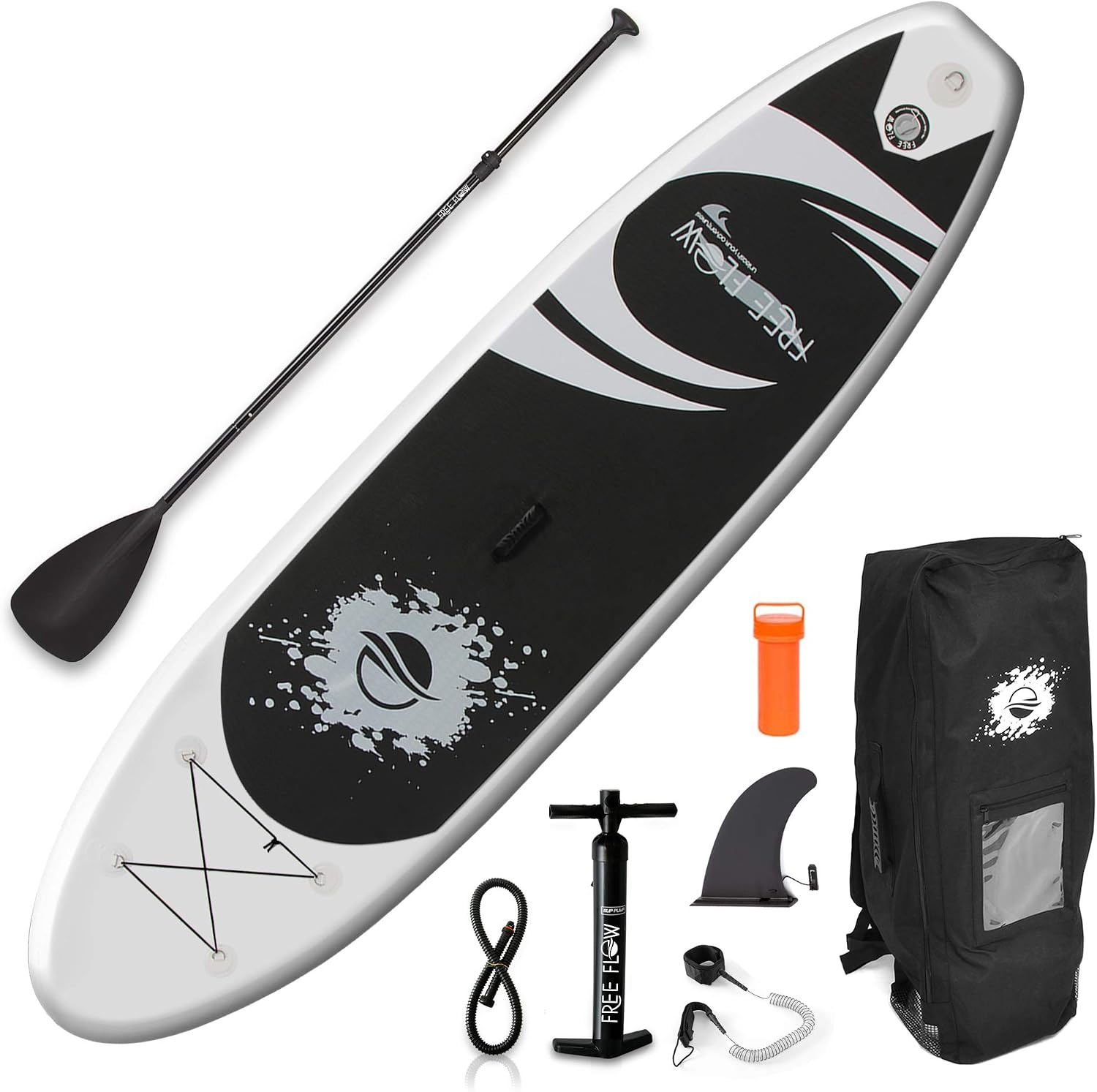
SereneLife Premium Review
The SereneLife Premium is a solid step up from the bare-bones budget crowd — the wider 32-inch deck adds real stability that beginners will feel right away. It's still a single-layer board at a budget price, so paddlers who want touring performance or rough-water durability should spend more, but for calm-water fun on a tight budget, it earns its keep.
We’ve tested a lot of budget inflatable paddle boards, and the SereneLife Premium sits in a category we’d call “the honest budget board” — it doesn’t pretend to be something it isn’t. At around $200, you’re getting a complete kit, a board that actually inflates to a usable stiffness, and a 32-inch width that keeps you upright while you find your footing. That last part matters more than most buyers realize.
The Premium is essentially a refined version of the SereneLife Free Flow — same brand, same single-layer construction, but with a wider deck platform and a few cosmetic upgrades. We spent time on flatwater lakes and calm river sections to see whether those changes translate to a meaningfully better experience on the water. Here’s what we found.
If you’re still comparing options at this price point, our guide to the best budget paddle boards lays out the full field. But if you’re leaning toward the Premium specifically, read on — we’ll tell you exactly what you’re getting into.
SereneLife Premium specs
| Length | 10’6″ |
| Width | 32″ |
| Thickness | 6″ |
| Capacity | ~285 lb |
| Type | Budget all-around |
| Paddle | Included |
On the Water
We launched the SereneLife Premium on a calm lake on a mild morning — ideal conditions for a board like this, and honestly the conditions most buyers will actually use it in. Inflation to 12 PSI took about eight minutes with the included hand pump, which is about par for the course at this price. The board felt reasonably firm underfoot, though anyone who has paddled a premium double-layer board will notice the subtle flex when you shift your weight toward the nose or tail.
That 32-inch width is the headline feature here, and it delivers. Compared to boards in the 30–31-inch range, the extra inch or two gives a noticeably wider stance and lowers your effective center of gravity. We had a first-time paddler on the board within twenty minutes of arrival, and she was upright and moving within a few strokes. That’s not a small thing. Stability anxiety is the number-one thing that kills the experience for new paddlers, and the Premium mostly solves it for calm-water use.
Tracking is adequate for leisure paddling. It’s not going to win any straight-line efficiency awards — the wide platform creates more drag than a narrower touring shape — but for recreational use, you can hold a reasonable line without constantly correcting. The included fin setup helps. Speed is modest, which is fine; this board is built for enjoyment, not distance.
Where you’ll feel the limits is in any kind of chop or current. Single-layer construction means more flex under dynamic loads, and that flex becomes noticeable when small waves come from the side or you’re paddling into a headwind. We wouldn’t recommend this board for open-water paddling or anything beyond a sheltered lake or slow river. The American Canoe Association recommends matching your gear to the conditions — solid advice that applies directly here.
Premium vs. Free Flow
The obvious question for anyone already familiar with SereneLife’s lineup is whether the Premium justifies the price difference over the Free Flow. In short: yes, but not dramatically. Both boards share the same single-layer PVC construction and the same general shape philosophy. The differences are real but modest.
The most meaningful upgrade is the width. The Free Flow typically runs around 30 inches; the Premium’s 32-inch deck is legitimately more stable for riders who are still building balance. If you’re a complete beginner or you’re buying for a family member who has never paddled before, that extra stability margin is worth paying for. We’ve covered this in more depth in our best beginner paddle board guide, but the short version is: wider is almost always better when you’re learning.
The Premium also ships with a slightly more complete accessory kit and a weight limit of approximately 285 pounds, which is a few pounds more than the Free Flow’s rated capacity. The cosmetic differences — deck pad texture, graphics — are minor and won’t affect your time on the water.
What hasn’t changed: the single-layer construction, the budget-grade aluminum paddle, and the overall durability ceiling. Both boards will serve a casual paddler well for a few seasons of gentle use. Neither is built for aggressive paddling, rock-garden rivers, or year-round heavy use. If you want a board that will genuinely last five-plus years of regular paddling, you’re looking at a different price tier entirely.
What's in the Kit
One of the SereneLife Premium’s strongest selling points is that you don’t need to buy anything extra to get on the water. The kit includes the board, a three-piece aluminum paddle, a hand pump with pressure gauge, a removable center fin, a coil ankle leash, and a carry backpack. For a $200 board, that’s a complete setup.
The quality of the accessories is honest budget-grade. The aluminum paddle is functional — it’s what we’d expect at this price point — but it’s heavier than fiberglass or carbon alternatives, and you’ll feel that weight on longer paddles. If you end up using this board regularly, a paddle upgrade is the single best investment you can make; a decent fiberglass paddle in the $60–80 range will transform the experience.
The hand pump does the job, but inflating to 12 PSI by hand takes effort. If you paddle frequently, an electric pump is worth the $30–50 investment. The carry backpack is roomy enough to fit everything, which we appreciate — too many budget kits ship with bags that barely close.
The leash is a basic coil design and perfectly adequate. Wear it. It’s a simple safety habit that keeps the board from drifting away if you fall, and falls are part of learning. Our best inflatable paddle board guide has more detail on what separates premium kits from budget kits if you want to benchmark what you’re getting.
Who It's For (and Who Should Skip It)
The SereneLife Premium is built for a specific kind of buyer, and it serves that buyer genuinely well. If you’re new to paddle boarding, paddling on calm flatwater, shopping on a hard budget, or buying a board for occasional family use, this is a reasonable choice. The stability, complete kit, and sub-$200 price make it one of the more defensible options at this tier.
It’s also a reasonable second board for a household that already has a nicer board and wants something the kids can use at the lake without worrying about it. The durability ceiling is real, but for light recreational use, it holds up.
Who should skip it: experienced paddlers who want performance, anyone planning to tour or cover distance, paddlers who want to use it in anything other than calm conditions, and buyers who want a board that will last five-plus hard seasons. Single-layer construction has a durability ceiling that no amount of good design overcomes. If you paddle more than a dozen times a year and you care about the experience, budget an extra $100–150 and move up to a quality double-layer board.
Also worth noting: at 285 pounds weight capacity, heavier paddlers or anyone planning to carry significant gear should check the math before buying. Pushing close to a board’s weight limit reduces stability and increases stress on the seams — both things you want to avoid on a single-layer iSUP.
What we liked
- 32-inch width delivers genuine stability that beginners will notice immediately
- Complete kit — board, paddle, pump, leash, fin, and bag — nothing extra needed to launch
- 285 lb weight capacity covers most adult riders comfortably
- Priced under $200, making it one of the most accessible complete setups available
- Lighter single-layer construction is easier to carry to the water than heavier premium boards
The catches
- Single-layer PVC construction flexes noticeably compared to double-layer boards, especially in chop
- Included aluminum paddle is heavy and basic — a fiberglass upgrade makes a real difference
- Not suited for open water, touring, or any conditions beyond calm flatwater
- Durability ceiling is lower than premium boards; heavy regular use will shorten its lifespan