
SereneLife Free Flow Review
The SereneLife Free Flow is one of the cheapest complete iSUP kits you can buy, and it shows — single-layer construction flexes underfoot and the 30-inch width will humble first-timers. But if you want to try paddle boarding without dropping real money, it gets you on the water.
We picked up the SereneLife Free Flow at a big-box store for around $160, which is about as cheap as a complete inflatable paddle board kit gets. Everything was in the bag: board, paddle, hand pump, center fin, and a carry bag that fits it all. On paper it looks like a slam dunk for beginners on a tight budget.
In practice, it’s more nuanced than that. The board measures roughly 10 feet by 30 inches by 6 inches thick and holds up to 275 pounds. That 30-inch width is narrower than most entry-level iSUPs, which typically run 32 to 34 inches. We noticed the difference the moment we stepped on. If you have never paddled before, that extra wobble is real.
We spent several sessions on flatwater with the Free Flow — calm lake, light chop, and a short river stretch — before writing this. Here is what we actually found.
SereneLife Free Flow specs
| Length | 10′ |
| Width | 30″ |
| Thickness | 6″ |
| Capacity | ~275 lb |
| Type | Budget all-around |
| Paddle | Included |
On the water — the 30-inch width
Let us be straight with you: 30 inches is narrow for a beginner board. Most instructors and paddling organizations recommend at least 32 inches for new paddlers, and the American Canoe Association emphasizes stability as a primary safety consideration for new stand-up paddlers. On the Free Flow, you will spend more mental energy keeping your balance than you will learning paddle strokes.
That said, it is not unrideable. Taller paddlers and anyone with decent balance — skaters, surfers, yogis — adapted in one session. Shorter paddlers with a lower center of gravity did fine too. Where it struggles is with larger-framed beginners who are brand new to the sport. On light chop, the board squirms noticeably, and at the 275-pound weight limit it gets soft enough that you feel every ripple.
Tracking is acceptable for the price. The single center fin keeps you pointed forward on flatwater, and the board responds to rail-to-rail weight shifts well enough. We did not feel like we were fighting it constantly — just keeping it honest.
Construction & value
Single-layer PVC construction is the defining compromise of any sub-$200 iSUP, and the Free Flow is no exception. Inflate it to the recommended 10–12 PSI and it feels reasonably firm underfoot when you are standing still, but load it close to the weight limit and you will see a slight banana bend under your feet. On our river stretch, that flex transmitted vibration into our ankles by the end of a two-hour session.
The seams and valve looked clean out of the box — no obvious delamination or bubbling after several sessions. We are not saying this board will fall apart in a week. Budget single-layer boards can last a couple of seasons with reasonable care: rinse it, dry it before rolling, and store it out of direct sunlight. What they will not do is match the stiffness or longevity of double-layer or fusion-layer construction you find on boards in the $400+ range. If you want to understand how thickness and construction affect performance, our paddle board size chart breaks it down clearly.
At $160 all-in with accessories, the value is real. Buying a board, paddle, pump, fin, and bag separately at this quality level would easily cost more. You are paying for convenience and accessibility, not performance.
What's in the kit
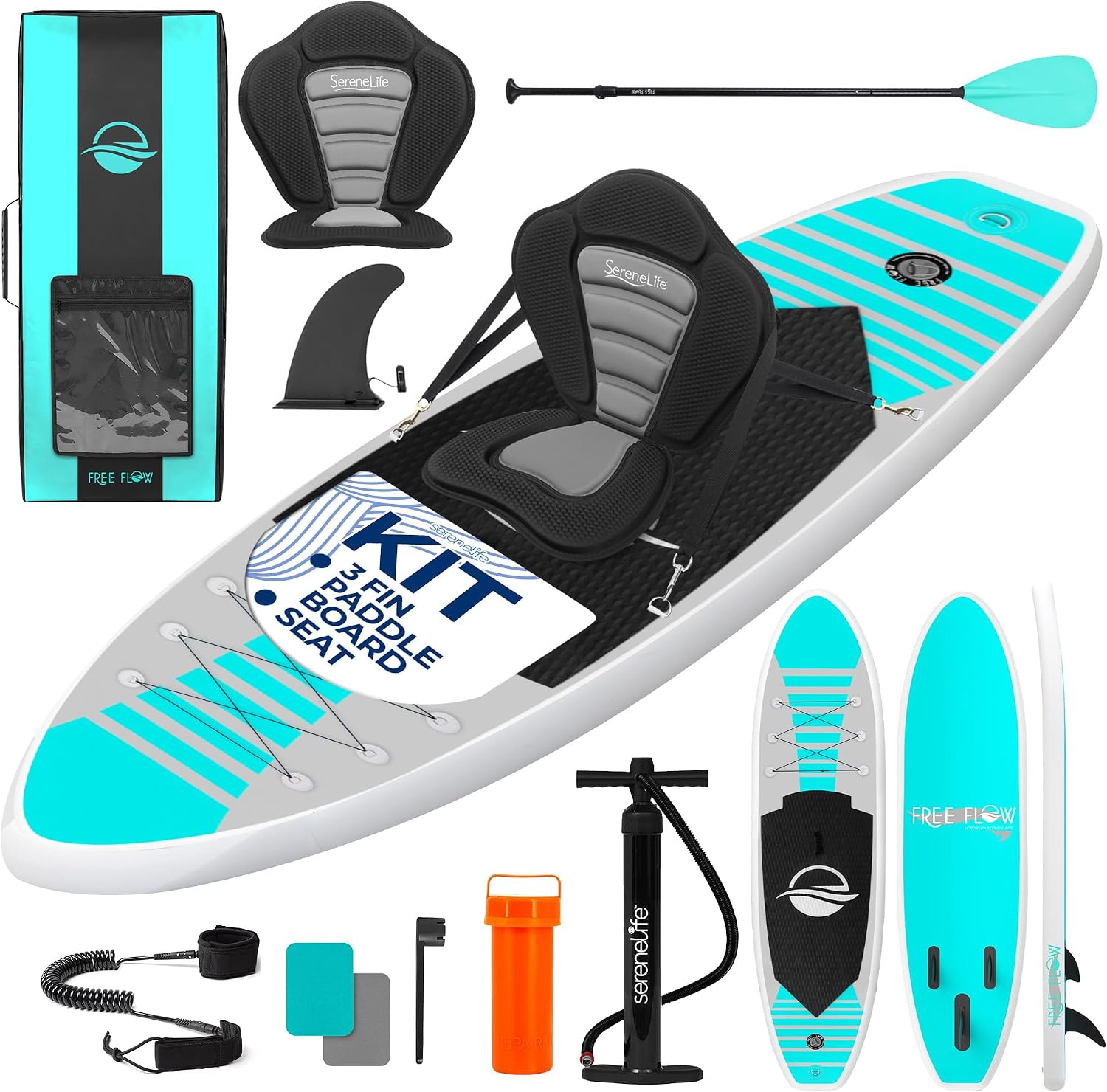
The Free Flow ships as a complete package, which is one of its genuine selling points. Here is what we found in the bag:
- Board: 10′ x 30″ x 6″, single-layer PVC, bungee nose tie-down, one carry handle
- Paddle: Three-piece aluminum shaft with a plastic blade — functional, heavy, and exactly what you’d expect at this price
- Hand pump: Single-action, gets the job done in about 10–15 minutes of pumping; dual-action would have been nicer
- Center fin: Snap-in US box fin, easy to install, stable enough for flatwater
- Carry bag: Fits everything with a little effort; shoulder straps are thin but usable
The paddle is the weakest link. It is noticeably heavier than even a mid-range aluminum paddle, and after a long session your shoulders know it. If you plan to paddle more than occasionally, budgeting another $40–60 for a better paddle is worth it. The pump works, but a dual-action pump cuts inflation time in half — something to consider if you plan to inflate solo regularly.
Nothing in the kit is premium, but nothing is broken or obviously defective. For a first board or an occasional-use guest board, the kit does its job. If you are comparing complete packages, check out our best budget paddle board roundup for other full-kit options at this price tier.
Who it's for (and who should skip it)
The SereneLife Free Flow makes sense for a specific kind of buyer: someone who wants to try paddle boarding cheaply before committing to a real investment, or who needs a guest board that will live in the garage and come out a few times a summer. If that is you, $160 for a complete kit is a reasonable entry point. Just go in knowing that the 30-inch width will require patience and that the construction is not built for years of serious use.
Who should skip it? True beginners who are not naturally athletic will have a frustrating time on a 30-inch board. If stability matters — kids, older adults, anyone nervous about falling — look at wider options. Our best inflatable paddle board guide includes options at $250–$350 that are meaningfully more stable and stiffer for only a modest step up in price. Anyone planning to paddle more than ten to fifteen times a season should also skip it; the single-layer construction will show its limits quickly under regular use.
It also is not a touring board or a fitness board. The narrow width combined with single-layer flex means you are not going to get efficient strokes or cover serious distance comfortably. It is a calm-water, casual-session board and that is about it.
What we liked
- Complete kit at ~$160 — board, paddle, pump, fin, and bag included
- Lightweight and easy to transport when rolled up
- 30" width means tighter turning radius than wider beginner boards
- Compact 10' length is manageable for smaller paddlers and tight storage
- Snap-in fin is easy to install and remove without tools
The catches
- 30" width is narrower than most beginner boards — noticeably less stable
- Single-layer construction flexes underfoot near the weight limit
- Included paddle is heavy aluminum — fatiguing on longer sessions
- Single-action pump is slow; inflation takes 10–15 minutes solo