
Roc Scout Review
The Roc Scout is the most affordable way to get on the water from Roc, and it delivers exactly what a first-timer needs — stability, a complete kit, and a price that doesn't sting. Just keep it to calm flatwater and don't push the weight limit.
We’ve tested a lot of entry-level inflatable paddle boards, and the Roc Scout sits right at the bottom of the budget range in the best possible way. At around $130, it’s the cheapest board Roc makes — one step below the Explorer — and it comes with everything you need to paddle your first day without a second trip to the store.
That said, “budget” comes with real trade-offs. Single-layer PVC construction, a lower weight capacity than the Explorer, and accessories that are functional but basic. If you know what you’re getting into, the Scout is a solid starter. If you’re expecting Explorer-level performance at Scout prices, you’ll be disappointed.
Here’s what we actually found after putting it through its paces on flatwater lakes and calm coastal inlets.
Roc Scout specs
| Length | 10′ |
| Width | 32″ |
| Thickness | 6″ |
| Capacity | ~250 lb |
| Type | Budget beginner |
| Paddle | Included |
On the Water
The Scout measures roughly 10 feet long by 32 inches wide by 6 inches thick — that’s a standard all-around shape that’s forgiving for beginners. At those dimensions, it pumps up to a decent 15 PSI and feels reasonably stiff underfoot when you’re centered and balanced. For riders under 180 lbs, it’s honestly stable enough that you won’t spend your first session swimming.
Where the single-layer construction shows up is under load. Push toward the 250 lb weight capacity and you’ll feel the board flex, especially at the nose and tail. It’s not dangerous, but it does affect tracking — the board wanders more than a stiffer double-layer board would. Paddling in a straight line takes more active correction, which can be tiring for beginners who are already managing balance.
Calm flatwater is where the Scout is at home: ponds, slow rivers, protected lakes, and calm coastal bays. Take it into chop or wind and the flex becomes more noticeable, and the entry-level paddle that comes in the kit doesn’t help — it’s aluminum and functional, but heavier than what you’d want for longer sessions.
For a deeper look at how board dimensions affect your ride, our paddle board size chart breaks down exactly what width and length mean for stability and speed.
What's in the Kit
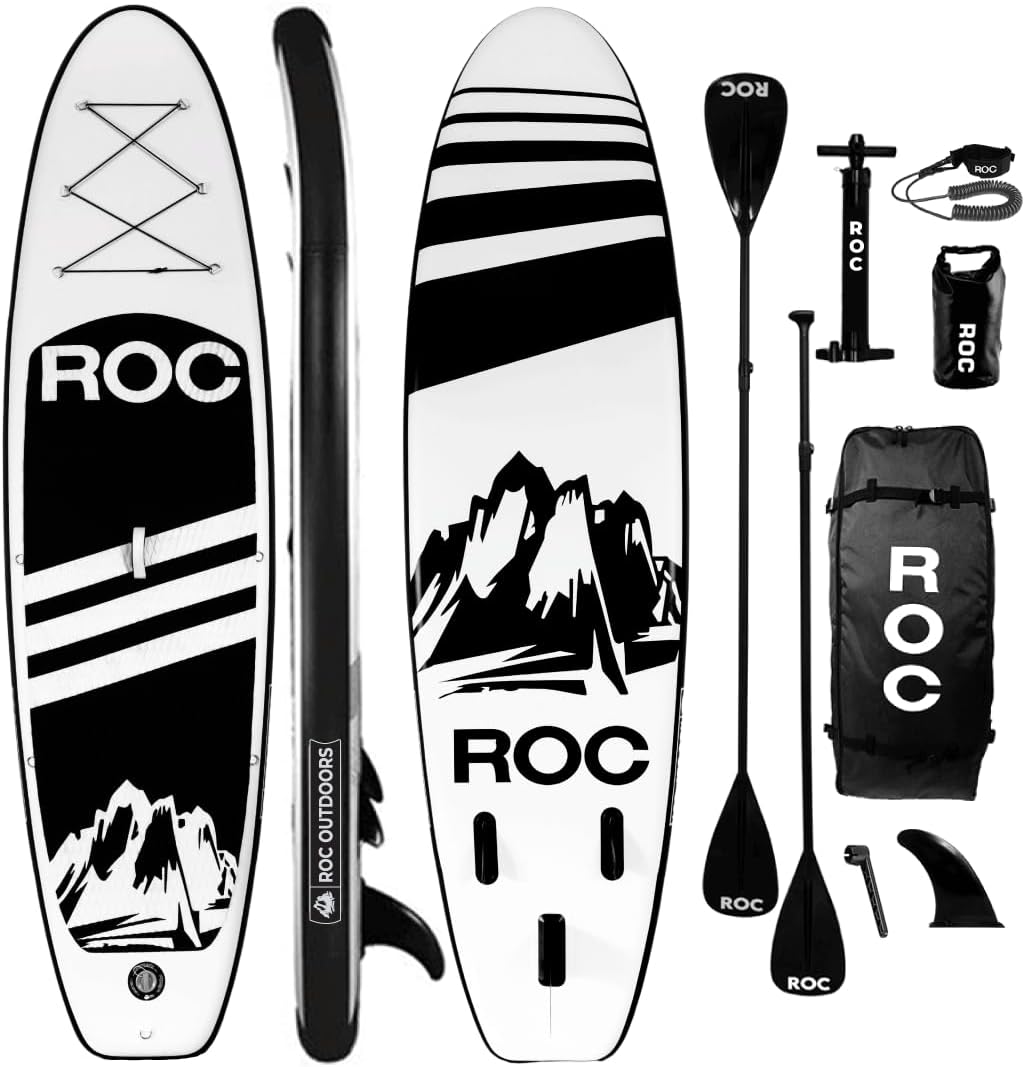
Roc ships the Scout as a complete starter kit, which is genuinely one of its best selling points. You’re not hunting down a separate pump or leash — everything lands in one box. Here’s what’s included:
- Aluminum 3-piece paddle — adjustable and functional. Heavy by touring standards, but fine for casual paddling.
- Hand pump with gauge — a standard double-action pump. Getting to 15 PSI takes some effort; plan for 10–15 minutes on your first inflation.
- Safety leash — coiled ankle leash, basic but adequate. Always wear it. The U.S. Coast Guard classifies SUPs as vessels in many states, so a leash and PFD aren’t optional on open water.
- Carry bag — backpack-style bag with enough room for the rolled board and all accessories. Shoulder straps aren’t padded, so long hikes to the launch aren’t comfortable, but it gets the job done.
- Removable center fin — a single snap-in fin for tracking. Simple, but it works.
The kit is genuinely complete. You can unbox it, pump it up, and paddle the same day. For $130, that’s real value — buying these accessories separately on a different brand would easily cost $40–60 more.
Scout vs. Explorer — Which Roc?
This is the question we get most often, so let’s be direct about it. The Roc Explorer is Roc’s step-up board — it typically runs $50–80 more than the Scout — and for most buyers, it’s the better buy if the budget allows.
The Explorer uses the same all-around shape but comes with a higher weight capacity, slightly stiffer construction, and better-quality accessories. On the water, the difference in stiffness is noticeable. The Explorer tracks better, flexes less under rider weight, and holds up better in mild chop.
So who should choose the Scout? Riders who are absolutely entry-level, paddling calm flatwater only, and genuinely unsure whether they’ll stick with the sport. At $130, the Scout lets you test the water (literally) without a big financial commitment. If you fall in love with SUP, upgrade to the Explorer or a double-layer board. If paddling turns out not to be your thing, you’re not out $200+.
Heavier riders — anyone over 200 lbs — should skip the Scout entirely and go straight to the Explorer. The Scout’s 250 lb capacity sounds adequate, but real-world performance drops off noticeably as you approach that ceiling.
Check out our best beginner paddle boards guide for a full comparison of entry-level options at every price point, including how the Scout stacks up against boards from other brands.
Who It's For (and Who Should Skip It)
The Roc Scout earns its place in the lineup because it’s honest about what it is. It’s not pretending to be a performance board or a heavy-duty tourer. It’s a starter board for people who want to try flatwater SUP without spending real money upfront.
Buy the Scout if:
- You’re a first-timer who wants to try paddleboarding before committing to a better board
- You’re under 200 lbs and paddling calm, protected flatwater
- You want everything in one kit with no extra shopping
- $130 is your hard ceiling
Skip the Scout if:
- You weigh over 200 lbs — look at the Explorer or a dedicated high-capacity board
- You want to paddle in wind, chop, or moving water
- You plan to paddle longer distances where flex and tracking matter
- You’re an intermediate paddler who’s outgrown a beginner board — the Scout will feel like a step backward
If you’re not sure what board size makes sense for your body weight and paddling style, run through our best budget paddle board picks — we’ve organized the top options by rider weight and use case so you’re not guessing.
What we liked
- Genuinely complete starter kit — paddle, pump, leash, and bag all included
- Most affordable entry point in the Roc lineup at around $130
- Stable 32-inch width works well for beginner balance on flatwater
- Lightweight and packs down small enough for trunk or backseat transport
- Good value per dollar at this price tier — budget competition can't match the full kit
The catches
- Single-layer construction flexes under load, especially near the 250 lb weight limit
- Aluminum paddle is heavy and tiring on longer sessions
- Calm-water only — performs poorly in chop, wind, or moving water
- Lower weight capacity than the Roc Explorer makes it a short-term option for heavier riders