
Roc Explorer Review
The Roc Explorer is a solid first board for calm-water beginners who want a complete kit without spending $500, but single-layer construction limits stiffness under heavier riders and the included paddle won't impress anyone past the starter stage.
The Roc Explorer keeps showing up at the top of budget inflatable SUP searches, and for good reason: it ships with everything a new paddler needs, holds a 275 lb weight limit, and retails around $150. We took it out on flat lakes, a calm river stretch, and a busy beach rental situation to see whether it earns that reputation or just benefits from a crowded Amazon listing.
Short answer: it earns it — with caveats. This is a board built to a price, and that price shows in a couple of places. If you go in with clear eyes about what single-layer PVC can and can’t do, you’ll likely be happy with it for a first or second season of recreational paddling.
We’ll break down what we found on the water, how construction compares to pricier alternatives, what’s actually in the box, and — most importantly — who should buy it and who should keep scrolling.
Roc Explorer specs
| Length | 10′ |
| Width | 33″ |
| Thickness | 6″ |
| Capacity | ~275 lb |
| Type | Budget all-around |
| Paddle | Included |
On the water
At 10 feet long and 33 inches wide, the Roc Explorer sits in the classic all-around sweet spot. That width gives beginners a stable platform right away — we had first-timers upright and paddling within about ten minutes, which is the goal for a board at this price point. Tracking is decent in still water; you’ll need to switch sides every few strokes in any kind of wind, but that’s true of most 10-foot all-arounds regardless of price.
Stability holds up well for riders under 180 lbs. As riders approach the 250–275 lb range, the single-layer construction starts to show: the board develops a slight flex under foot, which creates a subtle rocking sensation that more confident paddlers will compensate for and newer paddlers may find unsettling. It doesn’t feel unsafe, but it’s noticeable, and it’s the clearest real-world symptom of the budget trade-off.
Speed is average for the category. The 10′ x 33″ shape isn’t built for distance or exercise paddling; it’s built for casual exploring, and it handles that job well. If you’re looking at covering serious mileage or doing fitness sessions, check out our best inflatable paddle board guide for stiffer options with more performance-oriented shapes.
Construction & the budget trade-offs
The Roc Explorer uses single-layer drop-stitch PVC construction. That’s the standard build method for entry-level inflatables, and it’s what keeps the price at $150. Single-layer boards are lighter and easier to roll up, but they flex more under load compared to double-layer or fusion boards where a second sheet of PVC is bonded to the core for extra rigidity.
Inflated to the recommended 15 PSI, the Roc Explorer feels firm enough for most recreational use. The D-rings are well-placed and feel secure. The included single-fin box is a simple snap-in center fin, which is easy to use but limits your setup options — you can’t swap in a performance fin without an adapter. The deck pad covers a good portion of the standing area and has enough texture to keep your feet planted on calm days.
What you won’t get at this price: fusion laminate construction, a stiff carbon rail, or the kind of bomb-proof build quality you’d find on a premium inflatable. The seams are glued rather than machine-welded in places, and while we didn’t experience any delamination issues in our test period, single-layer boards are generally more vulnerable to UV degradation over time. Rinsing and storing dry, out of direct sun, will extend the life noticeably.
For context on how board dimensions affect performance and fit, our paddle board size chart is worth a read before you commit to any board in this size range.
What's in the kit
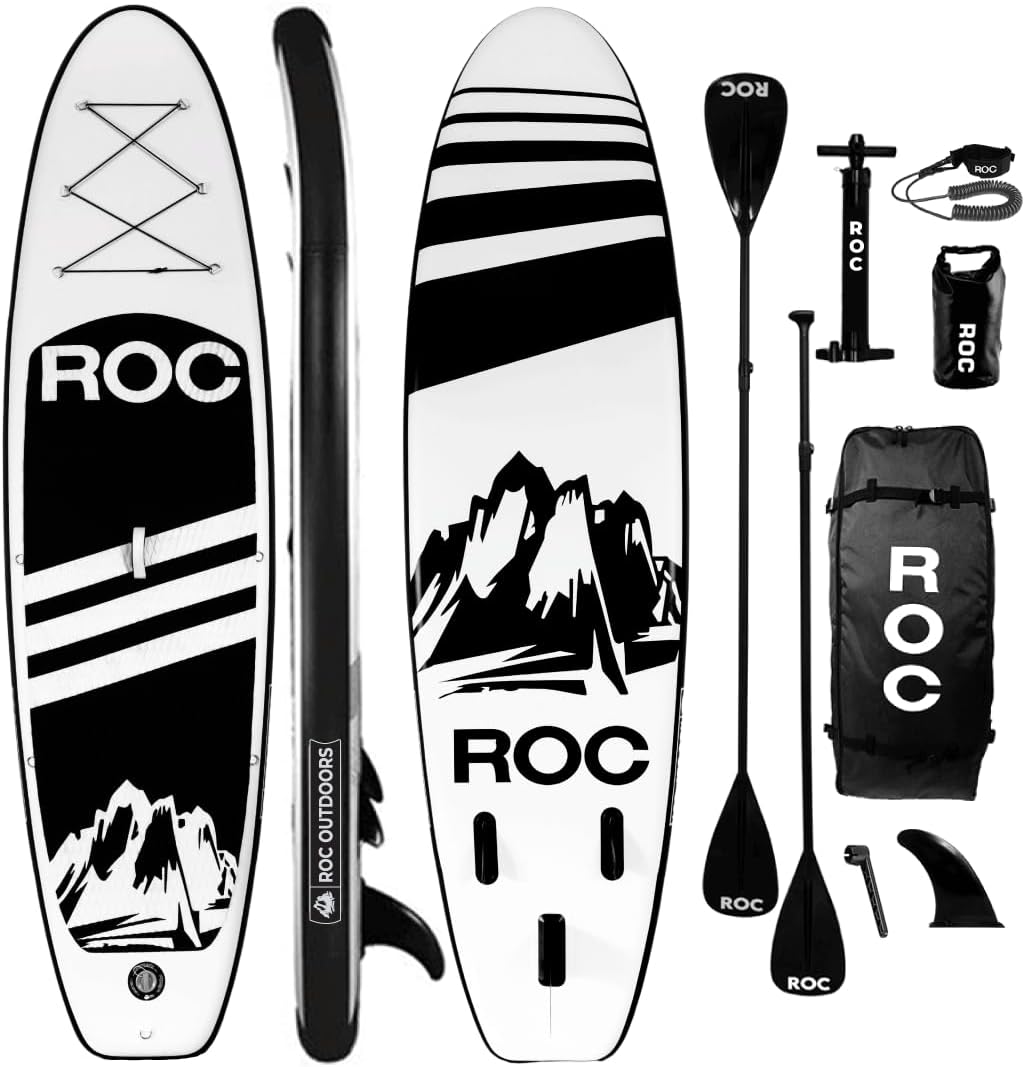
One thing Roc consistently does right is the kit. For $150 you get a three-piece adjustable aluminum paddle, a coil ankle leash, a single-chamber hand pump with pressure gauge, a removable center fin, and a carry backpack. Most comparable boards at this price strip one or two of those items to hit the number — Roc includes everything.
The aluminum paddle is the weakest link in the kit, which is normal for a board at this price. It’s heavy by paddle standards, which tires your arms faster on longer sessions. If you stick with paddling past your first summer, a carbon or fiberglass paddle upgrade is usually the first meaningful performance improvement you can make for under $80. The American Canoe Association recommends learning proper paddle technique from the start — a lighter paddle makes that easier once you’re ready.
The pump gets the board to 15 PSI reliably, though it takes 8–10 minutes of effort. An electric pump is a worthwhile add-on if you’re inflating frequently. The backpack fits everything comfortably and has enough shoulder padding to make the carry manageable — the whole packed kit weighs around 20 lbs, which is reasonable for a board this size.
Who it's for (and who should skip it)
The Roc Explorer is the right call if you’re a beginner or casual paddler who wants to try the sport without committing $600–$1,000 to a board you might paddle twice. It’s ideal for calm lakes, slow rivers, and protected coastal bays. Families passing one board between younger kids and lighter adults will get a lot of use out of it. It’s also a reasonable guest board to have around if you already own a better board but want something to hand off.
Our best beginner paddle board guide recommends the Roc Explorer as one of the top picks under $200 for exactly this reason: it hits the value-to-feature ratio better than almost anything else at the price.
Who should skip it: heavier riders over 220 lbs who plan to paddle regularly will notice the flex and may find it frustrating. Paddlers interested in fitness, distance touring, or any kind of surf or river use will outgrow it fast. If you already know you’re serious about the sport, spending $400–$600 on a double-layer board from the start will save you money over two seasons. Our best budget paddle board roundup covers the gap between entry-level and mid-tier options if you want to see what an extra $150–$200 buys you.
What we liked
- Complete kit included — paddle, pump, leash, fin, and backpack out of the box
- Wide 33" deck is genuinely stable for beginners and lighter riders
- 275 lb weight limit is competitive for a single-layer board in this price range
- Lightweight and easy to transport and store when deflated
- Strong value for first-season paddlers who want to try the sport without a big investment
- Carry backpack fits everything and is comfortable enough for a moderate walk to the water
The catches
- Single-layer construction flexes noticeably under heavier riders (200+ lbs), reducing confidence and performance
- Included aluminum paddle is heavy and tiring on longer sessions — an upgrade is almost inevitable
- Not suitable for surf, whitewater, or open-water conditions where rigidity and durability matter
- Glued seams and single-layer PVC are more vulnerable to UV and abrasion over time than premium alternatives