
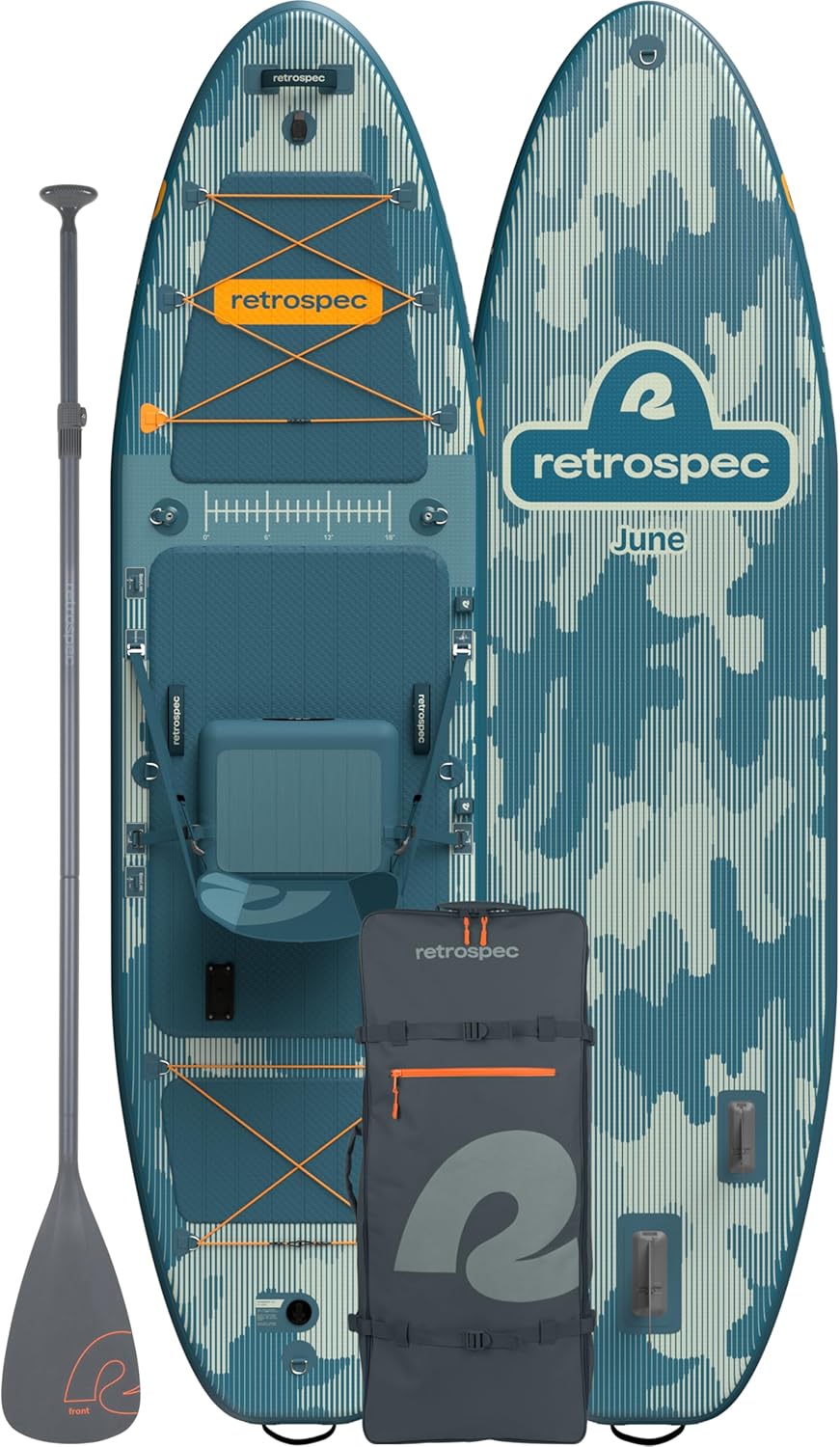
Retrospec June Review
The Retrospec June punches above its price tag in looks and kit completeness, and it handles calm water confidently for most recreational paddlers. It's not a premium board, but at around $300 it's one of the better mid-budget options we've tested.
The inflatable paddle board market is crowded at every price point, but the $300 range is where things get genuinely interesting. You’re past the truly flimsy entry-level boards, but you haven’t crossed into dual-layer premium territory yet. The Retrospec June lives right in that middle zone — and it does it with more style and polish than we expected.
We spent several sessions on the June across flat-water lakes and calm coastal bays, testing stability, stiffness, tracking, and whether the included kit is actually usable or just filler. Here’s what we found.
If you’re also comparing options, our best budget paddle board guide covers how the June stacks up against the broader field at this price.
Retrospec June specs
| Length | 10′ |
| Width | 33″ |
| Thickness | 6″ |
| Capacity | ~280 lb |
| Type | All-around |
| Paddle | Included |
On the Water
The June measures 10 feet long by 33 inches wide — a classic all-around shape that prioritizes stability over glide. For beginner and intermediate paddlers, that’s exactly the right call. We had no trouble finding our footing on flat water, and even when a passing boat wake hit us, the board recovered predictably without the squirrelly wobble you sometimes get from cheaper iSUPs.
Tracking is decent for the category. It doesn’t knife through the water the way a touring shape does, but with a couple of corrective strokes you stay on course without constant attention. We’d call it honest all-around performance — good enough to enjoy, not so specialized it limits how you use it.
Inflation takes the June to 15 PSI, and at that pressure the deck feels firm underfoot. It’s not as stiff as a premium dual-layer board and you’ll notice a very slight flex if you’re tall and heavy, but for paddlers under about 200 lbs it’s a non-issue. The 280 lb weight limit is on par for single-layer construction at this price.
Build Quality & Looks
This is where the June genuinely stands out from the crowd at $300. Retrospec put real thought into the colorways and finish — the board looks clean and modern rather than the generic bright-blue-with-logos aesthetic that dominates this price tier. The PVC construction is single-layer, which is standard at this price, but the seams are tidy and the rail edges feel more finished than many competitors.
The deck pad covers a generous section of the board and has enough grip to keep you planted even when the deck is wet. The D-rings and bungee attachment points feel secure, and the fin box accepted the included center fin without fuss. We did notice the valve stem required a bit of extra attention to seat the pump adapter properly — a minor quirk, not a flaw.
Compared to the best inflatable paddle boards at $600 and up, the single-layer construction does show its limits under close inspection. The board is lighter for it, but you’ll notice the difference in rigidity if you’ve paddled a premium dual-layer board back to back. At $300, though, the build quality is genuinely above average for the category.
What's in the Kit
Retrospec includes a full kit: adjustable aluminum paddle, dual-action hand pump, coil leash, and a rolling backpack-style carry bag. That’s everything you need to get on the water out of the box, which matters when you’re comparing the true cost of ownership across boards.
The paddle is a three-piece aluminum design. It’s functional and adjustable to a wide height range, but it’s a mid-tier paddle — heavier than fiberglass options and you’ll feel that weight over a long paddle session. If you plan to paddle regularly, budgeting $50–80 for a carbon or fiberglass upgrade paddle down the road is worth it. The pump is a dual-action design that speeds up inflation meaningfully compared to single-action pumps; it does the job without making you feel like you’ve already paddled a mile before you hit the water.
The carry bag has backpack straps and rolls on wheels, which is a thoughtful detail at this price point. The action mount on the nose is a nice bonus — it fits most GoPro-style mounts and adds utility for paddlers who want to capture footage or add an accessory without buying an aftermarket mount.
For safety basics before you head out, the U.S. Coast Guard’s boating safety resources are a solid reference for equipment requirements in your area.
Who It's For (and Who Should Skip It)
The Retrospec June is a strong pick for recreational paddlers who want a complete, good-looking setup without crossing the $400–500 threshold. If you’re a beginner looking for your first board, it’s forgiving and stable enough to learn on — our best beginner paddleboard guide puts it in solid company at this price. If you’re a casual weekend paddler who wants something that looks good and works reliably, the June delivers that.
It’s also a reasonable option for light fitness paddling on flat water, yoga sessions (the wide deck helps), and family use where multiple people of varying skill levels will take it out. The 280 lb limit accommodates most adult paddlers comfortably.
Who should look elsewhere? If you’re a serious paddler who goes out multiple times a week, you’ll outgrow the single-layer construction and mid-tier paddle faster than you’d like. Heavier paddlers approaching the weight limit will notice the flex more than lighter riders. And if fishing is a priority, the June lacks the gear mounts and stability of purpose-built fishing iSUPs — our best paddle board for fishing guide covers those options specifically. At $300 the June is excellent value; at $500 we’d push you toward a dual-layer board without hesitation.
What we liked
- Attractive design and colorways that stand out at this price point
- Complete kit included — paddle, pump, leash, and rolling carry bag
- Stable 33-inch width is forgiving for beginners and casual paddlers
- Action mount on the nose adds utility without extra cost
- Deck pad grip and overall finish quality are above average for $300
- Dual-action pump makes inflation faster than most budget competitors
The catches
- Single-layer PVC is less rigid than premium dual-layer boards — heavier paddlers will notice flex
- Included aluminum paddle is functional but heavy; a fiberglass or carbon upgrade is worthwhile
- Tracking requires more corrective strokes than a longer or narrower touring shape