
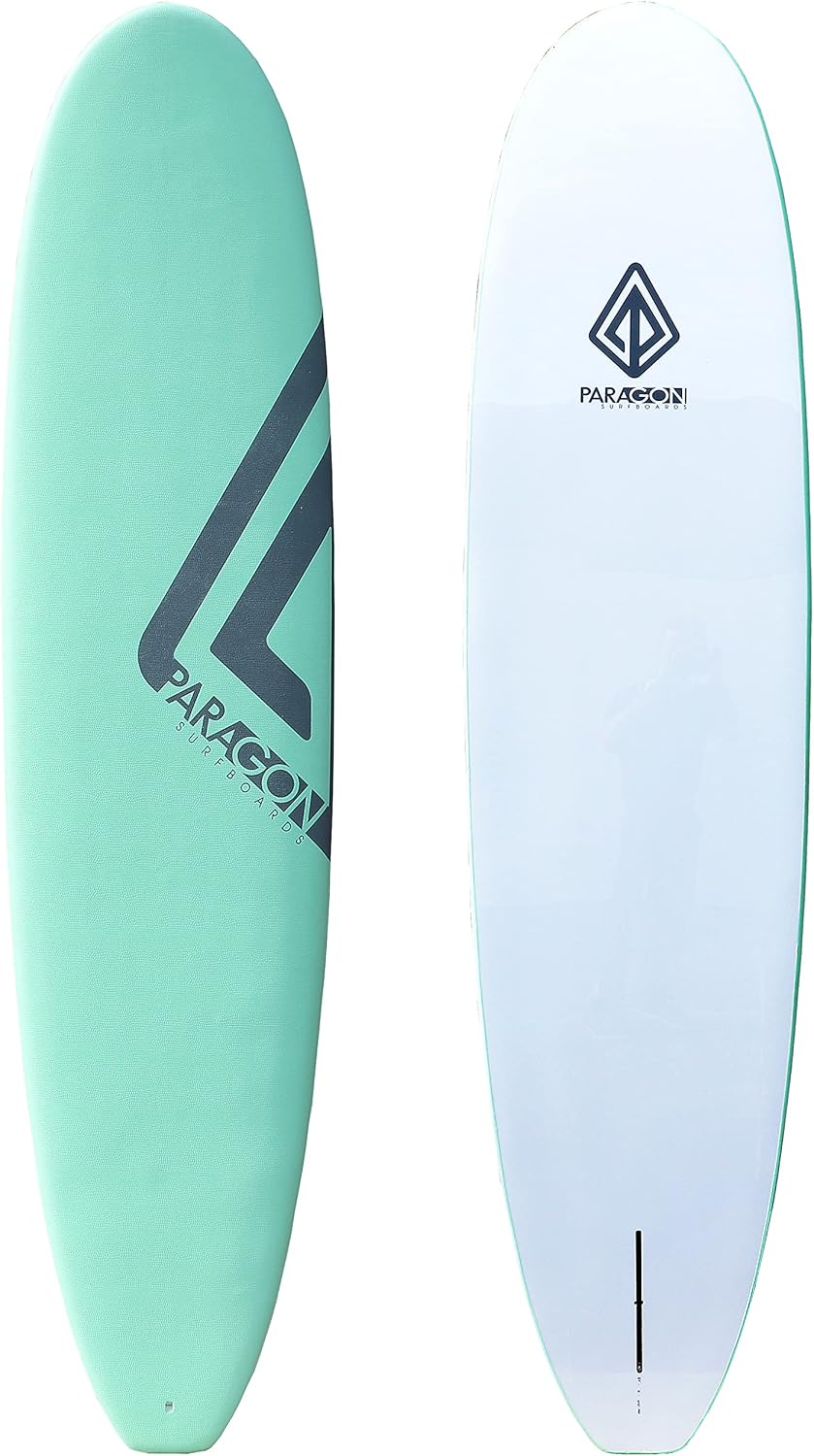
Paragon Surfboards 8'0" Soft-Top Review
The Paragon 8'0" Soft-Top punches above its price tag for bigger beginners who need real float and stability without spending serious money. It's not a premium board, but at around $280 it gives heavier first-timers a reliable, confidence-building ride that a shorter or thinner foam board simply can't match.
If you’re a larger adult who’s been eyeing foam boards and wondering whether any of them will actually float you without turning into a wobbly mess, the Paragon 8’0″ Soft-Top deserves a hard look. This board is built with volume in mind — you can feel it the moment you pick it up — and that extra foam is the whole point for riders pushing 200 to 250 pounds.
We spent time on this board across a range of small-to-medium beach break, and we’ll give you the honest version: what works, what’s mediocre, and who should probably look elsewhere. No fluff, just what we found on the water.
The short version: for a bigger beginner who wants something stable, affordable, and complete right out of the box, the Paragon 8′ is a genuinely solid choice. It’s not going to impress anyone at an intermediate level, but that’s not what it’s built for — and that’s fine.
Paragon 8'0" Soft-Top specs
| Length | 8′ |
| Type | Soft-top / foam |
| Rider | Up to ~250 lb |
| Fins | 3 (incl.) |
| Skill | Beginner |
| Best for | Heavier adult beginners |
On the water — float for bigger riders
The first thing you notice is that this board actually floats you. For heavier riders, that sounds basic, but it’s not — plenty of 7′ foam boards advertise beginner-friendly credentials and then sit low in the water under 220-plus pounds, making paddling exhausting and pop-ups awkward. The Paragon 8’0″ doesn’t have that problem.
Paddle-in is easy. The board catches waves early, which is exactly what beginners need to build timing and feel for the break. Once you’re up, the platform is wide and forgiving — you have room to adjust your feet without the board punishing you for it. Stability on the face is good for the price point; it’s not going to track a clean line like a higher-end soft-top, but for learning to stay on your feet and read waves, it does the job.
Wipeouts are soft — the foam deck and rounded rails mean you’re not catching a hard edge on the way down. That matters when you’re learning, because you’re going to fall a lot, and knowing the board isn’t going to hurt you removes one more mental hurdle.
Volume & weight rating
Paragon rates this board up to approximately 250 pounds, and in our experience that’s an honest number rather than an optimistic marketing claim. At 8 feet with a full foam blank and decent width through the nose and tail, there’s enough volume to keep a bigger rider high in the water where they can actually paddle efficiently.
If you’ve read about the best soft-top surfboards available right now, you know that volume-to-price ratio is one of the key things that separates boards worth buying from boards that look good on paper and disappoint on the water. The Paragon holds its own in that comparison — you get meaningful volume at a price point most beginners can swallow without hesitation.
For context, a standard Wavestorm runs 8 feet but tends to feel a touch underpowered for riders on the heavier end of the beginner spectrum — not because it lacks volume entirely, but because the rocker and outline aren’t optimized for bigger paddlers. The Paragon’s shaping choices lean a bit more toward buoyancy and stability, and it shows.
According to standard surfboard volume guidance, beginner riders generally want at least 1 liter of volume per kilogram of body weight, and heavier beginners benefit from going even higher. The Paragon 8′ meets that benchmark comfortably for its stated weight range.
Build & value
We’ll be straight with you: the finish on this board is basic. The deck graphics are simple, the construction is functional rather than refined, and if you put it next to a premium soft-top from Softech or Catch Surf, the difference in craftsmanship is visible. But at around $280, that’s the honest trade-off, and most beginners aren’t buying a board to put on the wall — they’re buying it to get in the water.
What matters at this price is durability under real use, and the Paragon holds up reasonably well. The foam deck resists dings from normal beginner abuse — dropped on pavement, dragged across sand, tossed in the back of a truck. The slick bottom has the expected scuffs after regular use but nothing that affects performance. The seams and fin boxes haven’t shown any stress cracking in our time with the board.
The included fins are functional. They’re not high-performance glass fins, but they give you directional stability and a predictable ride, which is all a beginner needs. You’re not going to upgrade the fins for a while anyway — focus on your surfing first.
At $280, this board competes well against comparable options. Check out our breakdown of the best surfboards for beginner adults for a fuller picture of how it stacks up in its price range.
Who it's for (and who should skip it)
The Paragon 8’0″ is built for a specific person: a heavier adult beginner — call it 180 to 250 pounds — who wants a foam board that floats them properly, catches waves easily, and won’t require a second mortgage. If that’s you, this board earns a real recommendation.
It’s also a solid option if you’ve tried a shorter or narrower foam board and found it frustrating — sink-y, hard to paddle into, or just exhausting. The extra length and volume of the Paragon 8′ solve most of those problems directly.
Who should skip it? If you’re under 160 pounds, this board is more board than you need and will actually slow down your progression — it’s too easy to ride, and you’ll plateau faster. Step down to a 7′ or even a 6’10” with more rocker and you’ll develop better instincts. Similarly, if you’re an intermediate surfer looking to push your surfing, move on — this board won’t grow with you past the early beginner stage.
And if you want a more complete look at how foam boards compare across the whole market, our best surfboards guide covers everything from beginner foam to performance shortboards.
What we liked
- Genuine float and stability for riders up to 250 lb — doesn't sit low in the water
- Early wave-catching makes learning timing and positioning much easier
- Fins included — no extra purchase needed to get in the water
- Soft foam construction is forgiving on wipeouts for new surfers
- Solid durability for the price — holds up to normal beginner handling
- At ~$280, one of the more affordable boards in the heavier-beginner category
The catches
- Basic finish and graphics — noticeably less refined than premium soft-tops
- Limited progression ceiling — you'll outgrow this board relatively quickly once your surfing develops
- Not ideal for lighter riders (under 160 lb), where the extra volume works against skill development