
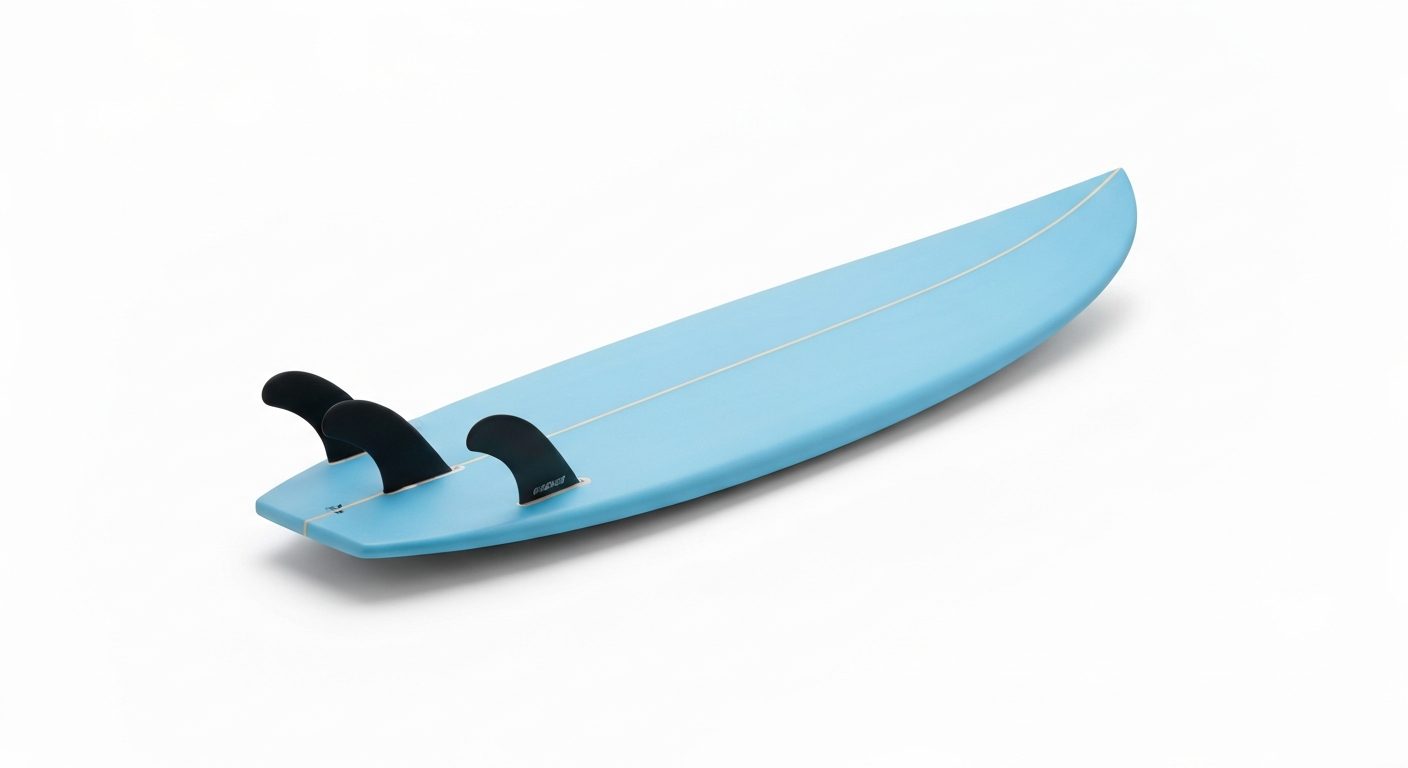
Isle Coronado Soft-Top Review
The Isle Coronado is the rare softboard that actually rewards surfers who are ready to grow — its epoxy core and stiffer deck give you real feedback and trim without the chaos of a pure foamie. At around $450, it earns its place as a legitimate step-up for improvers who've outgrown beginner foam but aren't ready to commit to a hard board.
Isle built its name on stand-up paddleboards, so when they released the Coronado soft-top surfboard, plenty of people raised an eyebrow. A SUP brand making a step-up surfboard? We paddled out skeptical. We came in impressed.
The Coronado runs roughly 7′ to 8′ depending on the size you choose, and it’s built around an epoxy core rather than the soft EPS foam you’ll find in a standard foamie. That one construction decision changes everything about how this board rides — it’s stiffer underfoot, more responsive on rail, and noticeably quicker to trim than a classic soft-top. It still has a soft EVA deck, so wipeouts stay forgiving, but it surfs much closer to a proper hard board than anything in the Wavestorm tier.
We tested the 7’6″ over several sessions across waist-to-head-high beach break. Here’s the full honest take on whether the Coronado deserves a spot in your quiver — or on our list of the best soft-top surfboards.
Isle Coronado specs
| Length | 7′-8′ |
| Type | Epoxy-core soft-top |
| Fins | 2+1 |
| Rider | Beginner-intermediate |
| Skill | Improver |
| Best for | Epoxy step-up |
On the water — epoxy-core feel
The first thing you notice paddling into a wave on the Coronado is that it doesn’t feel mushy. Most soft-tops have a slight flex that absorbs energy and makes it hard to feel what the board is doing. The Coronado’s epoxy core eliminates that. You get actual feedback through your feet — you can feel the rail engaging, sense when you’re on the right part of the wave, and make deliberate adjustments rather than just surviving the ride.
Down the line, the board has a clean, direct drive that surprised us. It’s not a performance shortboard — you’re still riding width and volume — but you can set a rail and actually generate speed rather than just floating along in a straight line. Cutbacks are clunky compared to a real fiberglass shortboard, as you’d expect at this volume, but the board responds. It doesn’t just go where inertia takes it.
Paddle-in is easy thanks to the volume and width, and duck dives are workable in the 7′ range — not effortless, but doable. The soft EVA deck keeps wax optional and makes long sessions comfortable on your knees when you’re still popping up. Stability is high enough that improvers will feel confident but not so much that you’re stuck on training wheels.
Construction & fin setup
The Coronado’s build is the story of this board. The epoxy core is wrapped in a fiberglass layer and finished with a soft EVA foam deck — it’s essentially a hybrid construction that sits between a pure foam softboard and a traditional hard-top. The result is a board that’s more durable than either extreme: the soft deck resists pressure dings, and the epoxy core doesn’t snap under normal surf stress the way a cheap foam blank might.
Edges and rails are firmer than a classic foamie, which helps with rail-to-rail transitions and keeps the tail from washing out in steeper sections. The bottom is a standard concave that channels water flow reasonably well for a board in this price class.
Fin setup is a 2+1 configuration — two small side bites plus a larger removable center fin. The center fin slot is a standard US box, so you can swap in aftermarket fins without issue. Out of the box, the setup is tuned toward stability and straight-line drive, which is right for the target surfer. More advanced riders can experiment with a smaller center fin to loosen the tail up. The side bites are fixed, which is the only real limitation here — you can’t adjust cant or toe to dial things in further, but at this level of surfing, it honestly doesn’t matter.
Build quality overall is solid for the price. Seams are clean, the fin box shows no play, and the leash plug is properly glassed in. Surfrider Foundation has noted that durable boards that last longer are better for the ocean — the Coronado’s longevity is a genuine point in its favor.
Is it a step-up for you?
The Coronado is designed for a specific surfer: someone who can consistently catch unbroken waves on a foamie, is working on linking turns, and wants a board that rewards better technique instead of masking it. If that’s you, this board fits the brief almost perfectly.
It’s not the right board if you’re still learning to pop up. For that, you want maximum foam and maximum forgiveness — check our guide to the best beginner surfboards first and come back to the Coronado when you’re ready. And it’s not the right board if you’re an intermediate surfer who already surfs hard boards comfortably — at that point you’d be buying volume you don’t need.
The sweet spot is the improver: six months to two years in, catching waves confidently, frustrated that your foamie won’t let you progress. The Coronado gives you the feel of a real surfboard without the penalty for imperfect technique. You’ll ding it less than a fiberglass board, recover easier from bad takeoffs, and still feel yourself improving session over session. At $450, it’s not cheap for a soft-top, but it’s significantly less than a quality fiberglass step-up from the same tier — and it’s more durable.
Who it's for (and who should skip it)
The Coronado makes the most sense for improvers in the 140–200 lb range looking at the 7’6″ or 8′ sizes. Lighter surfers can size down; heavier surfers or those surfing weaker, slower waves should go longer. Isle’s size charts are reasonable — follow them.
It also works as a travel board or a beater for surfers who already own a fiberglass quiver but want something they can toss on a roof rack and not stress about. The soft deck forgives parking lot fumbles and reef scrapes in ways that epoxy hard-tops never do.
Skip the Coronado if: you’re a complete beginner (too responsive, not enough stability for day-one surfers); you want the absolute cheapest soft-top on the market (this isn’t it); or you’re an advanced surfer who wants performance (this board has a ceiling and it’s not very high). For a broader look at where the Coronado fits in the market, our roundup of the best surfboards puts it in context against both soft-tops and hard-tops across all skill levels.
If you fit the improver profile, though, the Isle Coronado is one of the more thoughtfully built step-up softboards available at this price. Isle clearly applied some of the quality control from their SUP line to this board, and it shows.
What we liked
- Epoxy core gives real wave feedback — surfs noticeably closer to a hard board than a standard foamie
- Durable hybrid construction holds up to frequent use and rough handling
- 2+1 fin setup with standard US box lets you swap fins as you progress
- Soft EVA deck stays forgiving on wipeouts and keeps sessions comfortable
- Good paddle speed and stability for the target skill level
- Solid build quality at the price point — seams clean, no fin box wobble
The catches
- Fixed side-bite fins limit fine-tuning for more advanced riders
- At $450 it's one of the pricier soft-tops — beginners may not feel the difference over cheaper foamies
- Not enough performance ceiling for surfers already comfortable on hard boards
- Isle's surf-specific customer support and sizing guidance is thinner than their SUP resources