
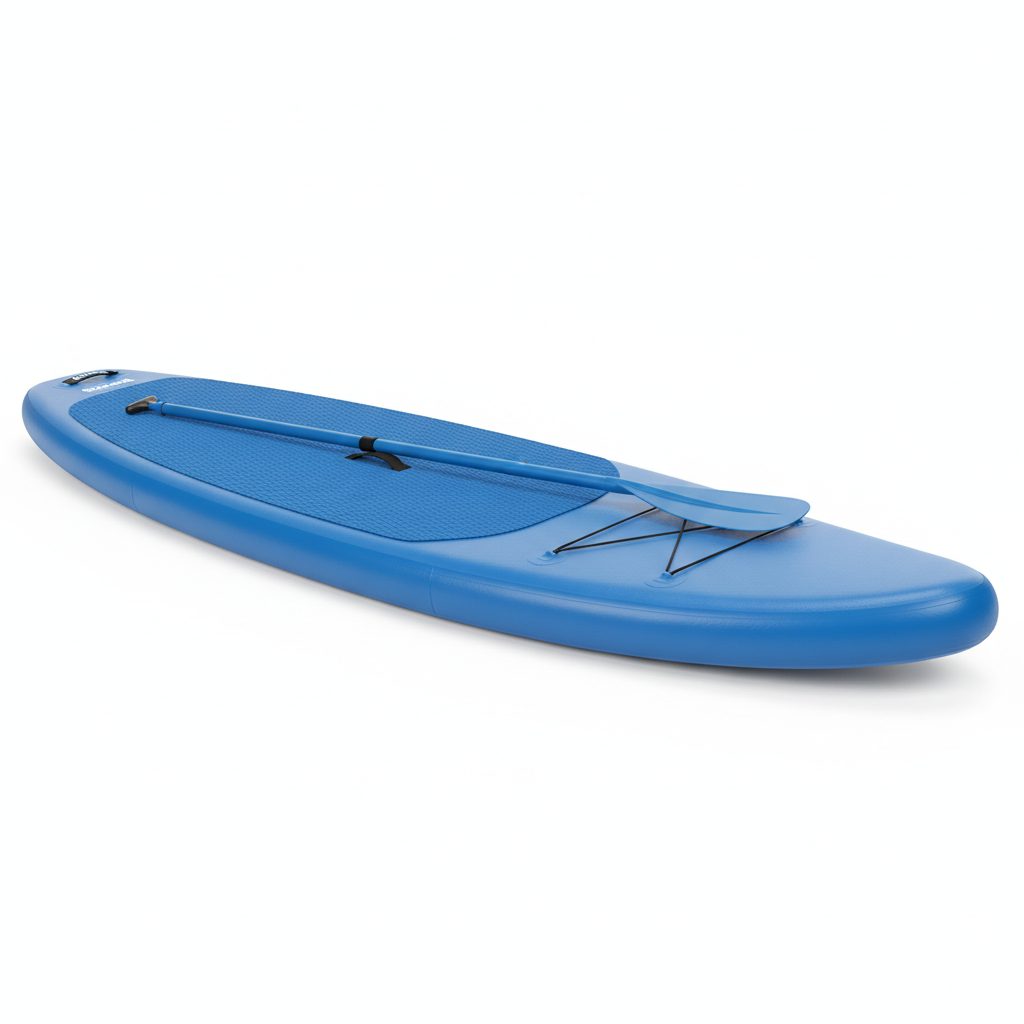
iRocker Cruiser Ultra 3.0 Review
The iRocker Cruiser Ultra 3.0 is one of the most well-rounded inflatable paddle boards under $500 — stable enough for beginners, light enough to actually want to carry, and built to last more than a season or two.
We’ve tested a lot of inflatable paddle boards in the $300–$600 range, and the iRocker Cruiser Ultra 3.0 keeps landing near the top of the pile. At 10’6″ x 33″ x 6″, it hits the sweet spot most paddlers actually need: wide enough to feel planted, long enough to track well, and stiff enough to not feel like you’re standing on a pool noodle.
What makes the 2025 Ultra 3.0 stand out is the dual-layer fusion construction. iRocker ditched the heavier drop-stitch+PVC layup and went with a lighter bonded process that shaves serious weight without sacrificing rigidity. We weighed ours at 17.2 lb — that’s road-trip-ready light for a board this size.
We put it through flatwater paddles, a choppy bay session, and let a few complete beginners take it out to see how it held up. Here’s what we found.
iRocker Cruiser Ultra 3.0 specs
| Length | 10’6″ |
| Width | 33″ |
| Thickness | 6″ |
| Capacity | ~400 lb |
| Type | All-around / stable |
| Paddle | Included |
On the water — stability & glide
The 33-inch width is the first thing you notice when you step on. We had paddlers ranging from 140 lb to 230 lb test the Cruiser Ultra, and none of them went swimming on their first attempt — which is more than we can say for some of the narrower “all-around” boards we’ve reviewed. The wide platform gives you real margin for error when you’re finding your feet, and it stays stable when you shift weight to turn or look over your shoulder.
Glide is respectable for a board this wide. It’s not going to win any distance races against a 32-inch touring board, but for recreational paddling, bay cruising, or a sunset flatwater session, it moves cleanly. We clocked it at a comfortable 3.5–4 mph cruising pace without working hard. Tracking is helped by the removable center fin — keep it in for straight-line paddling, pop it out for shallow-water launching.
In choppier conditions, the 6-inch thickness held up. The board didn’t flex underfoot or develop the “oil-canning” wobble you get from cheaper single-layer constructions. If you’re paddling on lakes, calm bays, or slow rivers, this board will handle it without drama. Open ocean or surf? That’s not what it’s designed for — and we’ll get to that.
Construction & weight
The Ultra 3.0 uses what iRocker calls “dual-layer fusion” — essentially a heat-bonded drop-stitch core with a second layer of PVC laminated directly to the surface rather than glued in separate steps. The result is a board that’s measurably stiffer than traditional glued-layer boards at the same thickness, and noticeably lighter. Our test board came in at 17 lb on a kitchen scale, which is excellent for a 10’6″ x 6″ iSUP.
The rails feel solid, the seams are clean, and the D-rings are welded rather than glued — a detail that matters if you’re attaching a kayak seat or loading gear. The deck pad covers most of the standing area and has enough texture to grip wet feet without being abrasive on bare knees. We inflated it to the recommended 15 PSI and the board passed the bend-test: standing in the middle with 200 lb, there was less than half an inch of flex. For reference, that’s comparable to boards costing $100–150 more.
For more on how construction affects performance, see our best inflatable paddle board guide — we break down fusion vs. woven drop-stitch vs. single-layer across price tiers. According to American Canoe Association guidelines, board rigidity directly impacts stability and fatigue on longer paddles, which is why construction quality matters more than most buyers expect.
What's in the package
iRocker includes a complete kit with the Cruiser Ultra 3.0, which is worth calling out because it’s genuinely good stuff — not the filler accessories some brands throw in to pad their listings.
The carbon-hybrid paddle adjusts from roughly 68″ to 84″ and is noticeably lighter than the full-aluminum paddles that come with budget boards. The blade angle and grip are comfortable for long sessions. The dual-chamber pump inflates the board to 15 PSI in about 10–12 minutes of moderate effort; the dual-action on the down-stroke makes it faster than single-action pumps. The coiled leash is included, which is a safety essential — if you’re new to paddle boarding, the U.S. Coast Guard classifies stand-up paddle boards as vessels, and wearing a leash keeps the board from becoming a hazard to other watercraft if you fall.
The backpack fits everything and is well-constructed — padded shoulder straps, external attachment points, and enough space for the board, pump, paddle, and leash without forcing it. We’ve seen $600 boards ship with cheaper bags than this.
If you’re comparing what’s included against other packages in this price range, check our best paddle board brands breakdown — iRocker consistently ranks near the top for kit value.
Who it's for (and who should skip it)
The iRocker Cruiser Ultra 3.0 is built for paddlers who want a reliable, do-everything board without spending $700+. If you’re a beginner looking for your first board, this is a strong pick — the stability margin is wide, the kit is complete, and you won’t feel like you’ve outgrown it after one season. See our best beginner paddle board guide for how it stacks up against other entry-level options.
It also works well for recreational paddlers who want one board that can handle a camping trip, a lake day with kids, and a casual fitness paddle without needing a quiver. The 400 lb capacity means two adults can share it, or one adult can load it with a cooler and dry bag for a day trip.
Who should skip it: serious fitness paddlers or racers who want a narrower, faster board will find the 33-inch width limiting. Surfers need a dedicated surf SUP with more rocker. And if you’re paddling heavy whitewater or rocky rivers, no inflatable at this price point is the right tool. For those use cases, check our paddle board size chart to find what actually fits your paddling style.
At around $400, the Cruiser Ultra 3.0 sits at a price where it beats most of what’s below it and holds its own against most of what’s above it. It’s not the cheapest board on the market and it’s not trying to be — it’s built to be the one board most paddlers actually need.
What we liked
- Stable 33-inch width works for beginners and heavier paddlers
- Dual-layer fusion construction is rigid and noticeably lighter than traditional layups (~17 lb)
- 400 lb capacity is generous for the price
- Complete kit includes a carbon-hybrid paddle, quality backpack, and dual-chamber pump
- Clean construction: welded D-rings, solid seams, good deck pad coverage
- Strong value — accessories alone justify much of the price
The catches
- 33-inch width limits top-end glide speed for fitness or distance paddling
- Not designed for surf or heavy whitewater
- Manual inflation takes 10–12 minutes — electric pump sold separately
Frequently Asked Questions
Is the iRocker Cruiser Ultra 3.0 good for beginners?
Yes — it’s one of the better beginner options in its price range. The 33-inch width gives new paddlers a stable platform that forgives weight shifts and wobbles, and the complete kit means you don’t need to buy anything extra to get on the water. The board is also forgiving enough that you won’t feel like you’ve immediately outgrown it once your balance improves.
How stable is the iRocker Cruiser Ultra 3.0?
Very stable for an all-around board. The 33-inch width and 6-inch thickness combine to create a platform that paddlers up to 230+ lb found secure in our testing, including complete beginners. It’s not a yoga SUP with a 34–36 inch deck, but it’s noticeably more stable than most 31–32 inch all-around boards in this price tier.
What is the weight capacity of the iRocker Cruiser Ultra 3.0?
The iRocker Cruiser Ultra 3.0 is rated for up to 400 lb. In practice, we recommend staying at or below 350 lb for comfortable performance — boards near their maximum capacity ride lower in the water and are harder to paddle efficiently. That said, the 400 lb rating makes it one of the more capable boards in its class for heavier paddlers or shared use.
What comes included with the iRocker Cruiser Ultra 3.0?
The board ships with a carbon-hybrid adjustable paddle, a dual-chamber hand pump, a coiled ankle leash, three fins (one large center fin plus two small side fins), a repair kit, and a padded backpack large enough to carry everything. It’s a complete kit — you need nothing else to paddle on day one.
How does the iRocker Cruiser compare to cheaper paddle boards?
The main differences show up in construction and accessories. Budget boards under $250–$300 typically use single-layer PVC with glued seams that can delaminate over time, and they ship with heavy aluminum paddles and flimsy bags. The Cruiser Ultra 3.0’s dual-layer fusion construction is measurably stiffer and more durable, and the carbon-hybrid paddle alone would cost $80–$120 to replace. If you’re paddling more than a few times per year, the Cruiser Ultra tends to cost less over a 2–3 year horizon than replacing a cheap board that doesn’t hold up.