
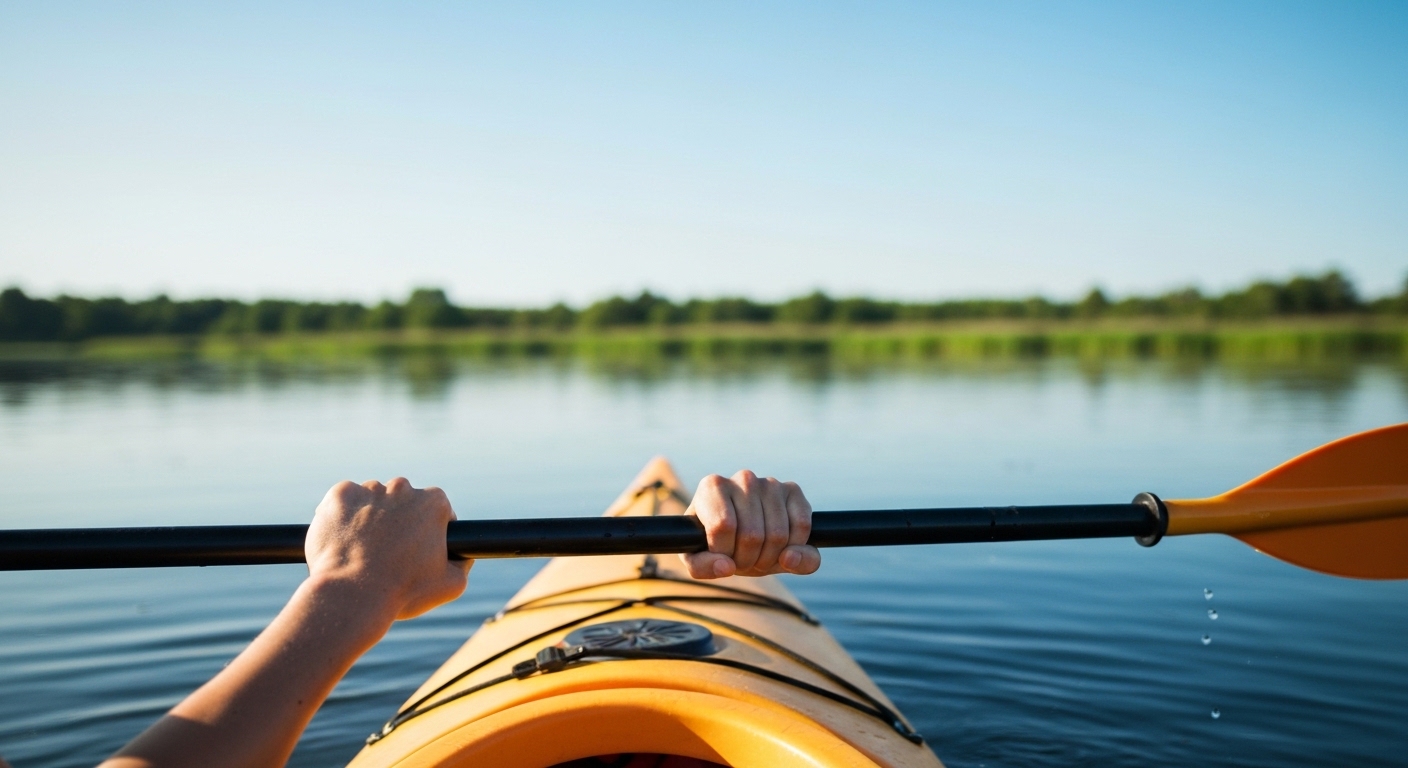
How to Hold a Kayak Paddle
Get your grip right before your first stroke and every mile after that gets easier.
Kayak paddle sizeMost paddling problems—tired arms, wobbly tracking, sore wrists—trace back to one thing: a bad paddle grip. The good news is that holding a kayak paddle correctly takes about two minutes to learn and pays off for the rest of your life on the water. This guide covers everything from which end is up to why you should never death-grip the shaft.
Start Here: Which Way Is the Blade Facing?
Before you even think about where your hands go, you need the blade oriented correctly—because a surprising number of beginners (and even some veterans) put theirs in upside down or backward on day one.
Longer edge on top. Most kayak paddle blades are asymmetrical: one edge is slightly longer than the other. The longer edge goes at the top of the stroke, nearest the surface of the water as you plant the blade. This shape is engineered to enter the water cleanly and exit without flutter.
Scooped side faces you. Run your thumb across both faces of the blade. One side is concave—slightly curved inward like a shallow spoon. That is the power face. It should face you, toward the stern, so it scoops and pushes water on every forward stroke. The smooth, convex side faces away from you. If your blade feels like it is slipping or “fluttering” through the water rather than catching it, flip the blade around—you almost certainly have it backward.
Check your kayak paddle size guide to confirm you have the right shaft length before locking in your grip—a paddle that is too long forces your elbows too high and changes everything downstream.
Hand Spacing: The 90-Degree Elbow Rule
Hold the shaft horizontally in front of you at forehead height with your arms extended. Now bend your elbows until each forearm forms a 90-degree angle with the shaft. Where your hands land naturally is roughly where they should stay—slightly wider than shoulder width for most paddlers.
A simple field check: rest the center of the shaft on top of your head and let your hands fall to the shaft. Your elbows should form right angles. If your hands are way out near the blades, you are working too hard for too little power. If they are bunched toward the center, your strokes will be short and cramped.
Why spacing matters: Hands too close together mean short, choppy strokes and zero torso rotation. Hands too far out put strain on your shoulders and wrists, especially over long distances. The shoulder-width-plus-a-bit spacing keeps the paddle shaft inside what instructors call the “paddler’s box”—a zone in front of your body where your shoulders are protected from rotation injuries.
Most recreational paddles have a center drip ring or a slight texture change at the grip zone. Use those as a reference, but always verify with the elbow rule rather than trusting the markings blindly.
The Control Hand and the Loose Hand
This is the concept most beginners have never heard of, and it changes everything once it clicks.
The control hand is whichever hand you designate as dominant (usually your right). It maintains a firm, consistent grip throughout the stroke cycle and never rotates on the shaft. Your knuckles on the control hand should stay aligned with the top edge of the blade on that side—if you can see your knuckles pointing straight up when the blade is upright, you are in the right position.
The loose hand (your non-dominant hand) holds the shaft lightly—loosely enough that the shaft can rotate inside your fingers during feathered strokes (more on that below). Think of the loose hand as a guide ring, not a clamp. You steer and stabilize with it, but you do not grip with it.
Together, the control hand and loose hand create a system where your paddle moves efficiently without your wrists fighting each other. Paddlers who grip equally hard with both hands end up with sore wrists by lunch, because feathering forces one wrist into an unnatural cocked position on every single stroke.
Feathering: What It Is and Whether You Need It
Feathering means the two blades are set at an offset angle to each other—anywhere from 15 to 60 degrees depending on the paddle. When you complete a stroke on the right side, the left blade is already rotated to slice through the air rather than catch wind resistance on its flat face.
Why it exists: In headwinds, an unfeathered paddle acts like a sail on the recovery stroke, pushing you backward with every swing. Feathering kills that drag. In calm conditions on flat water, it matters less.
How you use it: Your control hand holds its position. After each stroke, you rotate the shaft slightly in your loose hand so the recovering blade angles into the wind. The rotation happens naturally at the loose hand; the control hand never moves. This is exactly why the loose hand must stay relaxed—it has to allow that rotation without fighting it.
Most modern paddles let you set the feather angle (or remove it entirely) with a push-button ferrule at the center joint. If you are brand new, starting at zero feather or a low angle like 15 degrees while you build muscle memory is perfectly fine. Plenty of flatwater recreational paddlers never feather at all. Explore the rest of our our kayak guides for gear that makes setup like this easier from day one.
The Paddler's Box and Why You Must Not Death-Grip
Imagine a rectangle in front of your chest—formed by your arms, your chest, and the paddle shaft. That rectangle is the paddler’s box. The core rule of safe, efficient kayaking is to keep the paddle inside that box at all times. When you reach too far behind you, twist past your hips, or let the blade drop too low, you break the box and put torque directly on your shoulder joint.
Keep your elbows slightly bent and in front of your body. Drive strokes with torso rotation, not arm extension. Your core muscles—not your biceps—should be doing most of the work. If your arms are burning after twenty minutes, you are probably paddling with arms-only and the box has collapsed.
Grip pressure: Hold the shaft like you are holding a live bird—firm enough that it will not fly away, loose enough that you are not crushing it. A death grip kills your endurance, restricts blood flow to your fingers, and turns a two-hour paddle into a forearm cramp-fest. The moment you notice your knuckles going white, consciously open your hands slightly and shake them out one at a time.
Wearing paddling gloves can help here—they give you grip confidence without white-knuckling. Browse our picks in kayak accessories if you want gloves or other gear that supports good technique.