How Many Fins Should a Beginner Surfboard Have?
Three fins — a thruster setup — is the right starting point for almost every new surfer.
Fin setups explainedIf you’ve been staring at the bottom of a surfboard wondering how many fins you actually need, we’ll cut straight to it: three fins, set up as a thruster, is the answer for most beginners. It’s the default on nearly every foam learner board for good reason — it balances stability, control and forgiveness in a way that lets you focus on surfing instead of fighting your equipment.
The short answer: a thruster (3 fins)
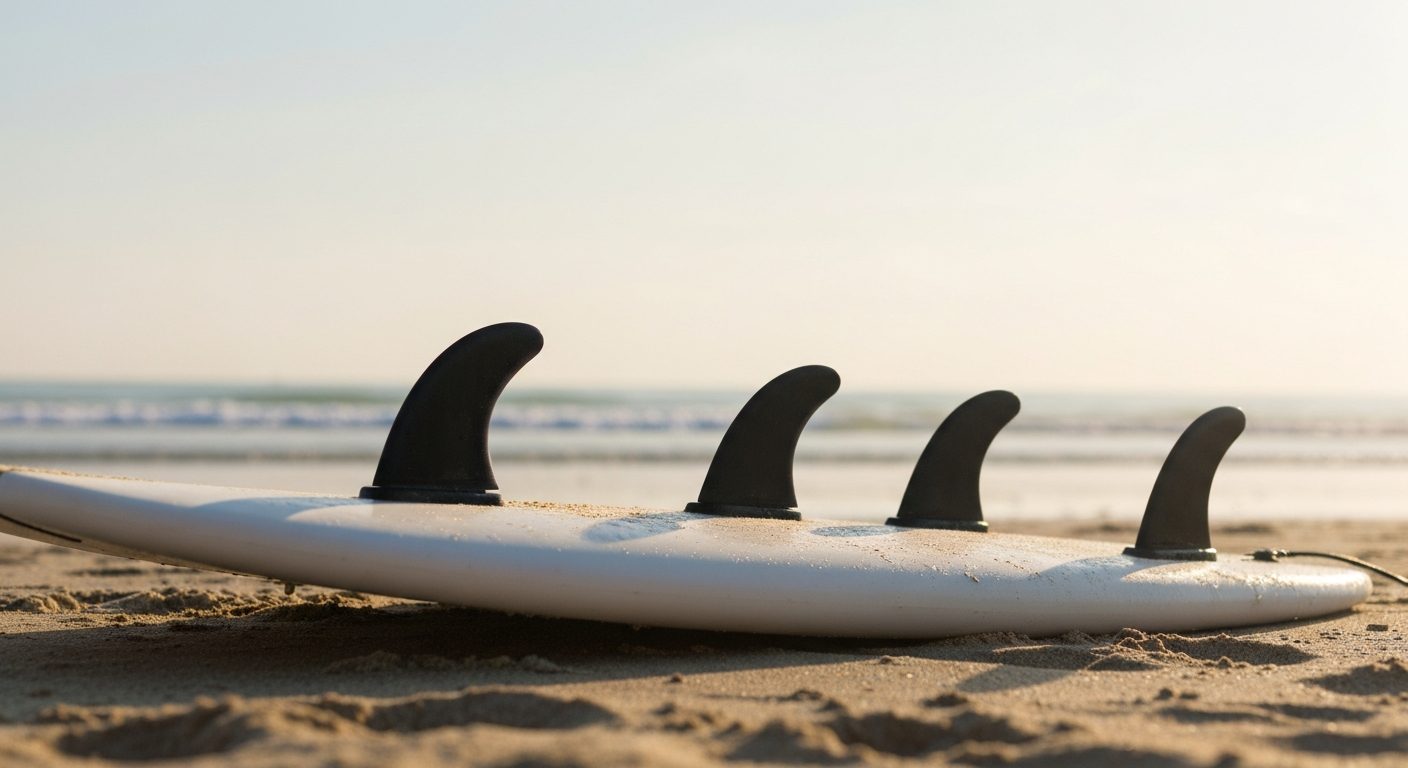
A thruster is three fins arranged in a triangle — one center fin and two side fins (called side bites). This setup has been the worldwide standard since the early 1980s, when Australian surfer Simon Anderson popularized it, and it remains the go-to configuration for good reason.
For beginners, the thruster delivers exactly what you need: forward drive to catch waves, side fins that help hold a line and stop the tail sliding out, and enough predictability that you can actually feel what the board is doing. Most soft-top foam boards — the best soft-tops we recommend for beginners — ship with a thruster setup installed and ready to go. You don’t have to think about it.
The one exception worth knowing is the longboard single fin — more on that below. But if you’re riding a 7–9 ft foam board or a mid-length, thruster is your answer.
What fins actually do
Fins are the steering and tracking system of a surfboard. Without any fins, a surfboard would spin out the moment you tried to angle across a wave — the tail would slide sideways and you’d have almost no directional control.
Fins work by generating drag and lateral resistance as water flows past them. The more fin surface area you have in the water, the more hold the board has — meaning the tail stays planted and the board tracks in the direction you’re pointing. Too little fin and the board feels loose and skittery. Too much fin and the board feels stiff and hard to turn.
According to the International Surfing Association, equipment choice — including fin setup — plays a meaningful role in how quickly beginners progress. The right setup gives you feedback you can learn from; the wrong one just makes everything harder. For a deeper dive into how different configurations behave, our surfboard fin setups explained guide covers the mechanics in full.
Single, twin, thruster, quad — quick rundown
There are four common fin setups you’ll encounter. Here’s what each one means for a beginner:
- Single fin: One center fin. Classic longboard setup. Very stable and smooth on small, rolling waves — great for noseriding and cruise-style surfing. If you’re learning on a traditional longboard, a single fin is totally appropriate. Turns are wide and drawn out, which actually suits longboard technique well.
- Twin fin: Two fins, no center fin. Fast and loose — the tail has a lot of freedom to slide around. Fun for experienced surfers who want a skatey feel, but too unpredictable for beginners. We don’t recommend starting here.
- Thruster: Three fins (two side fins + one center). The balanced middle ground. Drive, hold, and control without being stiff. The standard on almost every beginner surfboard we’ve reviewed. Start here.
- Quad: Four fins, no center fin. Generates a lot of speed and has good hold in hollow waves, but it’s a more advanced tool. Skip it until you’re comfortably turning and reading waves on a thruster.
Understanding the full range of board shapes that suit each setup is covered in our surfboard types explained breakdown — useful context as you progress beyond the foam board stage.
What a beginner should actually run
Our recommendation is simple: ride whatever fins came with your board and don’t change them yet. Almost every beginner foam board comes stock with a thruster — three fins that are already sized and positioned for that specific board. They’ve been tuned for it. Swapping fins before you can consistently stand up and trim across a wave introduces a variable you don’t need.
Once you’re comfortable riding green waves and starting to make bottom turns, fin experimentation becomes worthwhile. Until then, the gains from fin swapping are real but small compared to the gains from more time in the water.
If you’re shopping for your first board and the fin setup isn’t clear, look for “FCS II” or “Futures” — those are the two dominant fin box systems and they tell you the board is set up for removable fins. Most foam learner boards use a fixed thruster setup with molded-in fins, which is perfectly fine and actually reduces the chance of fins falling out mid-session.
Bottom line: three fins, thruster setup, stock configuration. That’s the answer. Get in the water.
Frequently Asked Questions
Is a thruster good for beginners?
Yes — a thruster is the best all-around setup for beginners. Three fins give you a balanced combination of stability, directional drive and control without being too stiff or too loose. Almost every foam learner board ships as a thruster, and it’s the configuration we recommend starting on. You won’t need to change it until you’ve built solid foundational skills.
Can you surf a single-fin as a beginner?
Yes, especially on a longboard. Single fins are smooth, stable and predictable on small rolling waves — the style of surfing a longboard encourages actually suits a single fin well. If you’re learning on a traditional longboard (9 ft or longer), a single fin is a perfectly appropriate choice. On a shorter foam board, you’ll want to stick with the thruster.
Do more fins mean more control?
Not exactly. More fins mean more hold and less tail slide, which can feel like control — but they also make the board stiffer and harder to turn. A quad (four fins) has tremendous hold but can feel locked in and unresponsive for surfers who aren’t ready for it. For beginners, three fins hits the sweet spot between enough hold and enough freedom to learn on.
Can you remove fins on a foamie?
It depends on the board. Many budget foam boards have fins molded directly into the blank — those can’t be removed. Boards with FCS II or Futures fin boxes do have removable fins. Either way, we’d leave them alone while you’re learning. Riding a foamie without fins (or with fewer than stock) is more likely to frustrate you than help you progress at the beginner stage.