
High-Angle vs Low-Angle Kayak Paddles
One question separates paddlers who feel efficient on the water from those who feel like they're fighting it: are you using the right paddle style for the way you actually paddle?
Kayak paddle sizeMost kayakers buy a paddle without knowing there are two completely different philosophies baked into its design — and choosing the wrong one quietly wrecks your efficiency, your comfort, and your reach. High-angle and low-angle paddles look similar hanging on a wall. On the water, they behave like different tools entirely.
What Low-Angle Paddling Actually Means
Low-angle paddling is the default style for most recreational and touring kayakers — and there’s nothing passive about calling it relaxed. It refers to the angle your paddle shaft makes with the water surface during a stroke. In low-angle technique, the shaft stays relatively horizontal, somewhere around 20 to 30 degrees from flat. Your top hand stays at roughly shoulder height or below. The movement is long, sweeping, and efficient.
This style suits people who want to cover distance comfortably, paddle for hours without wrecking their shoulders, or simply enjoy being on the water without turning every outing into a workout. It’s what most recreational paddlers naturally fall into without being taught, and it’s what most touring and fishing kayakers use because endurance matters more than top-end speed.
The blade on a low-angle paddle matches the stroke. It’s longer and narrower — often called a “spoon” or touring blade. That narrower profile slips through the water with less resistance, which sounds counterintuitive until you realize that efficiency over thousands of strokes matters more than raw bite on any single one. Less flutter, less fatigue, more miles.
If you’re planning an all-day float, paddling a recreational or touring kayak, or covering open water without a stopwatch, low-angle is almost certainly your style — even if you’ve never heard the term before.
What High-Angle Paddling Actually Means
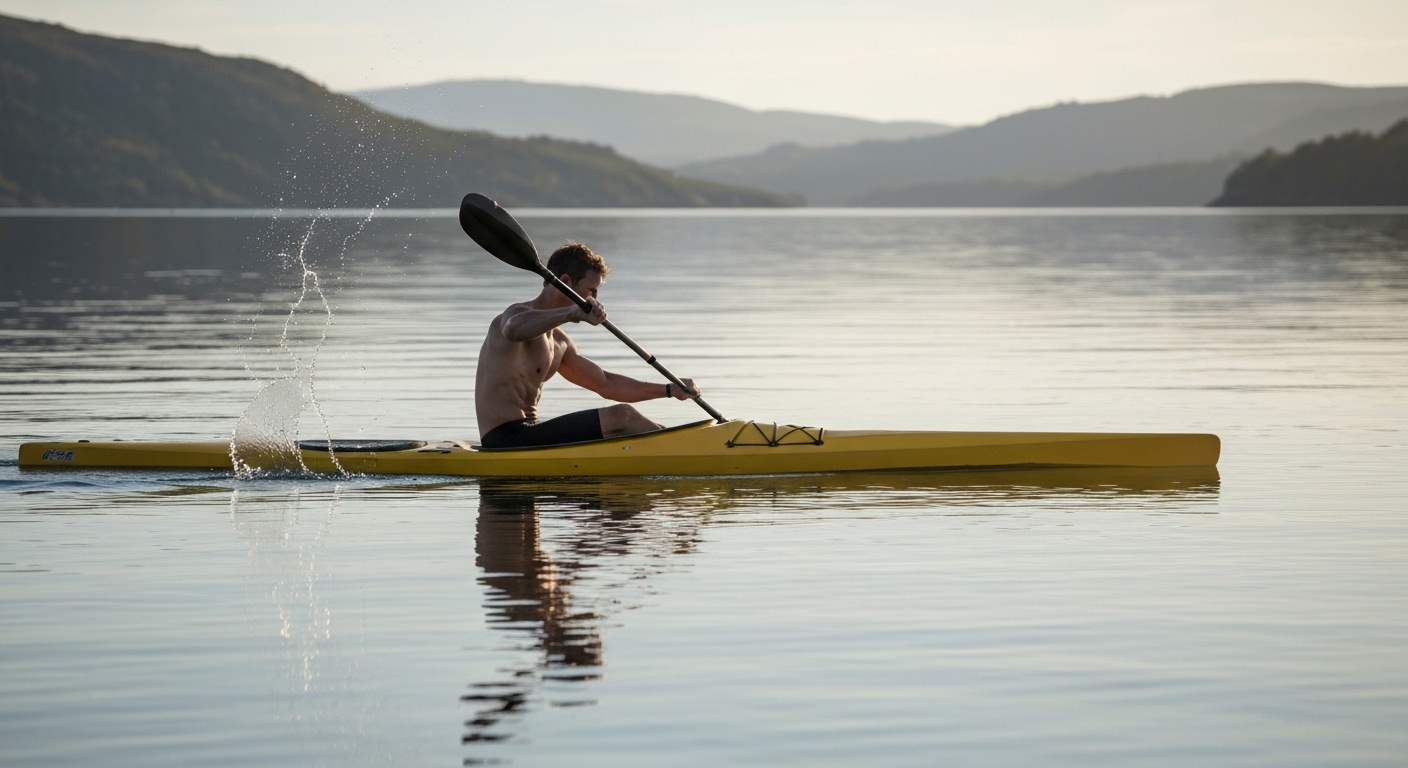
High-angle paddling is more aggressive. The shaft comes up steeper — 45 to 60 degrees or higher from the water — and your top hand crosses up toward or above eye level during the stroke. The blade enters the water close to the hull and exits near your hip. It’s a shorter, more powerful stroke with more torso rotation required to do it right.
Whitewater kayakers live here. So do sea kayakers who sprint between ferry lines, surf ski paddlers, and fitness kayakers who use their paddle sessions like interval training. High-angle technique generates more power per stroke and more control in dynamic water, but it demands more from your body — especially your core and shoulders — and it doesn’t scale well to a six-hour lake crossing unless you’re extremely conditioned.
The blade on a high-angle paddle is shorter and wider. That wider face catches more water per stroke, which is what you want when each stroke needs to count and you’re not trying to minimize effort over a marathon session. You’ll also notice high-angle blades are often more asymmetrical and dihedral-shaped to manage the higher forces involved.
If you’re paddling whitewater, doing fitness training, racing, or surfing coastal waves, high-angle is built for you. Most casual rec and touring paddlers who pick up a high-angle paddle by accident find it tiring and harder to keep on a straight line.
How to Tell Which Style You Are
Watch your top hand during a normal, comfortable stroke. If it stays at or below your shoulder — if the shaft feels like it’s sitting at a diagonal across your body — you’re a low-angle paddler. If your top hand naturally comes up toward your face or above your chin and the shaft angles steeply toward the boat, you’re trending high-angle.
Here’s a more honest test: what kind of kayaking do you actually do? Run through this list.
- Recreational lakes, slow rivers, casual day trips: Low-angle.
- Multi-day touring, fishing kayak, open-water cruising: Low-angle.
- Whitewater class II and above: High-angle.
- Fitness paddling, sprint training, surf ski: High-angle.
- Coastal paddling in big water and chop: Probably high-angle, depending on your conditioning.
Most people reading a comparison article on a gear site are recreational or touring paddlers. If you’re unsure, you’re almost certainly a low-angle paddler. That’s not a consolation prize — low-angle is efficient, sustainable, and exactly right for most on-water goals.
Our kayak paddle size guide covers this distinction as part of sizing, since the two styles call for different shaft lengths.
Paddle Length: High-Angle Is Shorter
This is one of the most practical differences and one that trips people up constantly. High-angle paddles are shorter than low-angle paddles, even for the same paddler with the same kayak width.
Why? Because in a high-angle stroke, the blade enters the water closer to the hull at a steep angle. You don’t need the extra shaft length to reach the water comfortably. A longer shaft would actually put the blade too far from the boat and throw off the stroke entirely.
Low-angle paddling requires more reach — you’re sweeping the blade out and forward with the shaft sitting flatter — so the extra length is functional, not decorative.
As a rough reference: a 5’10” paddler in a 26-inch-wide recreational kayak using low-angle technique might reach for a 230–240 cm paddle. That same paddler switching to high-angle technique would likely size down to 215–220 cm. Manufacturers publish sizing charts, but they’re only useful if you know which style column to look at. Grabbing a low-angle length paddle for high-angle use (or vice versa) is one of the most common mistakes at demo days.
Check our full kayak paddle size guide for width and height charts broken out by technique — it’s more detailed than what most brands publish.
Choosing for Rec, Touring, and Fishing
If you’re paddling a recreational kayak on calm lakes and slow rivers, the choice is easy: low-angle. Full stop. A low-angle paddle with a quality fiberglass or carbon shaft and decent blades will feel noticeably better than the plastic big-box option most rec boats come bundled with, and you’ll end a long day far less tired.
Touring kayakers have a little more nuance. Most dedicated sea touring and flatwater distance paddlers use low-angle — the efficiency argument wins over long crossings. Some coastal paddlers in rough conditions prefer high-angle for the control and bracing power, but that’s a technique-specific choice, not an equipment upgrade. If you’re a touring paddler who hasn’t been coached on high-angle technique, the blade won’t help you use it.
Fishing kayakers almost universally want low-angle. You’re sitting in a wider boat, often paddling one-handed between spots, and you need endurance more than sprint power. A low-angle touring blade in the 230–240 cm range with a light shaft material is the working setup for most kayak anglers. Check our picks in kayak accessories for accessories that pair well with a fishing paddle setup, and browse our kayak guides for boat recommendations to match.
You Can't Really Mix and Match
Some paddlers wonder whether they can use a high-angle blade with low-angle technique, or vice versa. Technically you can hold either paddle and make it move through water. Practically, you’re sabotaging yourself.
A wide high-angle blade used with a low-angle stroke flutters, catches water at bad angles, and fatigues your arms faster because it’s not feathering through the water the way a narrow touring blade does. The extra surface area that makes it powerful in a steep, vertical stroke becomes drag when the shaft is horizontal.
A narrow low-angle blade used with a high-angle stroke gives you less catch per stroke than the technique demands. You’ll work harder to generate the same power, and the blade will feel like it’s skipping on the surface instead of biting in.
Paddle design and paddling style are matched from the ground up. If you genuinely do both types of paddling — say, flatwater touring and occasional whitewater — experienced paddlers own two paddles. There’s no hybrid that does both well without compromising on both ends.
If you’re still dialing in what gear you actually need, start with the kayak paddle size guide and then browse kayak accessories once the paddle is sorted. Getting the paddle right first is the move.