
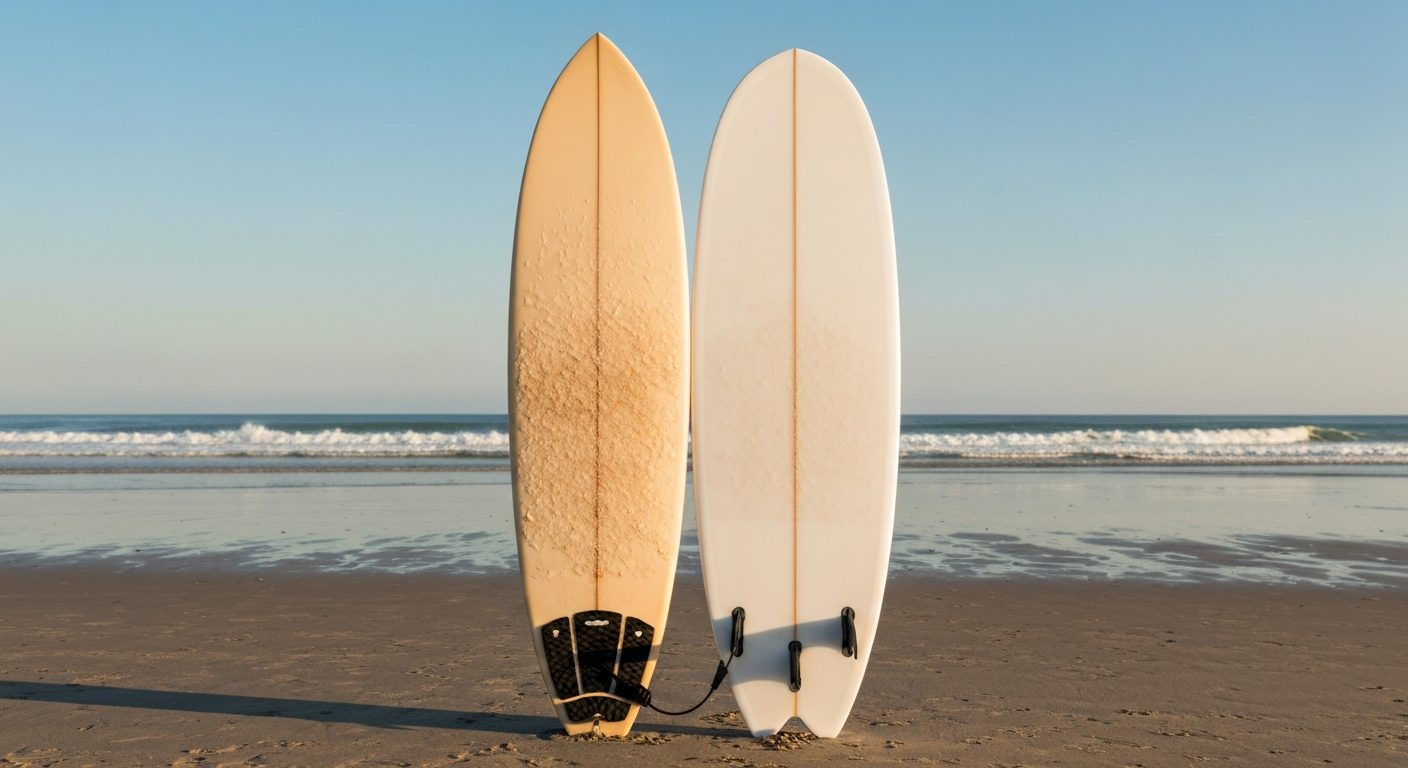
Foam vs Epoxy vs Fiberglass Surfboards: Which Should You Buy?
Three constructions, one question: which surfboard is actually right for you?
Best soft-top surfboardsWalk into any surf shop and you’ll face a wall of boards built three different ways — soft-top foam, epoxy, and traditional fiberglass — each with a different feel, price tag, and ideal rider. We’ve ridden all three across every skill level, and the honest answer is that none of them is universally “best.” The right choice depends on where you are in your surfing, how you’ll use the board, and how much you want to spend on repairs.
What Are Foam (Soft-Top) Surfboards?
Soft-top surfboards — often called foamies — use an EPS foam core wrapped in a layer of expanded polyethylene (IXPE) foam on the deck and bottom. That soft outer skin is the defining feature: it won’t ding your knees when you’re learning to pop up, it won’t wreck another surfer’s shin in a crowded lineup, and it bounces off the reef instead of cracking. Most have a hard plastic bottom slick that adds speed and stiffness without sacrificing the forgiving deck.
Foamies have shed their kook stigma hard over the last decade. Professional surfers ride them for fun days, and brands like Catch Surf and Softech have pushed the design to the point where a good soft-top genuinely surfs — it’s not just a pool toy.
- Core: EPS foam (expanded polystyrene)
- Deck/skin: IXPE closed-cell foam — soft, grippy, and forgiving
- Bottom: HDPE plastic slick for speed and rigidity
- Fins: Usually rubber or soft plastic — safer, but less responsive
Check out our picks for the best soft-top surfboards if you’re shopping in this category right now.
What Are Epoxy Surfboards?
Epoxy surfboards use the same EPS foam core as a soft-top, but instead of an IXPE skin, they’re laminated with fiberglass cloth and epoxy resin. Epoxy resin is chemically different from polyester — it bonds to EPS foam without dissolving it, it’s significantly stronger per gram, and it cures to a harder, more impact-resistant shell. The result is a board that’s noticeably lighter than a traditional fiberglass board of the same size, and meaningfully more durable.
Epoxy boards have become the dominant choice in the mid-range market ($400–$750) because they’re a genuine all-rounder: light enough for performance surfing, tough enough to survive a season of regular use without a quiver of dings. They paddle well in small waves and still respond in overhead surf.
- Core: EPS foam (expanded polystyrene)
- Laminate: Fiberglass cloth + epoxy resin
- Weight: Typically 15–20% lighter than equivalent PU/PE boards
- Durability: High — resists pressure dings and cracking better than polyester
One practical note: epoxy boards cannot be repaired with standard polyester ding repair kits. You need an epoxy-specific kit — use the wrong resin and the repair will fail. It’s an easy fix once you know, but worth mentioning upfront.
What Are Fiberglass (PU/PE) Surfboards?
When people say “fiberglass surfboard,” they almost always mean a polyurethane (PU) foam core laminated with fiberglass cloth and polyester resin — the construction that defined performance surfing from the 1960s through the 2000s. The abbreviation PU/PE covers both the core and the resin, and you’ll see both terms used interchangeably in shops.
PU foam is denser than EPS and flexes differently under pressure — this is what surfers mean when they talk about “flex” and “feel.” Polyester resin transmits vibration differently than epoxy, which is why experienced surfers often describe PU boards as feeling more “connected” to the wave. The difference is subtle, but at a high performance level it’s real and meaningful.
- Core: Polyurethane (PU) foam — denser than EPS, more flex
- Laminate: Fiberglass cloth + polyester resin
- Weight: Heavier than epoxy — typically 6–9 lbs for a shortboard vs. 5–7 lbs epoxy
- Repairability: Excellent — polyester ding repair kits are cheap and available everywhere
The tradeoff is durability. PU/PE boards ding more easily, are more prone to delamination in hot cars, and absorb water through cracks faster than epoxy. A performance shortboard left with a small ding for a season can end up waterlogged and blown out. They require more maintenance discipline. See our surfboard types explained guide for a deeper look at how construction interacts with shape.
Side-by-Side Comparison
Here’s how the three constructions stack up across the factors that matter most to real surfers:
| Factor | Foam / Soft-Top | Epoxy (EPS/Epoxy) | Fiberglass (PU/PE) |
|---|---|---|---|
| Durability | Excellent — shrugs off bumps | Very good — hard shell, impact resistant | Moderate — dings easily, needs maintenance |
| Weight | Medium-heavy (volume is high) | Light — best strength-to-weight ratio | Heavier than epoxy at same volume |
| Performance feel | Muted — forgiving, not responsive | Lively and light — good response | Best flex and feel at high performance |
| Price (entry) | $150–$350 | $400–$750 | $450–$900+ |
| Repairability | Easy — patch kits or duct tape | Moderate — needs epoxy-specific kit | Easy — polyester kits everywhere |
| Best for | Beginners, fun surfers, kids | Intermediate to advanced, travel | Advanced surfers, performance focus |
| Water absorption risk | Low (closed-cell IXPE skin) | Low (epoxy seals well) | Higher if dings go unrepaired |
Use our surfboard size chart and volume calculator to make sure whichever construction you choose comes in the right dimensions for your weight and ability.
Which Should You Buy? (By Skill Level)
The honest answer to “foam vs fiberglass surfboard” depends almost entirely on where you are in your surfing — not on which construction sounds more serious or more “real.”
Beginners: Buy a foam soft-top. Full stop. You will fall constantly, the board will hit you and other people, and you need volume to catch waves — not performance flex. A 7’6″ to 9’0″ soft-top will get you to your feet faster than any other tool. The investment is lower too, so when you’re ready to size down in six to twelve months, you haven’t sunk $700 into a board you’ve outgrown. Our best beginner surfboards guide covers the top picks at every price point.
Improvers and intermediate surfers: This is where epoxy earns its place. You want a board that responds when you push on a turn, paddles efficiently, and travels without falling apart in a bag. A mid-length or shortboard in epoxy construction handles all of that while being forgiving enough that the occasional rail dig won’t cost you a $150 repair. Most surfers stay on epoxy boards for the rest of their surfing lives and are happy about it.
Performance-focused and experienced surfers: If you’re surfing overhead waves regularly, competing, or chasing a specific feel through turns, a hand-shaped or production PU/PE board is worth exploring. The flex pattern and resin weight distribution that comes with polyester laminate is genuinely different, and at this level you’ll feel it. Just budget for more frequent repairs and keep ding kits in your car.
Fun-day surfers and all-rounders: Don’t overlook a quality epoxy mid-length or a higher-end soft-top. The “serious surfer” framing that pushes people toward PU boards is largely marketing — plenty of excellent surfers ride epoxy and foam boards because they’re more enjoyable on a Tuesday morning with two-foot beachbreak.
Durability, Repairability, and Long-Term Value
Construction choice has a real impact on what you’ll spend over the life of a board beyond the sticker price.
Foam soft-tops are the most abuse-tolerant. The IXPE skin compresses and rebounds rather than cracking, the EPS core is closed-cell so water intrusion is minimal even with surface damage, and minor repairs are simple patch jobs. The tradeoff is that they don’t last forever under hard use — the skin eventually delaminates from the core on cheaper boards, and the plastic slick bottom can crack under heavy impacts.
Epoxy boards hold up well under normal use but are vulnerable to pressure dings (dents from foot pressure over time) and to impact cracks at the rails. When they do crack, the repair requires epoxy-specific resin — you can’t grab a generic ding kit from a gas station. Epoxy kits are easy to find online and at any surf shop, but be aware that mixing polyester resin into an EPS core will dissolve the foam. Label your board and your kit.
PU/PE boards are the most repair-friendly in terms of materials availability — polyester resin kits are genuinely everywhere — but they also need repairs most often. Pressure dings are common on well-used PU boards, and any crack that exposes the foam should be fixed quickly. Waterlogged EPS foam can eventually be dried out; waterlogged PU foam is heavier, slower, and usually a board’s death sentence. Regular visual inspections pay off here.
For environmental context, EPS foam and epoxy resin have a somewhat better lifecycle profile than PU/polyester — ISA (the International Surfing Association) has published resources on sustainable surfboard construction at isasurf.org. It’s not a reason to choose one over the other on its own, but worth knowing if sustainability factors into your purchasing decisions.
Frequently Asked Questions
Should beginners start on a foam or hard board?
Beginners should start on a foam soft-top, without exception. The forgiving deck reduces injury risk during falls, the extra volume makes wave-catching dramatically easier, and the lower price means you can upgrade without regret once you’ve outgrown it. Hard boards — epoxy or fiberglass — reward surfers who already know how to generate speed and control a rail. On day one, you need volume and safety, not performance.
Is epoxy or fiberglass better?
It depends on what you mean by better. Epoxy is lighter, more durable, and more resistant to pressure dings — making it the better all-around choice for most surfers. Traditional fiberglass (PU/PE) offers a different flex and feel that experienced performance surfers often prefer, and repairs use widely available polyester resin. For anyone below an advanced level, epoxy wins on practical grounds. For high-performance surfing in solid waves, PU/PE has a real-feel advantage.
Which surfboard construction lasts the longest?
Foam soft-tops are most resistant to casual damage and abuse. Epoxy boards hold up the best under regular intermediate-to-advanced use — their hard shell resists impacts and the closed EPS core doesn’t absorb water easily. Traditional PU/PE fiberglass boards are the most fragile of the three and require more frequent repair, but when properly maintained they can last many years. How long any board lasts depends more on care than construction.
What's the difference between a foamie and an epoxy board?
A foamie (soft-top) has a soft IXPE foam skin over an EPS core — the deck compresses underfoot and is forgiving on impact. An epoxy board uses the same EPS foam core but covers it in fiberglass cloth and epoxy resin, creating a hard, rigid shell. Epoxy boards are significantly stiffer, lighter, and more performance-oriented than soft-tops, while soft-tops are safer, more durable under casual use, and ideal for learning.
Are epoxy boards good for beginners?
Epoxy boards can work for beginners, but soft-tops are a better starting point. The hard epoxy shell means the board can injure you or others when it hits during a wipeout — a real concern when you’re falling a lot. That said, if a beginner is buying a longer, high-volume epoxy board (a longboard or mid-length) and surfing uncrowded breaks, it’s workable. Once you can control the board reliably, epoxy is an excellent construction to stay with long-term.
Do foam surfboards actually surf well?
Yes — modern foam boards surf much better than their reputation suggests. High-end soft-tops from brands like Catch Surf, Softech, and Slater Designs’ Cypher line genuinely perform: they generate speed, hold a rail on a turn, and handle overhead surf in the right shape. They’re not the same feeling as a performance PU shortboard, but they’re fun, responsive, and capable in the right hands. Don’t write off a foamie because it seems less serious — plenty of good surfers ride them by choice.